

Page 1 of 102
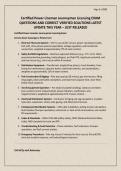
Certified Power Lineman Journeyman Licensing EXAM
QUESTIONS AND CORRECT VERIFIED SOLUTIONS LATEST
UPDATE THIS YEAR – JUST RELEASED
Certified Power Lineman Journeyman Licensing Exam
10-Line Exam Coverage in Points Form
1. Electrical Theory & Systems – Ohm's Law, AC/DC circuits, power calculations (watts,
kVA, kW), three-phase systems (wye/delta), voltage regulation, and transformer
connections; weighted at approximately 27% of exam content .
2. Safety & OSHA Regulations – Minimum approach distances (e.g., 2 ft 1 in for 15kV),
personal protective grounding, lockout/tagout, arc flash PPE, step/touch potential, and
pole-top rescue (e.g., Herz rescue within 4 minutes) .
3. Distribution Equipment – Transformers (single/three-phase), circuit breakers, fuses
(sizing for transformers), capacitor banks, load break switches, and sectionalizers;
weighted at approximately 15% of exam content .
4. Pole Construction & Rigging – Pole step spacing (18 inches), guy wire tension, lifting
sling angles, block and tackle calculations, and rope knots (square knot, clove hitch,
timber hitch, bowline) .
5. Tool & Equipment Operation – Hot sticks (insulated handling), clamp-on ammeters
(non-contact current measurement), phase indicators, multimeters, and
megohmmeters; weighted at approximately 12% of exam content .
6. Overhead Distribution Systems – Conductor stringing and sag calculations, insulator
types (pin, suspension, strain), pole guying, and dead-end structures .
7. Underground Distribution Systems – URD cable installation, pulling tension calculations,
fault location (thumper operation), cold-shrink vs. heat-shrink terminations, and conduit
fill requirements .
8. Codes & Standards – OSHA 1910.269 (utility safety), NESC (National Electrical Safety
Code), ANSI standards for tools and PPE .
9. Troubleshooting & Fault Detection – Phase indicators, fault indicators, thumper
operations, and fault current analysis .
10. Emergency Procedures – Pole-top rescue (4 minutes for Herz rescue), first aid/CPR,
electrical accident response, and lockout/tagout sequence .
250 MCQs with Rationales
, Page 2 of 102
1. According to OSHA 29 CFR 1910.269, what is the minimum approach distance (MAD) for a
15 kV distribution line under normal conditions?
A) 1 foot
B) 2 feet
C) 2 feet 1 inch
D) 3 feet
Answer: C
Rationale: OSHA specifies 2 ft 1 in (0.64 m) for 15.1 kV to 36.0 kV lines; this distance reduces
the risk of electrical contact and arc flash .
2. What is the current in amperes when a 240 V load draws 12 kW of real power at unity
power factor?
A) 25 A
B) 30 A
C) 50 A
D) 100 A
Answer: C
Rationale: P = V × I → I = P/V = 12,000 W / 240 V = 50 A. Because the power factor is 1,
apparent power equals real power, so I = 50 A .
3. In a series circuit of three resistors 4 Ω, 6 Ω, and 10 Ω connected to a 120 V source, what is
the voltage across the 6 Ω resistor?
A) 24 V
, Page 3 of 102
B) 30 V
C) 36 V
D) 48 V
Answer: C
Rationale: Total resistance = 4+6+10 = 20 Ω. Total current I = V/R = 120 V / 20 Ω = 6 A. Voltage
across 6 Ω = I × R = 6 A × 6 Ω = 36 V .
4. Which type of transformer connection provides a neutral point on the secondary without
requiring a separate grounding transformer?
A) Delta-Delta
B) Wye-Wye
C) Open-Delta
D) Zig-Zag
Answer: B
Rationale: A wye-connected secondary inherently provides a neutral point. A zig-zag
transformer can also provide a neutral, but the wye-wye connection is the most
straightforward .
5. A three-phase, 4.16 kV (line-to-line) wye-connected system has what line-to-neutral
voltage?
A) 2.40 kV
B) 4.16 kV
, Page 4 of 102
C) 2.40 V
D) 7.21 kV
Answer: A
Rationale: V_L-N = V_L-L / √3 = 4.16 kV / 1.732 ≈ 2.40 kV. In a wye (star) connection, each line
conductor is directly connected to a phase, so line-to-ground voltage equals the phase voltage .
6. In a delta-connected three-phase load, the phase current is equal to:
A) Line current divided by √3
B) Line current multiplied by √3
C) Line voltage divided by √3
D) Line voltage multiplied by √3
Answer: B
Rationale: For a delta connection, I_phase = I_line / √3. The line voltage equals the phase
voltage, but the line current is √3 times the phase current .
7. A transformer has a primary of 240 V and a secondary of 120 V. What is its turns ratio
(N_primary : N_secondary)?
A) 1 : 2
B) 2 : 1
C) 1 : 1
D) 4 : 1
Answer: B
Rationale: Turns ratio equals voltage ratio. 240 V/120 V = 2, so N_primary : N_secondary = 2 : 1 .
Certified Power Lineman Journeyman Licensing EXAM
QUESTIONS AND CORRECT VERIFIED SOLUTIONS LATEST
UPDATE THIS YEAR – JUST RELEASED
Certified Power Lineman Journeyman Licensing Exam
10-Line Exam Coverage in Points Form
1. Electrical Theory & Systems – Ohm's Law, AC/DC circuits, power calculations (watts,
kVA, kW), three-phase systems (wye/delta), voltage regulation, and transformer
connections; weighted at approximately 27% of exam content .
2. Safety & OSHA Regulations – Minimum approach distances (e.g., 2 ft 1 in for 15kV),
personal protective grounding, lockout/tagout, arc flash PPE, step/touch potential, and
pole-top rescue (e.g., Herz rescue within 4 minutes) .
3. Distribution Equipment – Transformers (single/three-phase), circuit breakers, fuses
(sizing for transformers), capacitor banks, load break switches, and sectionalizers;
weighted at approximately 15% of exam content .
4. Pole Construction & Rigging – Pole step spacing (18 inches), guy wire tension, lifting
sling angles, block and tackle calculations, and rope knots (square knot, clove hitch,
timber hitch, bowline) .
5. Tool & Equipment Operation – Hot sticks (insulated handling), clamp-on ammeters
(non-contact current measurement), phase indicators, multimeters, and
megohmmeters; weighted at approximately 12% of exam content .
6. Overhead Distribution Systems – Conductor stringing and sag calculations, insulator
types (pin, suspension, strain), pole guying, and dead-end structures .
7. Underground Distribution Systems – URD cable installation, pulling tension calculations,
fault location (thumper operation), cold-shrink vs. heat-shrink terminations, and conduit
fill requirements .
8. Codes & Standards – OSHA 1910.269 (utility safety), NESC (National Electrical Safety
Code), ANSI standards for tools and PPE .
9. Troubleshooting & Fault Detection – Phase indicators, fault indicators, thumper
operations, and fault current analysis .
10. Emergency Procedures – Pole-top rescue (4 minutes for Herz rescue), first aid/CPR,
electrical accident response, and lockout/tagout sequence .
250 MCQs with Rationales
, Page 2 of 102
1. According to OSHA 29 CFR 1910.269, what is the minimum approach distance (MAD) for a
15 kV distribution line under normal conditions?
A) 1 foot
B) 2 feet
C) 2 feet 1 inch
D) 3 feet
Answer: C
Rationale: OSHA specifies 2 ft 1 in (0.64 m) for 15.1 kV to 36.0 kV lines; this distance reduces
the risk of electrical contact and arc flash .
2. What is the current in amperes when a 240 V load draws 12 kW of real power at unity
power factor?
A) 25 A
B) 30 A
C) 50 A
D) 100 A
Answer: C
Rationale: P = V × I → I = P/V = 12,000 W / 240 V = 50 A. Because the power factor is 1,
apparent power equals real power, so I = 50 A .
3. In a series circuit of three resistors 4 Ω, 6 Ω, and 10 Ω connected to a 120 V source, what is
the voltage across the 6 Ω resistor?
A) 24 V
, Page 3 of 102
B) 30 V
C) 36 V
D) 48 V
Answer: C
Rationale: Total resistance = 4+6+10 = 20 Ω. Total current I = V/R = 120 V / 20 Ω = 6 A. Voltage
across 6 Ω = I × R = 6 A × 6 Ω = 36 V .
4. Which type of transformer connection provides a neutral point on the secondary without
requiring a separate grounding transformer?
A) Delta-Delta
B) Wye-Wye
C) Open-Delta
D) Zig-Zag
Answer: B
Rationale: A wye-connected secondary inherently provides a neutral point. A zig-zag
transformer can also provide a neutral, but the wye-wye connection is the most
straightforward .
5. A three-phase, 4.16 kV (line-to-line) wye-connected system has what line-to-neutral
voltage?
A) 2.40 kV
B) 4.16 kV
, Page 4 of 102
C) 2.40 V
D) 7.21 kV
Answer: A
Rationale: V_L-N = V_L-L / √3 = 4.16 kV / 1.732 ≈ 2.40 kV. In a wye (star) connection, each line
conductor is directly connected to a phase, so line-to-ground voltage equals the phase voltage .
6. In a delta-connected three-phase load, the phase current is equal to:
A) Line current divided by √3
B) Line current multiplied by √3
C) Line voltage divided by √3
D) Line voltage multiplied by √3
Answer: B
Rationale: For a delta connection, I_phase = I_line / √3. The line voltage equals the phase
voltage, but the line current is √3 times the phase current .
7. A transformer has a primary of 240 V and a secondary of 120 V. What is its turns ratio
(N_primary : N_secondary)?
A) 1 : 2
B) 2 : 1
C) 1 : 1
D) 4 : 1
Answer: B
Rationale: Turns ratio equals voltage ratio. 240 V/120 V = 2, so N_primary : N_secondary = 2 : 1 .


