

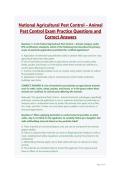
National Agricultural Pest Control – Animal
Pest Control Exam Practice Questions and
Correct Answers
Question 1: In the federal Agricultural Pest Control – Animal category under
EPA certification standards, which of the following best describes the primary
scope of pesticide applications permitted for certified applicators?
A. Application of restricted-use pesticides solely to protect field crops and non-crop
agricultural lands from plant pests.
B. Use of restricted-use pesticides on agricultural animals such as cattle, swine,
sheep, poultry, and horses, or in the places where these animals are confined, to
control pests affecting the animals.
C. Control of vertebrate predators such as coyotes using sodium cyanide or sodium
fluoroacetate products.
D. Application of pesticides only for structural pest control inside residential
buildings near farms.
CORRECT ANSWER: B. Use of restricted-use pesticides on agricultural animals
such as cattle, swine, sheep, poultry, and horses, or in the places where these
animals are confined, to control pests affecting the animals.
Rationale: The Agricultural Pest Control – Animal (Livestock) subcategory specifically
authorizes commercial applicators to use or supervise restricted-use pesticides on
livestock and in confinement areas to protect the animals from pests such as flies,
lice, mites, and ticks. It does not cover plant pests, predator control products, or
structural applications.
Question 2: When applying pesticides to control external parasites on dairy
cattle, why is it critical for the applicator to carefully follow pre-slaughter and
milk-withholding intervals listed on the pesticide label?
A. These intervals are recommendations only and can be shortened if the animals
appear healthy.
B. Failure to observe these intervals can result in illegal pesticide residues in milk or
meat, violating food safety regulations and potentially causing the product to be
condemned.
C. Withholding intervals apply only to beef cattle and have no relevance to dairy
animals.
D. The intervals are intended solely to protect the applicator from exposure and
have no effect on the animal products.
Page 1 of 71
,CORRECT ANSWER: B. Failure to observe these intervals can result in illegal
pesticide residues in milk or meat, violating food safety regulations and
potentially causing the product to be condemned.
Rationale: Pesticide labels for use on food-producing animals specify withholding
times to ensure residues decline below established tolerances. Violating these
intervals can lead to adulterated food products, regulatory action, and economic
loss for the producer.
Page 2 of 71
,Question 3: Which of the following is a primary advantage of using an
Integrated Pest Management (IPM) approach for controlling flies around
livestock confinement facilities?
A. IPM relies exclusively on chemical pesticides applied on a fixed calendar
schedule.
B. IPM combines cultural, mechanical, biological, and chemical methods to maintain
pest populations below economic thresholds while reducing unnecessary pesticide
use and resistance development.
C. IPM eliminates the need for any monitoring or identification of pest species.
D. IPM requires the complete eradication of all insects in the vicinity of livestock.
CORRECT ANSWER: B. IPM combines cultural, mechanical, biological, and
chemical methods to maintain pest populations below economic thresholds
while reducing unnecessary pesticide use and resistance development.
Rationale: IPM emphasizes prevention, monitoring, and the use of multiple tactics.
For livestock fly control this may include manure management, sanitation, biological
agents such as parasitic wasps, and targeted insecticide applications only when
thresholds are exceeded.
Question 4: According to standard pesticide applicator knowledge, what is the
most important first step before selecting any control method for animal pests
on a livestock operation?
A. Immediately apply the most toxic restricted-use pesticide available.
B. Correctly identify the pest species and understand its biology, life cycle, and the
specific damage or disease risk it poses to the animals.
C. Purchase the least expensive pesticide product without reading the label.
D. Treat the entire facility regardless of whether pests are present.
CORRECT ANSWER: B. Correctly identify the pest species and understand its
biology, life cycle, and the specific damage or disease risk it poses to the
animals.
Rationale: Accurate identification is foundational to effective and legal pest
management. Different pests (house flies versus stable flies, lice versus mites)
require different control strategies, products, and timing.
Question 5: Which signal word on a pesticide label indicates the highest level
of acute toxicity and requires the most stringent personal protective
equipment and handling precautions?
A. CAUTION
B. WARNING
C. DANGER or DANGER-POISON
D. No signal word is required on any agricultural pesticide label
Page 3 of 71
, CORRECT ANSWER: C. DANGER or DANGER-POISON
Rationale: Signal words are determined by acute toxicity testing. DANGER-POISON
(often with a skull-and-crossbones) indicates the highest toxicity category (Category
I), while DANGER alone may indicate severe eye or skin corrosivity. WARNING is
Category II and CAUTION is Category III or IV.
Question 6: When controlling Norway rats in and around livestock feed
storage areas, which cultural practice is considered the most effective long-
term foundation of an IPM program?
A. Relying solely on second-generation anticoagulant baits without sanitation.
B. Eliminating food, water, and harborage sources through improved sanitation,
feed storage in rodent-proof containers, and structural exclusion.
C. Applying residual insecticides to all surfaces regardless of rodent activity.
D. Releasing domestic cats as the only control method.
CORRECT ANSWER: B. Eliminating food, water, and harborage sources through
improved sanitation, feed storage in rodent-proof containers, and structural
exclusion.
Rationale: Commensal rodents thrive where food and shelter are abundant.
Sanitation and exclusion reduce carrying capacity and make chemical or trapping
methods more effective and sustainable.
Question 7: Under FIFRA and EPA regulations, what does the statement “It is a
violation of federal law to use this product in a manner inconsistent with its
labeling” mean for an animal pest control applicator?
A. The applicator may deviate from the label if the deviation seems more effective.
B. The label is the law; any use not specifically allowed or any prohibition ignored is
illegal.
C. Only the rate of application must be followed; other directions are optional.
D. State regulations always override federal label requirements.
CORRECT ANSWER: B. The label is the law; any use not specifically allowed or
any prohibition ignored is illegal.
Rationale: FIFRA establishes that the registered label is a legal document. Using a
pesticide in any way not permitted by the label (wrong site, animal, rate, method, or
timing) constitutes a violation.
Question 8: Which of the following pests is commonly associated with causing
significant economic loss and animal stress in confined poultry operations
through blood-feeding and disease transmission potential?
Page 4 of 71
Pest Control Exam Practice Questions and
Correct Answers
Question 1: In the federal Agricultural Pest Control – Animal category under
EPA certification standards, which of the following best describes the primary
scope of pesticide applications permitted for certified applicators?
A. Application of restricted-use pesticides solely to protect field crops and non-crop
agricultural lands from plant pests.
B. Use of restricted-use pesticides on agricultural animals such as cattle, swine,
sheep, poultry, and horses, or in the places where these animals are confined, to
control pests affecting the animals.
C. Control of vertebrate predators such as coyotes using sodium cyanide or sodium
fluoroacetate products.
D. Application of pesticides only for structural pest control inside residential
buildings near farms.
CORRECT ANSWER: B. Use of restricted-use pesticides on agricultural animals
such as cattle, swine, sheep, poultry, and horses, or in the places where these
animals are confined, to control pests affecting the animals.
Rationale: The Agricultural Pest Control – Animal (Livestock) subcategory specifically
authorizes commercial applicators to use or supervise restricted-use pesticides on
livestock and in confinement areas to protect the animals from pests such as flies,
lice, mites, and ticks. It does not cover plant pests, predator control products, or
structural applications.
Question 2: When applying pesticides to control external parasites on dairy
cattle, why is it critical for the applicator to carefully follow pre-slaughter and
milk-withholding intervals listed on the pesticide label?
A. These intervals are recommendations only and can be shortened if the animals
appear healthy.
B. Failure to observe these intervals can result in illegal pesticide residues in milk or
meat, violating food safety regulations and potentially causing the product to be
condemned.
C. Withholding intervals apply only to beef cattle and have no relevance to dairy
animals.
D. The intervals are intended solely to protect the applicator from exposure and
have no effect on the animal products.
Page 1 of 71
,CORRECT ANSWER: B. Failure to observe these intervals can result in illegal
pesticide residues in milk or meat, violating food safety regulations and
potentially causing the product to be condemned.
Rationale: Pesticide labels for use on food-producing animals specify withholding
times to ensure residues decline below established tolerances. Violating these
intervals can lead to adulterated food products, regulatory action, and economic
loss for the producer.
Page 2 of 71
,Question 3: Which of the following is a primary advantage of using an
Integrated Pest Management (IPM) approach for controlling flies around
livestock confinement facilities?
A. IPM relies exclusively on chemical pesticides applied on a fixed calendar
schedule.
B. IPM combines cultural, mechanical, biological, and chemical methods to maintain
pest populations below economic thresholds while reducing unnecessary pesticide
use and resistance development.
C. IPM eliminates the need for any monitoring or identification of pest species.
D. IPM requires the complete eradication of all insects in the vicinity of livestock.
CORRECT ANSWER: B. IPM combines cultural, mechanical, biological, and
chemical methods to maintain pest populations below economic thresholds
while reducing unnecessary pesticide use and resistance development.
Rationale: IPM emphasizes prevention, monitoring, and the use of multiple tactics.
For livestock fly control this may include manure management, sanitation, biological
agents such as parasitic wasps, and targeted insecticide applications only when
thresholds are exceeded.
Question 4: According to standard pesticide applicator knowledge, what is the
most important first step before selecting any control method for animal pests
on a livestock operation?
A. Immediately apply the most toxic restricted-use pesticide available.
B. Correctly identify the pest species and understand its biology, life cycle, and the
specific damage or disease risk it poses to the animals.
C. Purchase the least expensive pesticide product without reading the label.
D. Treat the entire facility regardless of whether pests are present.
CORRECT ANSWER: B. Correctly identify the pest species and understand its
biology, life cycle, and the specific damage or disease risk it poses to the
animals.
Rationale: Accurate identification is foundational to effective and legal pest
management. Different pests (house flies versus stable flies, lice versus mites)
require different control strategies, products, and timing.
Question 5: Which signal word on a pesticide label indicates the highest level
of acute toxicity and requires the most stringent personal protective
equipment and handling precautions?
A. CAUTION
B. WARNING
C. DANGER or DANGER-POISON
D. No signal word is required on any agricultural pesticide label
Page 3 of 71
, CORRECT ANSWER: C. DANGER or DANGER-POISON
Rationale: Signal words are determined by acute toxicity testing. DANGER-POISON
(often with a skull-and-crossbones) indicates the highest toxicity category (Category
I), while DANGER alone may indicate severe eye or skin corrosivity. WARNING is
Category II and CAUTION is Category III or IV.
Question 6: When controlling Norway rats in and around livestock feed
storage areas, which cultural practice is considered the most effective long-
term foundation of an IPM program?
A. Relying solely on second-generation anticoagulant baits without sanitation.
B. Eliminating food, water, and harborage sources through improved sanitation,
feed storage in rodent-proof containers, and structural exclusion.
C. Applying residual insecticides to all surfaces regardless of rodent activity.
D. Releasing domestic cats as the only control method.
CORRECT ANSWER: B. Eliminating food, water, and harborage sources through
improved sanitation, feed storage in rodent-proof containers, and structural
exclusion.
Rationale: Commensal rodents thrive where food and shelter are abundant.
Sanitation and exclusion reduce carrying capacity and make chemical or trapping
methods more effective and sustainable.
Question 7: Under FIFRA and EPA regulations, what does the statement “It is a
violation of federal law to use this product in a manner inconsistent with its
labeling” mean for an animal pest control applicator?
A. The applicator may deviate from the label if the deviation seems more effective.
B. The label is the law; any use not specifically allowed or any prohibition ignored is
illegal.
C. Only the rate of application must be followed; other directions are optional.
D. State regulations always override federal label requirements.
CORRECT ANSWER: B. The label is the law; any use not specifically allowed or
any prohibition ignored is illegal.
Rationale: FIFRA establishes that the registered label is a legal document. Using a
pesticide in any way not permitted by the label (wrong site, animal, rate, method, or
timing) constitutes a violation.
Question 8: Which of the following pests is commonly associated with causing
significant economic loss and animal stress in confined poultry operations
through blood-feeding and disease transmission potential?
Page 4 of 71


