

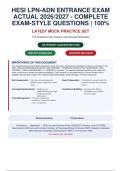
HESI LPN-ADN ENTRANCE EXAM
ACTUAL 2026/2027 - COMPLETE
EXAM-STYLE QUESTIONS | 100%
LATEST MOCK PRACTICE SET
170 Questions with Answers and Detailed Rationales
100 PERCENT GUARANTEED PASS
INSTANT DOWNLOAD ANSWERS INCLUDED
IMPORTANCE OF THIS DOCUMENT
This comprehensive examination preparation guide has been meticulously developed to help you succeed in the
HESI LPN-ADN ENTRANCE EXAM ACTUAL 2026/2027 - COMPLETE EXAM-STYLE QUESTIONS | 100%
VERIFIED - PASS GUARANTEED - A+ GRADED. It contains 170 carefully selected questions that reflect the
most current exam content and testing strategies. Each question is accompanied by a correct answer and a
detailed rationale that explains the underlying pathophysiology, pharmacology, or clinical reasoning.
Self-Assessment – Test your knowledge and Exam Preparation – Familiarize yourself with the
identify areas requiring further question format and content
study areas
Concept Reinforcement – Deepen your Confidence Building – Develop test-taking
understanding through strategies and reduce
evidence-based exam anxiety
rationales
Time Management – Practice answering
questions under simulated
exam conditions
Review Summary 170 Questions
Foundations - Application - HESI Lpn-adn Entrance Actual 2026/2027 Complete -style 100 PASS
Guaranteed A HESI Lpn-adn Entrance Anatomy & Physiology Biology Chemistry MATH Reading Vocabulary
AND General Knowledge Undergraduate YEAR 3 / Pre-licensure ADN
All answers with rationales
,Table of Contents
Section A - Prescribed Section B - Finding
Questions 1 to 43 Questions 44 to 86
Section C - Medication Section D - Laboratory
Questions 87 to 129 Questions 130 to 170
,Section A - Prescribed
Q1.
A patient with chronic kidney disease has a serum potassium of 6.2 mEq/L. Which ECG
change is most likely to be observed, and what is the underlying electrophysiological
mechanism?
A. Peaked T waves due to accelerated B. Prolonged PR interval due to slowed
phase 3 repolarization atrial conduction
C. Widened QRS complex due to delayed D. ST-segment depression due to
ventricular depolarization subendocardial ischemia
Correct: A - Peaked T waves due to accelerated phase 3 repolarization
Rationale:Hyperkalemia increases extracellular K+, causing a steeper concentration gradient
that accelerates phase 3 repolarization, leading to peaked T waves. PR prolongation and
QRS widening occur with more severe hyperkalemia, but peaked T waves are the earliest
and most characteristic finding. ST depression is not a direct effect of hyperkalemia.
Q2.
In a metabolic pathway, an enzyme's activity is inhibited by the final product. This
inhibition is reversed by increasing the substrate concentration. Which type of inhibition
is this, and what is the effect on Vmax and Km?
A. Competitive inhibition; Vmax unchanged, B. Noncompetitive inhibition; Vmax
Km increased decreased, Km unchanged
C. Uncompetitive inhibition; both Vmax and D. Allosteric inhibition; Vmax decreased, Km
Km decreased increased
Correct: A - Competitive inhibition; Vmax unchanged, Km increased
Rationale:The scenario describes feedback inhibition, which is often competitive if the
product structurally resembles the substrate. Competitive inhibitors bind to the active site,
increasing Km (lower affinity) but Vmax remains unchanged because high substrate can
outcompete the inhibitor. Noncompetitive inhibition would not be reversed by substrate.
Q3.
A solution has a pH of 3.0. What is the approximate concentration of hydroxide ions [OH]
in this solution?
A. 1 × 10¹¹ M B. 1 × 10³ M
C. 1 × 10 M D. 1 × 10¹ M
Page 3
, Section A - Prescribed
Correct: A - 1 × 10¹¹ M
Rationale:pH = 3.0 means [H z] = 1 × 10 {³ M. Using Kw = 1 × 10 {¹ t = [H z][OH {], we get
[OH] = 1 × 10¹ / 1 × 10³ = 1 × 10¹¹ M. The other options misapply the relationship.
Q4.
Which of the following best explains the role of the juxtaglomerular apparatus in blood
pressure regulation?
A. It secretes renin in response to B. It directly senses systemic blood
decreased renal perfusion pressure, pressure via baroreceptors and stimulates
activating the renin-angiotensin-aldosterone sympathetic output
system
C. It releases atrial natriuretic peptide to D. It produces erythropoietin to increase red
reduce blood volume and pressure blood cell mass and blood viscosity
Correct: A - It secretes renin in response to decreased renal perfusion pressure, activating
the renin-angiotensin-aldosterone system
Rationale:The juxtaglomerular apparatus consists of macula densa and juxtaglomerular cells
that detect low NaCl and stretch, triggering renin release. Renin initiates the RAAS cascade,
increasing blood pressure. Baroreceptors are in the carotid sinus and aortic arch; ANP is from
the heart; EPO is from peritubular fibroblasts.
Q5.
A medication order reads: 'Administer 0.5 mg of digoxin IV. The ampule label states:
Digoxin 0.25 mg/mL.' How many milliliters should the nurse administer?
A. 0.5 mL B. 1 mL
C. 2 mL D. 0.25 mL
Correct: C - 2 mL
Rationale:Dose required = 0.5 mg. Concentration = 0.25 mg/mL. Volume = 0.5 mg / 0.25
mg/mL = 2 mL. The other options reflect incorrect calculations (e.g., 0.5 mL would give 0.125
mg).
Q6.
In a study examining the effect of a new drug on blood pressure, researchers find a
p-value of 0.03 with a 95% confidence interval for the mean difference of (-1.2 to 5.6)
mmHg. Which is the most appropriate interpretation?
A. The result is statistically significant but B. The result is not statistically significant
may not be clinically significant because the because the CI includes zero
CI includes zero
Page 4
ACTUAL 2026/2027 - COMPLETE
EXAM-STYLE QUESTIONS | 100%
LATEST MOCK PRACTICE SET
170 Questions with Answers and Detailed Rationales
100 PERCENT GUARANTEED PASS
INSTANT DOWNLOAD ANSWERS INCLUDED
IMPORTANCE OF THIS DOCUMENT
This comprehensive examination preparation guide has been meticulously developed to help you succeed in the
HESI LPN-ADN ENTRANCE EXAM ACTUAL 2026/2027 - COMPLETE EXAM-STYLE QUESTIONS | 100%
VERIFIED - PASS GUARANTEED - A+ GRADED. It contains 170 carefully selected questions that reflect the
most current exam content and testing strategies. Each question is accompanied by a correct answer and a
detailed rationale that explains the underlying pathophysiology, pharmacology, or clinical reasoning.
Self-Assessment – Test your knowledge and Exam Preparation – Familiarize yourself with the
identify areas requiring further question format and content
study areas
Concept Reinforcement – Deepen your Confidence Building – Develop test-taking
understanding through strategies and reduce
evidence-based exam anxiety
rationales
Time Management – Practice answering
questions under simulated
exam conditions
Review Summary 170 Questions
Foundations - Application - HESI Lpn-adn Entrance Actual 2026/2027 Complete -style 100 PASS
Guaranteed A HESI Lpn-adn Entrance Anatomy & Physiology Biology Chemistry MATH Reading Vocabulary
AND General Knowledge Undergraduate YEAR 3 / Pre-licensure ADN
All answers with rationales
,Table of Contents
Section A - Prescribed Section B - Finding
Questions 1 to 43 Questions 44 to 86
Section C - Medication Section D - Laboratory
Questions 87 to 129 Questions 130 to 170
,Section A - Prescribed
Q1.
A patient with chronic kidney disease has a serum potassium of 6.2 mEq/L. Which ECG
change is most likely to be observed, and what is the underlying electrophysiological
mechanism?
A. Peaked T waves due to accelerated B. Prolonged PR interval due to slowed
phase 3 repolarization atrial conduction
C. Widened QRS complex due to delayed D. ST-segment depression due to
ventricular depolarization subendocardial ischemia
Correct: A - Peaked T waves due to accelerated phase 3 repolarization
Rationale:Hyperkalemia increases extracellular K+, causing a steeper concentration gradient
that accelerates phase 3 repolarization, leading to peaked T waves. PR prolongation and
QRS widening occur with more severe hyperkalemia, but peaked T waves are the earliest
and most characteristic finding. ST depression is not a direct effect of hyperkalemia.
Q2.
In a metabolic pathway, an enzyme's activity is inhibited by the final product. This
inhibition is reversed by increasing the substrate concentration. Which type of inhibition
is this, and what is the effect on Vmax and Km?
A. Competitive inhibition; Vmax unchanged, B. Noncompetitive inhibition; Vmax
Km increased decreased, Km unchanged
C. Uncompetitive inhibition; both Vmax and D. Allosteric inhibition; Vmax decreased, Km
Km decreased increased
Correct: A - Competitive inhibition; Vmax unchanged, Km increased
Rationale:The scenario describes feedback inhibition, which is often competitive if the
product structurally resembles the substrate. Competitive inhibitors bind to the active site,
increasing Km (lower affinity) but Vmax remains unchanged because high substrate can
outcompete the inhibitor. Noncompetitive inhibition would not be reversed by substrate.
Q3.
A solution has a pH of 3.0. What is the approximate concentration of hydroxide ions [OH]
in this solution?
A. 1 × 10¹¹ M B. 1 × 10³ M
C. 1 × 10 M D. 1 × 10¹ M
Page 3
, Section A - Prescribed
Correct: A - 1 × 10¹¹ M
Rationale:pH = 3.0 means [H z] = 1 × 10 {³ M. Using Kw = 1 × 10 {¹ t = [H z][OH {], we get
[OH] = 1 × 10¹ / 1 × 10³ = 1 × 10¹¹ M. The other options misapply the relationship.
Q4.
Which of the following best explains the role of the juxtaglomerular apparatus in blood
pressure regulation?
A. It secretes renin in response to B. It directly senses systemic blood
decreased renal perfusion pressure, pressure via baroreceptors and stimulates
activating the renin-angiotensin-aldosterone sympathetic output
system
C. It releases atrial natriuretic peptide to D. It produces erythropoietin to increase red
reduce blood volume and pressure blood cell mass and blood viscosity
Correct: A - It secretes renin in response to decreased renal perfusion pressure, activating
the renin-angiotensin-aldosterone system
Rationale:The juxtaglomerular apparatus consists of macula densa and juxtaglomerular cells
that detect low NaCl and stretch, triggering renin release. Renin initiates the RAAS cascade,
increasing blood pressure. Baroreceptors are in the carotid sinus and aortic arch; ANP is from
the heart; EPO is from peritubular fibroblasts.
Q5.
A medication order reads: 'Administer 0.5 mg of digoxin IV. The ampule label states:
Digoxin 0.25 mg/mL.' How many milliliters should the nurse administer?
A. 0.5 mL B. 1 mL
C. 2 mL D. 0.25 mL
Correct: C - 2 mL
Rationale:Dose required = 0.5 mg. Concentration = 0.25 mg/mL. Volume = 0.5 mg / 0.25
mg/mL = 2 mL. The other options reflect incorrect calculations (e.g., 0.5 mL would give 0.125
mg).
Q6.
In a study examining the effect of a new drug on blood pressure, researchers find a
p-value of 0.03 with a 95% confidence interval for the mean difference of (-1.2 to 5.6)
mmHg. Which is the most appropriate interpretation?
A. The result is statistically significant but B. The result is not statistically significant
may not be clinically significant because the because the CI includes zero
CI includes zero
Page 4


