

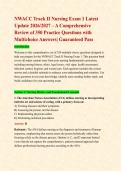
NWACC Track II Nursing Exam 1 Latest
Update 2026/2027 – A Comprehensive
Review of 350 Practice Questions with
Multichoice Answers| Guaranteed Pass
Introduction
Welcome to this comprehensive set of 350 multiple-choice questions designed to
help you prepare for the NNWACC Track II Nursing Exam 1. This question bank
covers all major content areas from your nursing fundamentals curriculum,
including nursing history, ethics, legal issues, vital signs, health assessment,
infection control, hygiene, and wound care. Each question includes the correct
answer and a detailed rationale to enhance your understanding and retention. Use
these questions to test your knowledge, identify areas needing further study, and
build confidence for your upcoming exam.
Section 1: Nursing History and Foundational Concepts
1. The American Nurses Association (ANA) defines nursing as incorporating
both the art and science of caring, with a primary focus on:
A) Treating diseases and their symptoms
B) Assessing the person, not the disease
C) Implementing physician orders
D) Performing technical procedures
Answer: B
Rationale: The ANA defines nursing as the diagnosis and treatment of human
responses, emphasizing that nurses assess the person holistically rather than
focusing solely on the disease process. Options A, C, and D represent limited
views that do not capture the comprehensive, patient-centered approach that
defines professional nursing practice according to the ANA.
,2. Which historical nursing figure is credited with establishing the American
Red Cross and providing care during the Civil War?
A) Florence Nightingale
B) Dorothea Dix
C) Clara Barton
D) Lillian Wald
Answer: C
Rationale: Clara Barton founded the American Red Cross and served as a nurse
during the Civil War. Florence Nightingale is known for her work during the
Crimean War and establishing nursing as a distinct profession. Dorothea Dix
created the first American mental asylum and served as superintendent of army
nurses. Lillian Wald started American community nursing and advocated for public
school nursing.
3. Florence Nightingale's most significant contribution to modern nursing
was:
A) Establishing the first nursing school in the United States
B) Creating the first medical record system
C) Believing nursing is separate and distinct from medicine and emphasizing
accurate record-keeping
D) Founding the Frontier Nursing Service
Answer: C
Rationale: Nightingale's core belief that nursing is separate from medicine and her
emphasis on maintaining accurate records as the beginning of nursing research
were foundational to professional nursing. The first American nursing school was
established later by others, Linda Richards created the first medical record system,
and Mary Breckinridge founded the Frontier Nursing Service.
4. Who was the first professionally trained American nurse and created the
first medical record system?
A) Isabel Hampton Robb
,B) Linda Richards
C) Mary Elizabeth Mahoney
D) Harriet Tubman
Answer: B
Rationale: Linda Richards was the first professionally trained American nurse and
developed the first medical record system to improve patient care documentation.
Isabel Hampton Robb taught nursing in institutions, Mary Elizabeth Mahoney was
the first African American nurse, and Harriet Tubman cared for black soldiers
during the Civil War.
5. Dorothea Dix is historically recognized for which major contribution to
healthcare?
A) Founding the American Red Cross
B) Creating the first American mental asylum and serving as superintendent of
army nurses during the Civil War
C) Starting American community nursing
D) Establishing the Frontier Nursing Service as a nurse-midwife
Answer: B
Rationale: Dorothea Dix created the first American mental asylum and served as
the superintendent of army nurses during the Civil War. Clara Barton founded the
American Red Cross, Lillian Wald started community nursing, and Mary
Breckinridge established the Frontier Nursing Service as a nurse-midwife.
6. Lillian Wald is recognized as a pioneer in which area of nursing?
A) Psychiatric nursing
B) American community nursing and public school nursing advocacy
C) Military nursing
D) Nursing education
Answer: B
, Rationale: Lillian Wald started American community nursing and was a strong
advocate for public school nursing. Her work focused on bringing healthcare
services to underserved communities. The other options represent contributions by
other historical nursing figures.
7. Mary Elizabeth Mahoney holds historical significance as:
A) The founder of the American Nurses Association
B) The first African American nurse
C) The developer of the nursing process
D) The creator of hospice nursing
Answer: B
Rationale: Mary Elizabeth Mahoney was the first African American nurse in the
United States, breaking racial barriers in the nursing profession. The ANA was
founded by multiple nursing leaders, the nursing process was developed through
collective professional efforts, and hospice nursing was pioneered by others
including Dame Cicely Saunders.
8. Harriet Tubman's contribution to healthcare during the Civil War
included:
A) Establishing field hospitals
B) Serving as a nurse for black soldiers
C) Creating the first nursing school
D) Developing surgical techniques
Answer: B
Rationale: Harriet Tubman is historically recognized for caring for black soldiers
during the Civil War, in addition to her work with the Underground Railroad. She
did not establish field hospitals, create nursing schools, or develop surgical
techniques.
Update 2026/2027 – A Comprehensive
Review of 350 Practice Questions with
Multichoice Answers| Guaranteed Pass
Introduction
Welcome to this comprehensive set of 350 multiple-choice questions designed to
help you prepare for the NNWACC Track II Nursing Exam 1. This question bank
covers all major content areas from your nursing fundamentals curriculum,
including nursing history, ethics, legal issues, vital signs, health assessment,
infection control, hygiene, and wound care. Each question includes the correct
answer and a detailed rationale to enhance your understanding and retention. Use
these questions to test your knowledge, identify areas needing further study, and
build confidence for your upcoming exam.
Section 1: Nursing History and Foundational Concepts
1. The American Nurses Association (ANA) defines nursing as incorporating
both the art and science of caring, with a primary focus on:
A) Treating diseases and their symptoms
B) Assessing the person, not the disease
C) Implementing physician orders
D) Performing technical procedures
Answer: B
Rationale: The ANA defines nursing as the diagnosis and treatment of human
responses, emphasizing that nurses assess the person holistically rather than
focusing solely on the disease process. Options A, C, and D represent limited
views that do not capture the comprehensive, patient-centered approach that
defines professional nursing practice according to the ANA.
,2. Which historical nursing figure is credited with establishing the American
Red Cross and providing care during the Civil War?
A) Florence Nightingale
B) Dorothea Dix
C) Clara Barton
D) Lillian Wald
Answer: C
Rationale: Clara Barton founded the American Red Cross and served as a nurse
during the Civil War. Florence Nightingale is known for her work during the
Crimean War and establishing nursing as a distinct profession. Dorothea Dix
created the first American mental asylum and served as superintendent of army
nurses. Lillian Wald started American community nursing and advocated for public
school nursing.
3. Florence Nightingale's most significant contribution to modern nursing
was:
A) Establishing the first nursing school in the United States
B) Creating the first medical record system
C) Believing nursing is separate and distinct from medicine and emphasizing
accurate record-keeping
D) Founding the Frontier Nursing Service
Answer: C
Rationale: Nightingale's core belief that nursing is separate from medicine and her
emphasis on maintaining accurate records as the beginning of nursing research
were foundational to professional nursing. The first American nursing school was
established later by others, Linda Richards created the first medical record system,
and Mary Breckinridge founded the Frontier Nursing Service.
4. Who was the first professionally trained American nurse and created the
first medical record system?
A) Isabel Hampton Robb
,B) Linda Richards
C) Mary Elizabeth Mahoney
D) Harriet Tubman
Answer: B
Rationale: Linda Richards was the first professionally trained American nurse and
developed the first medical record system to improve patient care documentation.
Isabel Hampton Robb taught nursing in institutions, Mary Elizabeth Mahoney was
the first African American nurse, and Harriet Tubman cared for black soldiers
during the Civil War.
5. Dorothea Dix is historically recognized for which major contribution to
healthcare?
A) Founding the American Red Cross
B) Creating the first American mental asylum and serving as superintendent of
army nurses during the Civil War
C) Starting American community nursing
D) Establishing the Frontier Nursing Service as a nurse-midwife
Answer: B
Rationale: Dorothea Dix created the first American mental asylum and served as
the superintendent of army nurses during the Civil War. Clara Barton founded the
American Red Cross, Lillian Wald started community nursing, and Mary
Breckinridge established the Frontier Nursing Service as a nurse-midwife.
6. Lillian Wald is recognized as a pioneer in which area of nursing?
A) Psychiatric nursing
B) American community nursing and public school nursing advocacy
C) Military nursing
D) Nursing education
Answer: B
, Rationale: Lillian Wald started American community nursing and was a strong
advocate for public school nursing. Her work focused on bringing healthcare
services to underserved communities. The other options represent contributions by
other historical nursing figures.
7. Mary Elizabeth Mahoney holds historical significance as:
A) The founder of the American Nurses Association
B) The first African American nurse
C) The developer of the nursing process
D) The creator of hospice nursing
Answer: B
Rationale: Mary Elizabeth Mahoney was the first African American nurse in the
United States, breaking racial barriers in the nursing profession. The ANA was
founded by multiple nursing leaders, the nursing process was developed through
collective professional efforts, and hospice nursing was pioneered by others
including Dame Cicely Saunders.
8. Harriet Tubman's contribution to healthcare during the Civil War
included:
A) Establishing field hospitals
B) Serving as a nurse for black soldiers
C) Creating the first nursing school
D) Developing surgical techniques
Answer: B
Rationale: Harriet Tubman is historically recognized for caring for black soldiers
during the Civil War, in addition to her work with the Underground Railroad. She
did not establish field hospitals, create nursing schools, or develop surgical
techniques.


