

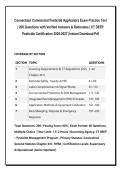
Connecticut Commercial Pesticide Applicators Exam Practice Test
| 200 Questions with Verified Answers & Rationales | CT DEEP
Pesticide Certification 2026-2027 |Instant Download Pdf
COVERAGE BY SECTION
SECTION TOPIC QUESTIONS
1 Licensing Requirements & CT Regulations (CGS 1–40
Chapter 441)
2 Pesticide Safety, Toxicity & PPE 41–80
3 Label Comprehension & Signal Words 81–110
4 Environmental Protection & Drift Management 111–140
5 Integrated Pest Management (IPM) Principles 141–160
6 Application Methods & Equipment Calibration 161–180
7 Recordkeeping, Disposal & Emergency 181–200
Response
Total Questions: 200 | Passing Score: 80% | Exam Format: 60 Questions,
Multiple-Choice | Time Limit: 1.5–2 Hours | Governing Agency: CT DEEP
– Pesticide Management Program | Primary Statutes: Connecticut
General Statutes Chapter 441, FIFRA | Certification Levels: Supervisory
& Operational (Junior Operator)
,Section 1: Licensing Requirements & CT Regulations (CGS Chapter 441)
(Questions 1–40)
1. Under Connecticut General Statutes Chapter 441, which certificate is
specifically required for a person hired to perform pesticide
application in a commercial capacity?
a) Supervisory Certificate
b) General Use Certificate
c) Operational Certificate
d) Permit Use Certificate
An Operational Certificate is specifically required for persons hired to perform
pesticide application in commercial settings in Connecticut. A Supervisory
Certificate is required for those supervising applications, not performing them
directly .
2. According to Connecticut law (CGS 22a-54), what are the two
classifications for commercial pesticide applicators?
,a) Public and private
b) General and restricted
c) Supervisory and operational
d) Agricultural and structural
Connecticut classifies commercial applicators as supervisory (responsible for
pesticide decisions) and operational (junior operators who actively apply
pesticides in a non-supervisory capacity). Both require passing appropriate
examinations through DEEP .
3. What is the primary responsibility of a Supervisory Certificate holder
under Connecticut regulations?
a) To actively mix and load pesticides only
b) To perform applications without written instructions
c) To make decisions about pesticide selection, dosage, timing, and
methods of application
d) To apply pesticides only under direct supervision
Supervisory applicators are decision makers who determine whether
pesticides are to be employed, how they are to be mixed, where they are to be
employed, what pesticides are to be used, the dosages and timing involved,
and the methods of application and precautions to be taken .
, 4. Who is required to hold an operator's license (Junior Operator
certificate) for commercial pesticide application in Connecticut?
a) Only supervisory decision-makers
b) Anyone who actively uses, mixes, handles, or applies pesticides in a
non-supervisory capacity
c) Only pesticide dealers
d) Only agricultural workers
Operational (junior operator) license holders perform the physical work of
pesticide application, including mixing, handling, and applying pesticides.
They must follow written instructions from a supervisor .
5. According to Connecticut law, what is the color of a Commercial
Supervisory certificate?
a) Blue
b) Yellow
c) White
d) Green
| 200 Questions with Verified Answers & Rationales | CT DEEP
Pesticide Certification 2026-2027 |Instant Download Pdf
COVERAGE BY SECTION
SECTION TOPIC QUESTIONS
1 Licensing Requirements & CT Regulations (CGS 1–40
Chapter 441)
2 Pesticide Safety, Toxicity & PPE 41–80
3 Label Comprehension & Signal Words 81–110
4 Environmental Protection & Drift Management 111–140
5 Integrated Pest Management (IPM) Principles 141–160
6 Application Methods & Equipment Calibration 161–180
7 Recordkeeping, Disposal & Emergency 181–200
Response
Total Questions: 200 | Passing Score: 80% | Exam Format: 60 Questions,
Multiple-Choice | Time Limit: 1.5–2 Hours | Governing Agency: CT DEEP
– Pesticide Management Program | Primary Statutes: Connecticut
General Statutes Chapter 441, FIFRA | Certification Levels: Supervisory
& Operational (Junior Operator)
,Section 1: Licensing Requirements & CT Regulations (CGS Chapter 441)
(Questions 1–40)
1. Under Connecticut General Statutes Chapter 441, which certificate is
specifically required for a person hired to perform pesticide
application in a commercial capacity?
a) Supervisory Certificate
b) General Use Certificate
c) Operational Certificate
d) Permit Use Certificate
An Operational Certificate is specifically required for persons hired to perform
pesticide application in commercial settings in Connecticut. A Supervisory
Certificate is required for those supervising applications, not performing them
directly .
2. According to Connecticut law (CGS 22a-54), what are the two
classifications for commercial pesticide applicators?
,a) Public and private
b) General and restricted
c) Supervisory and operational
d) Agricultural and structural
Connecticut classifies commercial applicators as supervisory (responsible for
pesticide decisions) and operational (junior operators who actively apply
pesticides in a non-supervisory capacity). Both require passing appropriate
examinations through DEEP .
3. What is the primary responsibility of a Supervisory Certificate holder
under Connecticut regulations?
a) To actively mix and load pesticides only
b) To perform applications without written instructions
c) To make decisions about pesticide selection, dosage, timing, and
methods of application
d) To apply pesticides only under direct supervision
Supervisory applicators are decision makers who determine whether
pesticides are to be employed, how they are to be mixed, where they are to be
employed, what pesticides are to be used, the dosages and timing involved,
and the methods of application and precautions to be taken .
, 4. Who is required to hold an operator's license (Junior Operator
certificate) for commercial pesticide application in Connecticut?
a) Only supervisory decision-makers
b) Anyone who actively uses, mixes, handles, or applies pesticides in a
non-supervisory capacity
c) Only pesticide dealers
d) Only agricultural workers
Operational (junior operator) license holders perform the physical work of
pesticide application, including mixing, handling, and applying pesticides.
They must follow written instructions from a supervisor .
5. According to Connecticut law, what is the color of a Commercial
Supervisory certificate?
a) Blue
b) Yellow
c) White
d) Green


