

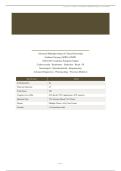
NUR 6111 Exam 2 | Advanced Pathophysiology | 2026 Update
NUR 6111 EXAM 2
QUESTIONS WITH COMPLETE SOLUTIONS
Advanced Pathophysiology & Clinical Reasoning
Graduate Nursing (APRN) | SNHU
2026 | 2027 Academic Standards Update
Cardiovascular · Respiratory · Endocrine · Renal · GI
Neurological · Musculoskeletal · Integumentary
Advanced Diagnostics · Pharmacology · Precision Medicine
Specification Detail
Total Questions 40
Points per Question 2.5
Total Points 100
Cognitive Level Mix 30% Recall / 50% Application / 20% Analysis
Question Style 75% Scenario-Based / 25% Direct
Format Multiple Choice (A-D), One Correct
Sections 4 (10 questions each)
Page 1
, NUR 6111 Exam 2 | Advanced Pathophysiology | 2026 Update
PART 1: EXAM QUESTIONS
Section 1: Cardiovascular & Respiratory Pathophysiology
Q1: A 68-year-old male with HFrEF (LVEF 28%) presents with progressive dyspnea, bilateral crackles, and a
BNP of 1,240 pg/mL. Which pathophysiological mechanism best explains his pulmonary symptoms?
A. Decreased left ventricular end-diastolic volume leading to reduced pulmonary capillary wedge pressure
B. Impaired left ventricular systolic function causing increased left ventricular end-diastolic pressure and
retrograde pulmonary congestion [CORRECT]
C. Increased right ventricular afterload resulting in isolated right-sided volume overload
D. Enhanced myocardial contractility with secondary diastolic filling abnormalities
Correct Answer: B
Rationale: In HFrEF, impaired systolic emptying elevates LVEDP, which transmits retrograde through the left atrium to
the pulmonary vasculature, causing transudation of fluid into the alveolar spaces. Option A describes a reduced-preload
scenario that would decrease pulmonary congestion, not cause it. Option C describes right-sided failure, which would
present with JVD and peripheral edema rather than bilateral crackles. Option D contradicts the definition of HFrEF,
which is characterized by reduced contractility.
Q2: A 72-year-old female with HFpEF (LVEF 62%) develops exertional dyspnea and lower extremity edema.
Which pathophysiological process is the primary driver of her symptoms?
A. Reduced left ventricular systolic ejection fraction with compensatory tachycardia
B. Impaired left ventricular relaxation and decreased compliance leading to elevated filling pressures despite
preserved ejection fraction [CORRECT]
C. Primary pulmonary arterial hypertension with secondary right ventricular failure
D. Acute mitral regurgitation causing volume overload of the left atrium
Correct Answer: B
Rationale: HFpEF is characterized by diastolic dysfunction: the stiff, non-compliant ventricle requires elevated filling
pressures to achieve adequate preload, leading to pulmonary congestion and systemic venous congestion. Option A
describes HFrEF. Option C describes a different disease process (Group 1 PAH). Option D is a valvular etiology, not the
primary mechanism in HFpEF.
Q3: A 55-year-old male presents with crushing substernal chest pain, diaphoresis, and ST-segment elevation in
leads V2-V4. Troponin I is elevated at 12.8 ng/mL. Which pathophysiological cascade best describes his
condition?
A. Gradual atherosclerotic plaque growth causing progressive luminal narrowing and stable angina
B. Coronary artery vasospasm leading to transient transmural ischemia without plaque rupture
C. Atherosclerotic plaque rupture with thrombus formation causing complete coronary artery occlusion and
transmural myocardial necrosis [CORRECT]
D. Microvascular coronary dysfunction with subendocardial ischemia and non-obstructive coronary disease
Correct Answer: C
Rationale: ST-elevation MI (STEMI) results from plaque rupture, thrombosis, and complete occlusion producing
transmural necrosis. Option A describes stable angina (gradual, not acute). Option B describes Prinzmetal/variant angina
(vasospasm). Option D describes INOCA (ischemia with non-obstructive coronary arteries), which does not produce ST
elevation or significant troponin elevation.
Q4: A 60-year-old female with long-standing essential hypertension develops left ventricular hypertrophy
(LVH). Which cellular and molecular mechanism primarily drives this structural adaptation?
A. Decreased afterload leading to eccentric hypertrophy through addition of sarcomeres in series
B. Volume overload causing dilation of the left ventricular chamber with thinning of the ventricular wall
Page 2
, NUR 6111 Exam 2 | Advanced Pathophysiology | 2026 Update
C. Sustained pressure overload activating renin-angiotensin-aldosterone system signaling, stimulating
cardiomyocyte hypertrophy with parallel sarcomere addition [CORRECT]
D. Myocardial fibrosis from repeated microinfarctions causing restrictive cardiomyopathy
Correct Answer: C
Rationale: Chronic pressure overload in hypertension triggers concentric hypertrophy via RAAS-mediated signaling
(Ang II, aldosterone), adding sarcomeres in parallel to normalize wall stress per Laplace's law. Option A describes
eccentric hypertrophy from volume overload. Option B is the opposite adaptation. Option D describes a different
pathological process (restrictive cardiomyopathy) rather than the compensatory hypertrophy.
Q5: A 45-year-old male with a history of rheumatic fever presents with a holosystolic murmur at the apex
radiating to the axilla. Echocardiography reveals severe mitral regurgitation. Which hemodynamic consequence
is most likely?
A. Increased afterload on the left ventricle with decreased left atrial pressure
B. Volume overload of the left atrium and left ventricle with decreased forward cardiac output [CORRECT]
C. Isolated right ventricular pressure overload with preserved left ventricular function
D. Increased systemic vascular resistance compensating for reduced stroke volume
Correct Answer: B
Rationale: Mitral regurgitation creates a low-resistance pathway for ejection back into the left atrium, causing volume
overload of both the LA (from regurgitant flow) and LV (from increased total preload). Forward stroke volume is
reduced. Option A is incorrect because MR decreases afterload (the regurgitant pathway offers lower resistance). Option
C describes pulmonary hypertension sequelae, not the primary hemodynamic effect. Option D is not a direct
consequence of MR.
Q6: A 35-year-old female with a history of childhood asthma presents with wheezing, chest tightness, and an
FEV1/FVC ratio of 0.65 that improves to 0.78 after bronchodilator administration. Which pathophysiological
process best explains her airflow limitation?
A. Irreversible fibrosis of small airways with parenchymal destruction and loss of elastic recoil
B. Reversible bronchoconstriction, airway inflammation with eosinophilic infiltration, and hyperresponsiveness
of smooth muscle [CORRECT]
C. Fixed airway narrowing from airway remodeling with minimal response to bronchodilators
D. Alveolar destruction and decreased diffusing capacity due to protease-antiprotease imbalance
Correct Answer: B
Rationale: Asthma is characterized by reversible airflow obstruction driven by Th2-mediated eosinophilic
inflammation, smooth muscle hyperresponsiveness, and bronchoconstriction. The significant bronchodilator response
confirms reversibility. Option A describes COPD with irreversible changes. Option C describes advanced airway
remodeling (more COPD-like). Option D describes emphysema.
Q7: A 70-year-old male with a 50 pack-year smoking history presents with progressive dyspnea, chronic
cough, and an FEV1/FVC ratio of 0.55 with minimal bronchodilator response. CT shows upper
lobe-predominant emphysematous changes. Which pathophysiological mechanism is most central?
A. Eosinophilic airway inflammation with reversible bronchoconstriction
B. CD8+ T-cell and neutrophil-mediated inflammation with protease-antiprotease imbalance causing alveolar
destruction and loss of elastic recoil [CORRECT]
C. Pulmonary vascular remodeling leading to isolated pulmonary hypertension
D. Interstitial fibrosis with restrictive physiology and reduced total lung capacity
Correct Answer: B
Rationale: COPD/emphysema is driven by cigarette smoke-activated macrophages and neutrophils releasing proteases
(especially neutrophil elastase) that destroy alveolar walls when alpha-1 antitrypsin is overwhelmed. Option A describes
asthma. Option C is a complication, not the central mechanism. Option D describes ILD (restrictive, not obstructive).
Q8: A 58-year-old male is admitted to the ICU with fever, productive cough, and right lower lobe consolidation
on chest X-ray. Sputum culture grows Streptococcus pneumoniae. Which pathophysiologic process best
Page 3
NUR 6111 EXAM 2
QUESTIONS WITH COMPLETE SOLUTIONS
Advanced Pathophysiology & Clinical Reasoning
Graduate Nursing (APRN) | SNHU
2026 | 2027 Academic Standards Update
Cardiovascular · Respiratory · Endocrine · Renal · GI
Neurological · Musculoskeletal · Integumentary
Advanced Diagnostics · Pharmacology · Precision Medicine
Specification Detail
Total Questions 40
Points per Question 2.5
Total Points 100
Cognitive Level Mix 30% Recall / 50% Application / 20% Analysis
Question Style 75% Scenario-Based / 25% Direct
Format Multiple Choice (A-D), One Correct
Sections 4 (10 questions each)
Page 1
, NUR 6111 Exam 2 | Advanced Pathophysiology | 2026 Update
PART 1: EXAM QUESTIONS
Section 1: Cardiovascular & Respiratory Pathophysiology
Q1: A 68-year-old male with HFrEF (LVEF 28%) presents with progressive dyspnea, bilateral crackles, and a
BNP of 1,240 pg/mL. Which pathophysiological mechanism best explains his pulmonary symptoms?
A. Decreased left ventricular end-diastolic volume leading to reduced pulmonary capillary wedge pressure
B. Impaired left ventricular systolic function causing increased left ventricular end-diastolic pressure and
retrograde pulmonary congestion [CORRECT]
C. Increased right ventricular afterload resulting in isolated right-sided volume overload
D. Enhanced myocardial contractility with secondary diastolic filling abnormalities
Correct Answer: B
Rationale: In HFrEF, impaired systolic emptying elevates LVEDP, which transmits retrograde through the left atrium to
the pulmonary vasculature, causing transudation of fluid into the alveolar spaces. Option A describes a reduced-preload
scenario that would decrease pulmonary congestion, not cause it. Option C describes right-sided failure, which would
present with JVD and peripheral edema rather than bilateral crackles. Option D contradicts the definition of HFrEF,
which is characterized by reduced contractility.
Q2: A 72-year-old female with HFpEF (LVEF 62%) develops exertional dyspnea and lower extremity edema.
Which pathophysiological process is the primary driver of her symptoms?
A. Reduced left ventricular systolic ejection fraction with compensatory tachycardia
B. Impaired left ventricular relaxation and decreased compliance leading to elevated filling pressures despite
preserved ejection fraction [CORRECT]
C. Primary pulmonary arterial hypertension with secondary right ventricular failure
D. Acute mitral regurgitation causing volume overload of the left atrium
Correct Answer: B
Rationale: HFpEF is characterized by diastolic dysfunction: the stiff, non-compliant ventricle requires elevated filling
pressures to achieve adequate preload, leading to pulmonary congestion and systemic venous congestion. Option A
describes HFrEF. Option C describes a different disease process (Group 1 PAH). Option D is a valvular etiology, not the
primary mechanism in HFpEF.
Q3: A 55-year-old male presents with crushing substernal chest pain, diaphoresis, and ST-segment elevation in
leads V2-V4. Troponin I is elevated at 12.8 ng/mL. Which pathophysiological cascade best describes his
condition?
A. Gradual atherosclerotic plaque growth causing progressive luminal narrowing and stable angina
B. Coronary artery vasospasm leading to transient transmural ischemia without plaque rupture
C. Atherosclerotic plaque rupture with thrombus formation causing complete coronary artery occlusion and
transmural myocardial necrosis [CORRECT]
D. Microvascular coronary dysfunction with subendocardial ischemia and non-obstructive coronary disease
Correct Answer: C
Rationale: ST-elevation MI (STEMI) results from plaque rupture, thrombosis, and complete occlusion producing
transmural necrosis. Option A describes stable angina (gradual, not acute). Option B describes Prinzmetal/variant angina
(vasospasm). Option D describes INOCA (ischemia with non-obstructive coronary arteries), which does not produce ST
elevation or significant troponin elevation.
Q4: A 60-year-old female with long-standing essential hypertension develops left ventricular hypertrophy
(LVH). Which cellular and molecular mechanism primarily drives this structural adaptation?
A. Decreased afterload leading to eccentric hypertrophy through addition of sarcomeres in series
B. Volume overload causing dilation of the left ventricular chamber with thinning of the ventricular wall
Page 2
, NUR 6111 Exam 2 | Advanced Pathophysiology | 2026 Update
C. Sustained pressure overload activating renin-angiotensin-aldosterone system signaling, stimulating
cardiomyocyte hypertrophy with parallel sarcomere addition [CORRECT]
D. Myocardial fibrosis from repeated microinfarctions causing restrictive cardiomyopathy
Correct Answer: C
Rationale: Chronic pressure overload in hypertension triggers concentric hypertrophy via RAAS-mediated signaling
(Ang II, aldosterone), adding sarcomeres in parallel to normalize wall stress per Laplace's law. Option A describes
eccentric hypertrophy from volume overload. Option B is the opposite adaptation. Option D describes a different
pathological process (restrictive cardiomyopathy) rather than the compensatory hypertrophy.
Q5: A 45-year-old male with a history of rheumatic fever presents with a holosystolic murmur at the apex
radiating to the axilla. Echocardiography reveals severe mitral regurgitation. Which hemodynamic consequence
is most likely?
A. Increased afterload on the left ventricle with decreased left atrial pressure
B. Volume overload of the left atrium and left ventricle with decreased forward cardiac output [CORRECT]
C. Isolated right ventricular pressure overload with preserved left ventricular function
D. Increased systemic vascular resistance compensating for reduced stroke volume
Correct Answer: B
Rationale: Mitral regurgitation creates a low-resistance pathway for ejection back into the left atrium, causing volume
overload of both the LA (from regurgitant flow) and LV (from increased total preload). Forward stroke volume is
reduced. Option A is incorrect because MR decreases afterload (the regurgitant pathway offers lower resistance). Option
C describes pulmonary hypertension sequelae, not the primary hemodynamic effect. Option D is not a direct
consequence of MR.
Q6: A 35-year-old female with a history of childhood asthma presents with wheezing, chest tightness, and an
FEV1/FVC ratio of 0.65 that improves to 0.78 after bronchodilator administration. Which pathophysiological
process best explains her airflow limitation?
A. Irreversible fibrosis of small airways with parenchymal destruction and loss of elastic recoil
B. Reversible bronchoconstriction, airway inflammation with eosinophilic infiltration, and hyperresponsiveness
of smooth muscle [CORRECT]
C. Fixed airway narrowing from airway remodeling with minimal response to bronchodilators
D. Alveolar destruction and decreased diffusing capacity due to protease-antiprotease imbalance
Correct Answer: B
Rationale: Asthma is characterized by reversible airflow obstruction driven by Th2-mediated eosinophilic
inflammation, smooth muscle hyperresponsiveness, and bronchoconstriction. The significant bronchodilator response
confirms reversibility. Option A describes COPD with irreversible changes. Option C describes advanced airway
remodeling (more COPD-like). Option D describes emphysema.
Q7: A 70-year-old male with a 50 pack-year smoking history presents with progressive dyspnea, chronic
cough, and an FEV1/FVC ratio of 0.55 with minimal bronchodilator response. CT shows upper
lobe-predominant emphysematous changes. Which pathophysiological mechanism is most central?
A. Eosinophilic airway inflammation with reversible bronchoconstriction
B. CD8+ T-cell and neutrophil-mediated inflammation with protease-antiprotease imbalance causing alveolar
destruction and loss of elastic recoil [CORRECT]
C. Pulmonary vascular remodeling leading to isolated pulmonary hypertension
D. Interstitial fibrosis with restrictive physiology and reduced total lung capacity
Correct Answer: B
Rationale: COPD/emphysema is driven by cigarette smoke-activated macrophages and neutrophils releasing proteases
(especially neutrophil elastase) that destroy alveolar walls when alpha-1 antitrypsin is overwhelmed. Option A describes
asthma. Option C is a complication, not the central mechanism. Option D describes ILD (restrictive, not obstructive).
Q8: A 58-year-old male is admitted to the ICU with fever, productive cough, and right lower lobe consolidation
on chest X-ray. Sputum culture grows Streptococcus pneumoniae. Which pathophysiologic process best
Page 3


