

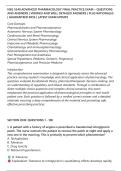
NSG 5240 ADVANCED PHARMACOLOGY FINAL PRACTICE EXAM – QUESTIONS
AND ANSWERS | VERIFIED AND WELL DETAILED ANSWERS | PLUS RATIONALES
| GUARANTEED PASS | LATEST EXAM UPDATE
Core Domains
Pharmacokinetics and Pharmacodynamics
Autonomic Nervous System Pharmacology
Cardiovascular and Renal Pharmacology
Central Nervous System Pharmacology
Endocrine and Metabolic Pharmacology
Chemotherapy and Immunopharmacology
Gastrointestinal and Respiratory Pharmacology
Pain Management and Anesthesia
Special Populations (Pediatric, Geriatric, Pregnancy)
Pharmacogenomics and Precision Medicine
Introduction
This comprehensive examination is designed to rigorously assess the advanced
practice nursing student's knowledge and clinical application of pharmacology. The
questions evaluate foundational theory, pharmacotherapeutic decision-making, and
an understanding of regulatory and ethical standards. Through a combination of
direct multiple-choice questions and complex clinical scenarios, this exam
emphasizes the practical application of pharmacological principles in real-world
patient care. Each question is followed by a verified correct answer and a detailed
rationale, ensuring a deep comprehension of the material and promoting safe,
effective prescribing practices.
SECTION ONE: QUESTIONS 1 - 100
1. A patient with a history of angina is prescribed a transdermal nitroglycerin
patch. The nurse instructs the patient to remove the patch at night and apply a
new one in the morning. This is primarily to prevent which phenomenon?
A. Tachyphylaxis
B. Tolerance
C. Drug toxicity
D. Rebound hypertension
🟢 B. Tolerance
🔴 Explanation: Tolerance to nitroglycerin's vasodilatory effects develops rapidly
,with continuous exposure (e.g., 24-hour patch use). A drug-free interval of 10-12
hours is essential to prevent or minimize this tolerance, allowing the body to
regain sensitivity to the drug. Tachyphylaxis is a rapid, acute form of tolerance,
but the clinical approach to nitroglycerin is specifically to prevent long-term
tolerance.
2. A patient with type 1 diabetes is experiencing hypoglycemia. Which of the
following glucagon preparations is administered via the intranasal route?
A. Glucagon injection (GlucaGen)
B. Dasiglucagon (Zegalogue)
C. Glucagon nasal powder (Baqsimi)
D. Aqueous glucagon
🟢 C. Glucagon nasal powder (Baqsimi)
🔴 Explanation: Baqsimi is the first and only approved nasal powder formulation
of glucagon for the treatment of severe hypoglycemia. It is administered as a
single dose into one nostril. GlucaGen and Dasiglucagon are injectable forms.
Aqueous glucagon is not a standard, commercially available formulation.
3. A patient is started on a sulfonylurea for the management of type 2 diabetes.
Which adverse effect is most concerning due to its potential severity in an
elderly patient?
A. Gastrointestinal distress
B. Weight gain
C. Hypoglycemia
D. Photosensitivity
🟢 C. Hypoglycemia
🔴 Explanation: Sulfonylureas (e.g., glipizide, glyburide) stimulate insulin release,
which can lead to hypoglycemia. This risk is significantly higher in elderly patients,
who may have impaired renal function, decreased hepatic metabolism, or
irregular eating patterns. Hypoglycemia in the elderly is a major concern due to
the risk of falls, cognitive impairment, and cardiovascular events. While other
options are known side effects, hypoglycemia is the most clinically significant and
severe.
4. The mechanism of action of bisphosphonates, such as alendronate, involves:
A. Stimulating osteoblast activity to form new bone.
B. Inhibiting osteoclast-mediated bone resorption.
C. Providing a calcium supplement to increase bone density.
D. Activating vitamin D receptors in the intestine.
,🟢 B. Inhibiting osteoclast-mediated bone resorption.
🔴 Explanation: Bisphosphonates are pyrophosphate analogues that bind to
hydroxyapatite in bone. When osteoclasts resorb this bone, they internalize the
bisphosphonate, which triggers apoptosis of the osteoclasts. This process directly
reduces bone resorption, preserving bone mass. They do not stimulate osteoblast
activity (A); their primary action is not calcium supplementation (C); and they do
not directly activate vitamin D receptors (D).
5. A nurse is caring for a patient receiving a loop diuretic (furosemide). Which
electrolyte imbalance is a common adverse effect of this medication and
requires careful monitoring?
A. Hyperkalemia
B. Hypernatremia
C. Hypokalemia
D. Hypercalcemia
🟢 C. Hypokalemia
🔴 Explanation: Loop diuretics act on the ascending loop of Henle to inhibit the
Na-K-2Cl cotransporter. By increasing the delivery of sodium to the distal tubule,
they promote potassium and hydrogen ion secretion in exchange for sodium,
leading to hypokalemia. This is a significant and common adverse effect that can
lead to cardiac arrhythmias.
6. A patient is prescribed a nitrate and a phosphodiesterase-5 (PDE5) inhibitor.
The combination of these drugs is contraindicated due to the risk of:
A. Severe hypertension
B. Profound bradycardia
C. Life-threatening hypotension
D. Atrioventricular block
🟢 C. Life-threatening hypotension
🔴 Explanation: Both nitrates and PDE5 inhibitors (e.g., sildenafil) produce
vasodilation through the nitric oxide-cGMP pathway. When combined, their
vasodilatory effects are additive and can lead to severe, life-threatening
hypotension. This is a critical, absolute contraindication. The combination does
not primarily cause hypertension, bradycardia, or AV block.
7. The therapeutic effect of the HMG-CoA reductase inhibitors (statins) is
primarily assessed by monitoring which laboratory value?
A. Serum creatinine
B. Aspartate aminotransferase (AST)
, C. Low-density lipoprotein (LDL) cholesterol
D. High-density lipoprotein (HDL) cholesterol
🟢 C. Low-density lipoprotein (LDL) cholesterol
🔴 Explanation: Statins work by inhibiting HMG-CoA reductase, the rate-limiting
enzyme in cholesterol synthesis. This leads to a significant reduction in LDL
cholesterol, making LDL the primary marker for monitoring therapeutic efficacy.
While statins can also modestly increase HDL and lower triglycerides, LDL
reduction is the main target for cardiovascular risk reduction. Monitoring liver
enzymes (AST) is for safety, not therapeutic effect.
8. A patient with a history of peptic ulcer disease is prescribed low-dose aspirin
for cardiovascular protection. The nurse should anticipate which co-
prescription to reduce the risk of gastrointestinal adverse effects?
A. An antacid containing calcium carbonate
B. A proton pump inhibitor (PPI)
C. An H2-receptor antagonist
D. Misoprostol
🟢 B. A proton pump inhibitor (PPI)
🔴 Explanation: Aspirin inhibits cyclooxygenase-1 (COX-1), leading to decreased
gastric mucosal prostaglandin synthesis and an increased risk of gastric ulcers.
PPIs (e.g., omeprazole) are the most effective agents for preventing and healing
aspirin-induced ulcers by reducing gastric acid secretion, which is the preferred
protective strategy for patients at high risk. While H2RAs provide some benefit,
PPIs are considered superior for this indication, and misoprostol is a
prostaglandin analogue but is not the standard first-line prophylactic agent.
9. A patient receiving morphine sulfate for severe pain is experiencing pruritus.
The nurse administers diphenhydramine to manage this side effect. This is an
example of:
A. An additive effect
B. A synergistic effect
C. An adverse effect being treated with another drug
D. An antagonistic effect
🟢 C. An adverse effect being treated with another drug
🔴 Explanation: Morphine-induced pruritus is a common adverse effect, often
related to histamine release. Diphenhydramine, an antihistamine, is administered
to treat this adverse effect. It is not an additive or synergistic effect (which would
enhance the primary therapeutic effect), nor an antagonistic effect (which would
oppose the therapeutic effect). It is the management of a side effect.
AND ANSWERS | VERIFIED AND WELL DETAILED ANSWERS | PLUS RATIONALES
| GUARANTEED PASS | LATEST EXAM UPDATE
Core Domains
Pharmacokinetics and Pharmacodynamics
Autonomic Nervous System Pharmacology
Cardiovascular and Renal Pharmacology
Central Nervous System Pharmacology
Endocrine and Metabolic Pharmacology
Chemotherapy and Immunopharmacology
Gastrointestinal and Respiratory Pharmacology
Pain Management and Anesthesia
Special Populations (Pediatric, Geriatric, Pregnancy)
Pharmacogenomics and Precision Medicine
Introduction
This comprehensive examination is designed to rigorously assess the advanced
practice nursing student's knowledge and clinical application of pharmacology. The
questions evaluate foundational theory, pharmacotherapeutic decision-making, and
an understanding of regulatory and ethical standards. Through a combination of
direct multiple-choice questions and complex clinical scenarios, this exam
emphasizes the practical application of pharmacological principles in real-world
patient care. Each question is followed by a verified correct answer and a detailed
rationale, ensuring a deep comprehension of the material and promoting safe,
effective prescribing practices.
SECTION ONE: QUESTIONS 1 - 100
1. A patient with a history of angina is prescribed a transdermal nitroglycerin
patch. The nurse instructs the patient to remove the patch at night and apply a
new one in the morning. This is primarily to prevent which phenomenon?
A. Tachyphylaxis
B. Tolerance
C. Drug toxicity
D. Rebound hypertension
🟢 B. Tolerance
🔴 Explanation: Tolerance to nitroglycerin's vasodilatory effects develops rapidly
,with continuous exposure (e.g., 24-hour patch use). A drug-free interval of 10-12
hours is essential to prevent or minimize this tolerance, allowing the body to
regain sensitivity to the drug. Tachyphylaxis is a rapid, acute form of tolerance,
but the clinical approach to nitroglycerin is specifically to prevent long-term
tolerance.
2. A patient with type 1 diabetes is experiencing hypoglycemia. Which of the
following glucagon preparations is administered via the intranasal route?
A. Glucagon injection (GlucaGen)
B. Dasiglucagon (Zegalogue)
C. Glucagon nasal powder (Baqsimi)
D. Aqueous glucagon
🟢 C. Glucagon nasal powder (Baqsimi)
🔴 Explanation: Baqsimi is the first and only approved nasal powder formulation
of glucagon for the treatment of severe hypoglycemia. It is administered as a
single dose into one nostril. GlucaGen and Dasiglucagon are injectable forms.
Aqueous glucagon is not a standard, commercially available formulation.
3. A patient is started on a sulfonylurea for the management of type 2 diabetes.
Which adverse effect is most concerning due to its potential severity in an
elderly patient?
A. Gastrointestinal distress
B. Weight gain
C. Hypoglycemia
D. Photosensitivity
🟢 C. Hypoglycemia
🔴 Explanation: Sulfonylureas (e.g., glipizide, glyburide) stimulate insulin release,
which can lead to hypoglycemia. This risk is significantly higher in elderly patients,
who may have impaired renal function, decreased hepatic metabolism, or
irregular eating patterns. Hypoglycemia in the elderly is a major concern due to
the risk of falls, cognitive impairment, and cardiovascular events. While other
options are known side effects, hypoglycemia is the most clinically significant and
severe.
4. The mechanism of action of bisphosphonates, such as alendronate, involves:
A. Stimulating osteoblast activity to form new bone.
B. Inhibiting osteoclast-mediated bone resorption.
C. Providing a calcium supplement to increase bone density.
D. Activating vitamin D receptors in the intestine.
,🟢 B. Inhibiting osteoclast-mediated bone resorption.
🔴 Explanation: Bisphosphonates are pyrophosphate analogues that bind to
hydroxyapatite in bone. When osteoclasts resorb this bone, they internalize the
bisphosphonate, which triggers apoptosis of the osteoclasts. This process directly
reduces bone resorption, preserving bone mass. They do not stimulate osteoblast
activity (A); their primary action is not calcium supplementation (C); and they do
not directly activate vitamin D receptors (D).
5. A nurse is caring for a patient receiving a loop diuretic (furosemide). Which
electrolyte imbalance is a common adverse effect of this medication and
requires careful monitoring?
A. Hyperkalemia
B. Hypernatremia
C. Hypokalemia
D. Hypercalcemia
🟢 C. Hypokalemia
🔴 Explanation: Loop diuretics act on the ascending loop of Henle to inhibit the
Na-K-2Cl cotransporter. By increasing the delivery of sodium to the distal tubule,
they promote potassium and hydrogen ion secretion in exchange for sodium,
leading to hypokalemia. This is a significant and common adverse effect that can
lead to cardiac arrhythmias.
6. A patient is prescribed a nitrate and a phosphodiesterase-5 (PDE5) inhibitor.
The combination of these drugs is contraindicated due to the risk of:
A. Severe hypertension
B. Profound bradycardia
C. Life-threatening hypotension
D. Atrioventricular block
🟢 C. Life-threatening hypotension
🔴 Explanation: Both nitrates and PDE5 inhibitors (e.g., sildenafil) produce
vasodilation through the nitric oxide-cGMP pathway. When combined, their
vasodilatory effects are additive and can lead to severe, life-threatening
hypotension. This is a critical, absolute contraindication. The combination does
not primarily cause hypertension, bradycardia, or AV block.
7. The therapeutic effect of the HMG-CoA reductase inhibitors (statins) is
primarily assessed by monitoring which laboratory value?
A. Serum creatinine
B. Aspartate aminotransferase (AST)
, C. Low-density lipoprotein (LDL) cholesterol
D. High-density lipoprotein (HDL) cholesterol
🟢 C. Low-density lipoprotein (LDL) cholesterol
🔴 Explanation: Statins work by inhibiting HMG-CoA reductase, the rate-limiting
enzyme in cholesterol synthesis. This leads to a significant reduction in LDL
cholesterol, making LDL the primary marker for monitoring therapeutic efficacy.
While statins can also modestly increase HDL and lower triglycerides, LDL
reduction is the main target for cardiovascular risk reduction. Monitoring liver
enzymes (AST) is for safety, not therapeutic effect.
8. A patient with a history of peptic ulcer disease is prescribed low-dose aspirin
for cardiovascular protection. The nurse should anticipate which co-
prescription to reduce the risk of gastrointestinal adverse effects?
A. An antacid containing calcium carbonate
B. A proton pump inhibitor (PPI)
C. An H2-receptor antagonist
D. Misoprostol
🟢 B. A proton pump inhibitor (PPI)
🔴 Explanation: Aspirin inhibits cyclooxygenase-1 (COX-1), leading to decreased
gastric mucosal prostaglandin synthesis and an increased risk of gastric ulcers.
PPIs (e.g., omeprazole) are the most effective agents for preventing and healing
aspirin-induced ulcers by reducing gastric acid secretion, which is the preferred
protective strategy for patients at high risk. While H2RAs provide some benefit,
PPIs are considered superior for this indication, and misoprostol is a
prostaglandin analogue but is not the standard first-line prophylactic agent.
9. A patient receiving morphine sulfate for severe pain is experiencing pruritus.
The nurse administers diphenhydramine to manage this side effect. This is an
example of:
A. An additive effect
B. A synergistic effect
C. An adverse effect being treated with another drug
D. An antagonistic effect
🟢 C. An adverse effect being treated with another drug
🔴 Explanation: Morphine-induced pruritus is a common adverse effect, often
related to histamine release. Diphenhydramine, an antihistamine, is administered
to treat this adverse effect. It is not an additive or synergistic effect (which would
enhance the primary therapeutic effect), nor an antagonistic effect (which would
oppose the therapeutic effect). It is the management of a side effect.


