

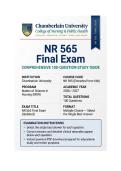
,NR 565 Final Exam | Advanced Pharmacology
Fundamentals (2026) Q&A | Chamberlain College
1. Which parameter reflects the margin of safety of a drug by comparing the dose that causes toxicity
to the dose that produces the desired effect?
A) Therapeutic index
B) Bioavailability
C) Potency
D) Half‑life
Correct Answer: A) Therapeutic index
Rationale: The therapeutic index is the ratio of the toxic dose to the effective dose. A narrow index
indicates a small safety margin, requiring close monitoring. Bioavailability is the fraction absorbed;
potency compares doses for effect; half‑life is elimination time.
2. A drug undergoes extensive first‑pass metabolism in the liver. How does this affect its oral dosing
compared to intravenous administration?
A) The oral dose must be higher to achieve therapeutic levels
B) The oral dose must be lower to prevent toxicity
C) Oral and IV doses are equivalent
D) The drug cannot be given orally
Correct Answer: A) The oral dose must be higher to achieve therapeutic levels
Rationale: First‑pass metabolism reduces the amount of active drug reaching systemic circulation
after oral administration. A higher oral dose compensates for the fraction lost during first‑pass.
3. Which schedule of controlled substances has the highest abuse potential and no currently accepted
medical use in the United States?
A) Schedule I
,B) Schedule II
C) Schedule III
D) Schedule IV
Correct Answer: C) Schedule I
Rationale: Schedule I drugs (e.g., heroin, LSD) have the highest abuse potential and no accepted
medical use. Schedule II drugs have high abuse potential but accepted medical uses with severe
restrictions.
4. The study of what the body does to a drug, including absorption, distribution, metabolism, and
excretion, is:
A) Pharmacodynamics
B) Pharmacokinetics
C) Pharmacogenetics
D) Pharmacotherapeutics
Correct Answer: D) Pharmacokinetics
Rationale: Pharmacokinetics describes the movement of drugs through the body (ADME).
Pharmacodynamics is what the drug does to the body. Pharmacogenetics studies genetic effects on
drug response.
5. A patient on warfarin has an INR of 5.2 and is experiencing minor gum bleeding. The nurse
anticipates administration of:
A) Protamine sulfate
B) Vitamin K
C) Fresh frozen plasma
D) Platelets
Correct Answer: B) Vitamin K
, Rationale: Vitamin K reverses warfarin's anticoagulant effect by promoting synthesis of clotting
factors. Protamine sulfate reverses heparin; fresh frozen plasma may be used in severe bleeding but
vitamin K is the specific antidote.
6. Which adverse effect is most characteristic of ACE inhibitors?
A) Hypokalemia
B) Persistent dry cough
C) Bradycardia
D) Tinnitus
Correct Answer: C) Persistent dry cough
Rationale: ACE inhibitors block the breakdown of bradykinin, leading to accumulation and a dry,
hacking cough. This is not harmful but may require switching to an ARB. Hyperkalemia, not
hypokalemia, may occur.
7. A patient with heart failure is prescribed digoxin. Before administering the next dose, the nurse
notes a heart rate of 54 bpm and the patient reports nausea and yellow‑tinged vision. What is the
priority action?
A) Administer the digoxin as scheduled
B) Hold the digoxin and notify the provider
C) Give the digoxin with an antiemetic
D) Double the next dose to reach therapeutic level
Correct Answer: D) Hold the digoxin and notify the provider
Rationale: Nausea, bradycardia, and visual disturbances are signs of digoxin toxicity. The drug should
be withheld and the provider notified immediately; serum digoxin levels and potassium should be
checked.
Fundamentals (2026) Q&A | Chamberlain College
1. Which parameter reflects the margin of safety of a drug by comparing the dose that causes toxicity
to the dose that produces the desired effect?
A) Therapeutic index
B) Bioavailability
C) Potency
D) Half‑life
Correct Answer: A) Therapeutic index
Rationale: The therapeutic index is the ratio of the toxic dose to the effective dose. A narrow index
indicates a small safety margin, requiring close monitoring. Bioavailability is the fraction absorbed;
potency compares doses for effect; half‑life is elimination time.
2. A drug undergoes extensive first‑pass metabolism in the liver. How does this affect its oral dosing
compared to intravenous administration?
A) The oral dose must be higher to achieve therapeutic levels
B) The oral dose must be lower to prevent toxicity
C) Oral and IV doses are equivalent
D) The drug cannot be given orally
Correct Answer: A) The oral dose must be higher to achieve therapeutic levels
Rationale: First‑pass metabolism reduces the amount of active drug reaching systemic circulation
after oral administration. A higher oral dose compensates for the fraction lost during first‑pass.
3. Which schedule of controlled substances has the highest abuse potential and no currently accepted
medical use in the United States?
A) Schedule I
,B) Schedule II
C) Schedule III
D) Schedule IV
Correct Answer: C) Schedule I
Rationale: Schedule I drugs (e.g., heroin, LSD) have the highest abuse potential and no accepted
medical use. Schedule II drugs have high abuse potential but accepted medical uses with severe
restrictions.
4. The study of what the body does to a drug, including absorption, distribution, metabolism, and
excretion, is:
A) Pharmacodynamics
B) Pharmacokinetics
C) Pharmacogenetics
D) Pharmacotherapeutics
Correct Answer: D) Pharmacokinetics
Rationale: Pharmacokinetics describes the movement of drugs through the body (ADME).
Pharmacodynamics is what the drug does to the body. Pharmacogenetics studies genetic effects on
drug response.
5. A patient on warfarin has an INR of 5.2 and is experiencing minor gum bleeding. The nurse
anticipates administration of:
A) Protamine sulfate
B) Vitamin K
C) Fresh frozen plasma
D) Platelets
Correct Answer: B) Vitamin K
, Rationale: Vitamin K reverses warfarin's anticoagulant effect by promoting synthesis of clotting
factors. Protamine sulfate reverses heparin; fresh frozen plasma may be used in severe bleeding but
vitamin K is the specific antidote.
6. Which adverse effect is most characteristic of ACE inhibitors?
A) Hypokalemia
B) Persistent dry cough
C) Bradycardia
D) Tinnitus
Correct Answer: C) Persistent dry cough
Rationale: ACE inhibitors block the breakdown of bradykinin, leading to accumulation and a dry,
hacking cough. This is not harmful but may require switching to an ARB. Hyperkalemia, not
hypokalemia, may occur.
7. A patient with heart failure is prescribed digoxin. Before administering the next dose, the nurse
notes a heart rate of 54 bpm and the patient reports nausea and yellow‑tinged vision. What is the
priority action?
A) Administer the digoxin as scheduled
B) Hold the digoxin and notify the provider
C) Give the digoxin with an antiemetic
D) Double the next dose to reach therapeutic level
Correct Answer: D) Hold the digoxin and notify the provider
Rationale: Nausea, bradycardia, and visual disturbances are signs of digoxin toxicity. The drug should
be withheld and the provider notified immediately; serum digoxin levels and potassium should be
checked.


