

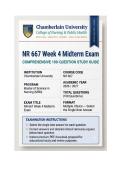
,NR 667 Week 4 Midterm Exam – FNP Capstone
Practicum – Actual Q&A (2026) PDF | Chamberlain
1. Which organization administers the Family Nurse Practitioner (FNP) national certification
exam?
A) American Academy of Nurse Practitioners Certification Board (AANPCB)
B) National Council of State Boards of Nursing (NCSBN)
C) American Association of Colleges of Nursing (AACN)
D) Federal Trade Commission (FTC)
Correct Answer: A) American Academy of Nurse Practitioners Certification Board (AANPCB)
Rationale: The AANPCB, along with the ANCC, is a primary certifying body for FNPs. The
NCSBN does not administer FNP exams, AACN focuses on education, and FTC is unrelated.
Certification validates advanced practice knowledge and is required for state licensure
eligibility.
2. A prospective FNP candidate is preparing to take the national certification exam. Which of
the following is an absolute prerequisite?
A) Master’s degree in nursing with any specialization
B) Current, unencumbered RN license
C) Two years of acute care experience
D) Membership in a professional nursing organization
Correct Answer: B) Current, unencumbered RN license
Rationale: Both AANPCB and ANCC require an active, unencumbered RN license to sit for the
exam. A master’s degree in a non-NP track does not qualify. Clinical experience requirements
vary, but the RN license is non-negotiable. Organizational membership is optional.
,3. After passing the national FNP certification exam, what is the very next required step to
legally practice as a Nurse Practitioner?
A) Apply for a DEA registration number
B) Obtain a National Provider Identifier (NPI)
C) Apply for state Advanced Practice Registered Nurse (APRN) licensure
D) Secure malpractice insurance
Correct Answer: C) Apply for state Advanced Practice Registered Nurse (APRN) licensure
Rationale: State licensure grants the legal authority to practice; certification alone is
insufficient. DEA and NPI come after licensure if needed. Malpractice insurance is not a legal
requirement but advisable. Licensure must be obtained in the state where the NP intends to
practice.
4. The APRN Consensus Model was developed to standardize which components across
states?
A) Liability, Assessment, Curriculum, and Examination
B) Legislation, Advocacy, Clinical practice, and Ethics
C) Laboratory, Assessment, Care coordination, and Evaluation
D) Licensure, Accreditation, Certification, and Education (LACE)
Correct Answer: D) Licensure, Accreditation, Certification, and Education (LACE)
Rationale: LACE ensures uniform regulation of APRNs. The model does not address liability or
specific curriculum directly. It promotes consistency in APRN roles and titles. Understanding
LACE is essential for recognizing the legal basis of advanced practice.
5. A newly licensed NP obtains a National Provider Identifier (NPI). What is the primary
function of this identifier?
A) To bill insurance and identify the provider in standard HIPAA transactions
, B) To prescribe controlled substances
C) To track continuing education hours
D) To document collaborative agreements with physicians
Correct Answer: A) To bill insurance and identify the provider in standard HIPAA transactions
Rationale: The NPI is a unique 10-digit number used in all HIPAA-standard transactions, such
as electronic claims. It does not replace DEA registration for controlled substances. It is not
used for tracking CE or collaborative agreements. Insurers and clearinghouses require the
NPI.
6. An FNP wishes to prescribe Schedule II controlled substances. Which federal registration
must be obtained?
A) State APRN license
B) NPI number
C) Drug Enforcement Administration (DEA) registration
D) Board of Pharmacy permit
Correct Answer: C) Drug Enforcement Administration (DEA) registration
Rationale: DEA registration is required for prescribing controlled substances. The state license
and NPI do not grant this authority. Some states also require additional permits, but DEA is
federal. NPs must renew this registration periodically. Prescribing without a DEA number is
illegal.
7. According to AANPCB recertification requirements, how many continuing education (CE)
hours must be completed every 5 years, and what is the minimum pharmacology
component?
A) 50 hours, at least 25 in pharmacology
B) 100 hours, at least 75 in pharmacology
Practicum – Actual Q&A (2026) PDF | Chamberlain
1. Which organization administers the Family Nurse Practitioner (FNP) national certification
exam?
A) American Academy of Nurse Practitioners Certification Board (AANPCB)
B) National Council of State Boards of Nursing (NCSBN)
C) American Association of Colleges of Nursing (AACN)
D) Federal Trade Commission (FTC)
Correct Answer: A) American Academy of Nurse Practitioners Certification Board (AANPCB)
Rationale: The AANPCB, along with the ANCC, is a primary certifying body for FNPs. The
NCSBN does not administer FNP exams, AACN focuses on education, and FTC is unrelated.
Certification validates advanced practice knowledge and is required for state licensure
eligibility.
2. A prospective FNP candidate is preparing to take the national certification exam. Which of
the following is an absolute prerequisite?
A) Master’s degree in nursing with any specialization
B) Current, unencumbered RN license
C) Two years of acute care experience
D) Membership in a professional nursing organization
Correct Answer: B) Current, unencumbered RN license
Rationale: Both AANPCB and ANCC require an active, unencumbered RN license to sit for the
exam. A master’s degree in a non-NP track does not qualify. Clinical experience requirements
vary, but the RN license is non-negotiable. Organizational membership is optional.
,3. After passing the national FNP certification exam, what is the very next required step to
legally practice as a Nurse Practitioner?
A) Apply for a DEA registration number
B) Obtain a National Provider Identifier (NPI)
C) Apply for state Advanced Practice Registered Nurse (APRN) licensure
D) Secure malpractice insurance
Correct Answer: C) Apply for state Advanced Practice Registered Nurse (APRN) licensure
Rationale: State licensure grants the legal authority to practice; certification alone is
insufficient. DEA and NPI come after licensure if needed. Malpractice insurance is not a legal
requirement but advisable. Licensure must be obtained in the state where the NP intends to
practice.
4. The APRN Consensus Model was developed to standardize which components across
states?
A) Liability, Assessment, Curriculum, and Examination
B) Legislation, Advocacy, Clinical practice, and Ethics
C) Laboratory, Assessment, Care coordination, and Evaluation
D) Licensure, Accreditation, Certification, and Education (LACE)
Correct Answer: D) Licensure, Accreditation, Certification, and Education (LACE)
Rationale: LACE ensures uniform regulation of APRNs. The model does not address liability or
specific curriculum directly. It promotes consistency in APRN roles and titles. Understanding
LACE is essential for recognizing the legal basis of advanced practice.
5. A newly licensed NP obtains a National Provider Identifier (NPI). What is the primary
function of this identifier?
A) To bill insurance and identify the provider in standard HIPAA transactions
, B) To prescribe controlled substances
C) To track continuing education hours
D) To document collaborative agreements with physicians
Correct Answer: A) To bill insurance and identify the provider in standard HIPAA transactions
Rationale: The NPI is a unique 10-digit number used in all HIPAA-standard transactions, such
as electronic claims. It does not replace DEA registration for controlled substances. It is not
used for tracking CE or collaborative agreements. Insurers and clearinghouses require the
NPI.
6. An FNP wishes to prescribe Schedule II controlled substances. Which federal registration
must be obtained?
A) State APRN license
B) NPI number
C) Drug Enforcement Administration (DEA) registration
D) Board of Pharmacy permit
Correct Answer: C) Drug Enforcement Administration (DEA) registration
Rationale: DEA registration is required for prescribing controlled substances. The state license
and NPI do not grant this authority. Some states also require additional permits, but DEA is
federal. NPs must renew this registration periodically. Prescribing without a DEA number is
illegal.
7. According to AANPCB recertification requirements, how many continuing education (CE)
hours must be completed every 5 years, and what is the minimum pharmacology
component?
A) 50 hours, at least 25 in pharmacology
B) 100 hours, at least 75 in pharmacology


