

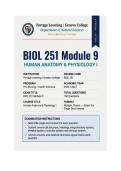
,BIOL 251 Module 9 Exam | Human Anatomy &
Physiology I w/Lab Exam Q&A | Portage Learning
1. The defining characteristic of an endocrine gland is that it:
A) Secretes products through ducts onto epithelial surfaces
B) Releases hormones directly into the interstitial fluid and bloodstream
C) Produces sweat, saliva, or digestive enzymes
D) Has local effects only
Correct Answer: B) Releases hormones directly into the interstitial fluid and
bloodstream
Rationale: Endocrine glands are ductless; they secrete hormones that diffuse
into capillaries for systemic distribution. Exocrine glands, such as sweat and
salivary glands, use ducts to carry their products to body surfaces or cavities.
2. Which of the following is NOT an endocrine gland?
A) Thyroid gland
B) Adrenal gland
C) Pituitary gland
D) Sweat gland
Correct Answer: D) Sweat gland
Rationale: Sweat glands are exocrine glands that secrete sweat through ducts
onto the skin. The thyroid, adrenal, and pituitary glands are classic endocrine
glands that lack ducts and secrete hormones into the blood.
,3. The pituitary gland is housed within the:
A) Sella turcica of the sphenoid bone
B) Foramen magnum
C) Cribriform plate
D) Optic canal
Correct Answer: C) Sella turcica of the sphenoid bone
Rationale: The pituitary sits in the sella turcica, a bony depression of the
sphenoid bone at the base of the skull. The foramen magnum transmits the
spinal cord; the cribriform plate supports the olfactory bulbs.
4. The posterior pituitary releases which two hormones?
A) Growth hormone and prolactin
B) Antidiuretic hormone (ADH) and oxytocin
C) TSH and ACTH
D) FSH and LH
Correct Answer: B) Antidiuretic hormone (ADH) and oxytocin
Rationale: ADH and oxytocin are synthesized by hypothalamic neurons and
stored in axon terminals in the posterior pituitary, from which they are
secreted. The other hormones listed are produced by the anterior pituitary.
5. Antidiuretic hormone (ADH) acts on the kidneys to:
, A) Increase urine output
B) Promote water reabsorption
C) Excrete potassium
D) Stimulate sodium reabsorption
Correct Answer: A) Promote water reabsorption
Rationale: ADH increases the permeability of collecting ducts to water, reducing
urine volume and conserving body water. It does not primarily affect sodium or
potassium excretion.
6. Oxytocin is responsible for:
A) Milk production in the mammary glands
B) Uterine contractions and milk ejection
C) Regulating metabolic rate
D) Stimulating bone growth
Correct Answer: B) Uterine contractions and milk ejection
Rationale: Oxytocin stimulates smooth muscle contractions during childbirth
and the let‑down reflex for breastfeeding. Prolactin, not oxytocin, stimulates
milk synthesis.
7. Which anterior pituitary hormone stimulates growth of bones and soft
tissues?
A) Growth hormone (GH)
Physiology I w/Lab Exam Q&A | Portage Learning
1. The defining characteristic of an endocrine gland is that it:
A) Secretes products through ducts onto epithelial surfaces
B) Releases hormones directly into the interstitial fluid and bloodstream
C) Produces sweat, saliva, or digestive enzymes
D) Has local effects only
Correct Answer: B) Releases hormones directly into the interstitial fluid and
bloodstream
Rationale: Endocrine glands are ductless; they secrete hormones that diffuse
into capillaries for systemic distribution. Exocrine glands, such as sweat and
salivary glands, use ducts to carry their products to body surfaces or cavities.
2. Which of the following is NOT an endocrine gland?
A) Thyroid gland
B) Adrenal gland
C) Pituitary gland
D) Sweat gland
Correct Answer: D) Sweat gland
Rationale: Sweat glands are exocrine glands that secrete sweat through ducts
onto the skin. The thyroid, adrenal, and pituitary glands are classic endocrine
glands that lack ducts and secrete hormones into the blood.
,3. The pituitary gland is housed within the:
A) Sella turcica of the sphenoid bone
B) Foramen magnum
C) Cribriform plate
D) Optic canal
Correct Answer: C) Sella turcica of the sphenoid bone
Rationale: The pituitary sits in the sella turcica, a bony depression of the
sphenoid bone at the base of the skull. The foramen magnum transmits the
spinal cord; the cribriform plate supports the olfactory bulbs.
4. The posterior pituitary releases which two hormones?
A) Growth hormone and prolactin
B) Antidiuretic hormone (ADH) and oxytocin
C) TSH and ACTH
D) FSH and LH
Correct Answer: B) Antidiuretic hormone (ADH) and oxytocin
Rationale: ADH and oxytocin are synthesized by hypothalamic neurons and
stored in axon terminals in the posterior pituitary, from which they are
secreted. The other hormones listed are produced by the anterior pituitary.
5. Antidiuretic hormone (ADH) acts on the kidneys to:
, A) Increase urine output
B) Promote water reabsorption
C) Excrete potassium
D) Stimulate sodium reabsorption
Correct Answer: A) Promote water reabsorption
Rationale: ADH increases the permeability of collecting ducts to water, reducing
urine volume and conserving body water. It does not primarily affect sodium or
potassium excretion.
6. Oxytocin is responsible for:
A) Milk production in the mammary glands
B) Uterine contractions and milk ejection
C) Regulating metabolic rate
D) Stimulating bone growth
Correct Answer: B) Uterine contractions and milk ejection
Rationale: Oxytocin stimulates smooth muscle contractions during childbirth
and the let‑down reflex for breastfeeding. Prolactin, not oxytocin, stimulates
milk synthesis.
7. Which anterior pituitary hormone stimulates growth of bones and soft
tissues?
A) Growth hormone (GH)


