

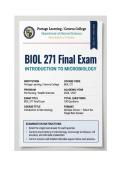
,BIOL 271 Final Exam | Microbiology w/Lab
Q&A | Portage Learning
1. The study of biological processes at the microscopic level is called:
A) Microbiology
B) Macroscopy
C) Molecular biology
D) Ecology
Correct Answer: A) Microbiology
Rationale: Microbiology focuses on organisms and agents too small to be seen
with the naked eye, including bacteria, archaea, fungi, protists, and viruses.
Macroscopy is the opposite; molecular biology studies molecules; ecology
studies organisms and their environments.
2. Which of the following is NOT considered a living microorganism?
A) Bacteria
B) Viruses
C) Fungi
D) Protozoa
Correct Answer: B) Viruses
,Rationale: Viruses lack cellular structure, metabolism, and the ability to
replicate independently. They are acellular and are not classified as living
organisms, although they are included as microbes.
3. The three domains of life include Bacteria, Archaea, and:
A) Eukarya
B) Protista
C) Fungi
D) Animalia
Correct Answer: A) Eukarya
Rationale: The three‑domain system, based on rRNA sequences, classifies all life
into Bacteria, Archaea, and Eukarya. Protista, Fungi, and Animalia are kingdoms
within Eukarya.
4. Prokaryotic cells are characterized by the absence of a:
A) Cell wall
B) Nucleus
C) Plasma membrane
D) Ribosome
Correct Answer: B) Nucleus
, Rationale: Prokaryotes lack a membrane‑bound nucleus; their DNA is in a
nucleoid region. They do have a cell wall, plasma membrane, and ribosomes.
Eukaryotes have a true nucleus.
5. A bacterium with a spherical shape is termed a:
A) Bacillus
B) Coccus
C) Vibrio
D) Spirillum
Correct Answer: B) Coccus
Rationale: Cocci are round; bacilli are rod‑shaped; vibrios are curved rods;
spirilla are spiral. Bacterial shape is an important taxonomic characteristic.
6. Archaea are often called extremophiles because they can:
A) Cause disease
B) Form spores
C) Survive in extreme environments
D) Photosynthesize
Correct Answer: C) Survive in extreme environments
Rationale: Many archaea thrive in high‑salt, high‑temperature, acidic, or
anaerobic conditions that would kill most other organisms.
Q&A | Portage Learning
1. The study of biological processes at the microscopic level is called:
A) Microbiology
B) Macroscopy
C) Molecular biology
D) Ecology
Correct Answer: A) Microbiology
Rationale: Microbiology focuses on organisms and agents too small to be seen
with the naked eye, including bacteria, archaea, fungi, protists, and viruses.
Macroscopy is the opposite; molecular biology studies molecules; ecology
studies organisms and their environments.
2. Which of the following is NOT considered a living microorganism?
A) Bacteria
B) Viruses
C) Fungi
D) Protozoa
Correct Answer: B) Viruses
,Rationale: Viruses lack cellular structure, metabolism, and the ability to
replicate independently. They are acellular and are not classified as living
organisms, although they are included as microbes.
3. The three domains of life include Bacteria, Archaea, and:
A) Eukarya
B) Protista
C) Fungi
D) Animalia
Correct Answer: A) Eukarya
Rationale: The three‑domain system, based on rRNA sequences, classifies all life
into Bacteria, Archaea, and Eukarya. Protista, Fungi, and Animalia are kingdoms
within Eukarya.
4. Prokaryotic cells are characterized by the absence of a:
A) Cell wall
B) Nucleus
C) Plasma membrane
D) Ribosome
Correct Answer: B) Nucleus
, Rationale: Prokaryotes lack a membrane‑bound nucleus; their DNA is in a
nucleoid region. They do have a cell wall, plasma membrane, and ribosomes.
Eukaryotes have a true nucleus.
5. A bacterium with a spherical shape is termed a:
A) Bacillus
B) Coccus
C) Vibrio
D) Spirillum
Correct Answer: B) Coccus
Rationale: Cocci are round; bacilli are rod‑shaped; vibrios are curved rods;
spirilla are spiral. Bacterial shape is an important taxonomic characteristic.
6. Archaea are often called extremophiles because they can:
A) Cause disease
B) Form spores
C) Survive in extreme environments
D) Photosynthesize
Correct Answer: C) Survive in extreme environments
Rationale: Many archaea thrive in high‑salt, high‑temperature, acidic, or
anaerobic conditions that would kill most other organisms.


