

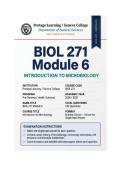
,BIOL 271 Module 6 Exam | Microbiology w/Lab
Q&A | Portage Learning
1. Which of the following is true regarding viruses?
A) They are acellular and obligate intracellular parasites
B) They contain both DNA and RNA
C) They are living prokaryotes
D) They can reproduce independently
Correct Answer: A) They are acellular and obligate intracellular parasites
Rationale: Viruses lack cellular structure; they are not alive and cannot replicate
without a host cell. They possess either DNA or RNA, never both, distinguishing
them from cellular organisms that contain both types of nucleic acid.
2. The protein coat that surrounds the viral genome is called the:
A) Envelope
B) Capsid
C) Nucleus
D) Matrix
Correct Answer: B) Capsid
Rationale: The capsid is the protein shell that protects the viral nucleic acid and
aids in its delivery into host cells. The envelope is a lipid bilayer derived from
the host membrane, present only in some viruses.
,3. A virus that infects bacteria is a:
A) Viroid
B) Prion
C) Bacteriophage
D) Satellite virus
Correct Answer: C) Bacteriophage
Rationale: Bacteriophages (phages) are viruses that specifically infect bacteria,
often consisting of an icosahedral head and a complex tail structure for
attachment and genome injection.
4. The lipid bilayer acquired from the host cell membrane is the:
A) Capsid
B) Nucleocapsid
C) Genome
D) Envelope
Correct Answer: D) Envelope
Rationale: The envelope is a membrane derived from the host cell's plasma
membrane or internal organelle, containing viral glycoproteins. It surrounds the
capsid in enveloped viruses.
5. Which of the following viruses is the largest in size?
, A) Variolavirus
B) Orthomyxovirus
C) Poliovirus
D) Rhinovirus
Correct Answer: A) Variolavirus
Rationale: Variolavirus (smallpox virus) is approximately 200 nm, making it one
of the largest human viruses. Orthomyxovirus (influenza) is 100‑150 nm,
poliovirus is about 30 nm.
6. The correct order of the viral life cycle is:
A) Entry → Attachment → Uncoating → Replication → Assembly → Release
B) Attachment → Entry → Replication → Uncoating → Assembly → Release
C) Attachment → Entry → Uncoating → Replication → Assembly → Release
D) Uncoating → Attachment → Entry → Replication → Assembly → Release
Correct Answer: C) Attachment → Entry → Uncoating → Replication →
Assembly → Release
Rationale: The virus first attaches to host receptors, enters, uncoats its genome,
replicates genetic material and proteins, assembles new virions, and finally
releases them.
7. Regarding the viral life cycle, which statement is true?
A) Genome replication occurs before attachment
Q&A | Portage Learning
1. Which of the following is true regarding viruses?
A) They are acellular and obligate intracellular parasites
B) They contain both DNA and RNA
C) They are living prokaryotes
D) They can reproduce independently
Correct Answer: A) They are acellular and obligate intracellular parasites
Rationale: Viruses lack cellular structure; they are not alive and cannot replicate
without a host cell. They possess either DNA or RNA, never both, distinguishing
them from cellular organisms that contain both types of nucleic acid.
2. The protein coat that surrounds the viral genome is called the:
A) Envelope
B) Capsid
C) Nucleus
D) Matrix
Correct Answer: B) Capsid
Rationale: The capsid is the protein shell that protects the viral nucleic acid and
aids in its delivery into host cells. The envelope is a lipid bilayer derived from
the host membrane, present only in some viruses.
,3. A virus that infects bacteria is a:
A) Viroid
B) Prion
C) Bacteriophage
D) Satellite virus
Correct Answer: C) Bacteriophage
Rationale: Bacteriophages (phages) are viruses that specifically infect bacteria,
often consisting of an icosahedral head and a complex tail structure for
attachment and genome injection.
4. The lipid bilayer acquired from the host cell membrane is the:
A) Capsid
B) Nucleocapsid
C) Genome
D) Envelope
Correct Answer: D) Envelope
Rationale: The envelope is a membrane derived from the host cell's plasma
membrane or internal organelle, containing viral glycoproteins. It surrounds the
capsid in enveloped viruses.
5. Which of the following viruses is the largest in size?
, A) Variolavirus
B) Orthomyxovirus
C) Poliovirus
D) Rhinovirus
Correct Answer: A) Variolavirus
Rationale: Variolavirus (smallpox virus) is approximately 200 nm, making it one
of the largest human viruses. Orthomyxovirus (influenza) is 100‑150 nm,
poliovirus is about 30 nm.
6. The correct order of the viral life cycle is:
A) Entry → Attachment → Uncoating → Replication → Assembly → Release
B) Attachment → Entry → Replication → Uncoating → Assembly → Release
C) Attachment → Entry → Uncoating → Replication → Assembly → Release
D) Uncoating → Attachment → Entry → Replication → Assembly → Release
Correct Answer: C) Attachment → Entry → Uncoating → Replication →
Assembly → Release
Rationale: The virus first attaches to host receptors, enters, uncoats its genome,
replicates genetic material and proteins, assembles new virions, and finally
releases them.
7. Regarding the viral life cycle, which statement is true?
A) Genome replication occurs before attachment


