

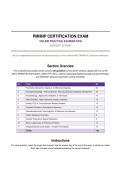
PMHNP CERTIFICATION EXAM
ONLINE PRACTICE EXAMINATION
2026/2027 EDITION
This is an independent practice exam for educational study; it is not an official ANCC PMHNP-BC certification examination.
Section Overview
This comprehensive practice exam contains 150 questions across eleven sections, aligned with the current
ANCC PMHNP-BC test blueprint, DSM-5-TR criteria, evidence-based psychopharmacology and psychotherapy,
and 2026/2027 advanced psychiatric nursing standards.
Sec Topic Qs
1 Psychiatric Assessment, Diagnosis, & Differential Diagnosis 20
2 Psychopharmacology - Pharmacokinetics, Pharmacodynamics, Medication Management 25
3 Psychotherapy - Approaches, Modalities, & Techniques 15
4 Mood Disorders - Major Depressive, Bipolar, & Related 15
5 Anxiety, OCD, & Trauma/Stressor-Related Disorders 15
6 Psychotic Disorders & Schizophrenia Spectrum 12
7 Neurodevelopmental, Neurocognitive, & Substance Use Disorders 12
8 Child & Adolescent Psychiatry 8
9 Geriatric Psychiatry & Special Populations 8
10 Ethics, Legal Issues, & Professional Practice 10
11 Integrated Clinical Case Studies - Complex Presentations 10
TOTAL 150
Instructions
For each question, select the single best answer. Use the answer key at the end of the exam to check your work.
Each item includes a brief rationale explaining the correct response.
, Answer Key Distribution: 38 A · 38 B · 37 C · 37 D
PMHNP Certification Exam - 2026/2027 Practice Page 2
, Section 1: Psychiatric Assessment, Diagnosis, & Differential Diagnosis
Q1: A 45-year-old woman presents with depressed mood and low energy for the past 3 weeks following the death of
her spouse. Which response is most important for the PMHNP to assess first?
A. The exact funeral date
B. Her medication allergies
C. Suicide risk and safety assessment [CORRECT]
D. Her insurance coverage
Correct Answer: C
Rationale: In any patient presenting with depressive symptoms, especially with recent bereavement, suicide risk assessment is
the priority. Other items are important but not the immediate priority.
Q2: The PHQ-9 is a screening tool primarily used to assess:
A. Anxiety symptoms
B. Substance use patterns
C. Psychotic symptoms
D. The severity of depressive symptoms [CORRECT]
Correct Answer: D
Rationale: The PHQ-9 is a 9-item patient questionnaire that screens for and measures the severity of depressive symptoms. The
GAD-7 screens anxiety, and CAGE/AUDIT screen substance use.
Q3: Which of the following best describes the purpose of the mental status exam (MSE)?
A. To determine the patient's blood pressure
B. To assess kidney function
C. To systematically evaluate a patient's cognitive, affective, and behavioral state at the time of the interview
[CORRECT]
D. To measure serum medication levels
Correct Answer: C
Rationale: The MSE is a structured assessment of appearance, behavior, speech, mood, affect, thought process/content,
cognition, insight, and judgment. It is not a physical or laboratory test.
Q4: A patient reports drinking a 'few drinks' daily. Which screening tool is most appropriate to quickly screen for
alcohol misuse?
A. PHQ-9
B. GAD-7
C. CAGE questionnaire [CORRECT]
D. Montreal Cognitive Assessment (MoCA)
Correct Answer: C
Rationale: The CAGE questionnaire is a brief 4-item screen for alcohol misuse. PHQ-9 screens depression, GAD-7 screens
anxiety, and MoCA screens cognition.
Q5: The AUDIT is designed to:
A. Diagnose schizophrenia
B. Screen only for opioid use
C. Assess the severity of alcohol use problems across multiple domains [CORRECT]
D. Measure thyroid function
Correct Answer: C
Rationale: The Alcohol Use Disorders Identification Test (AUDIT) assesses alcohol consumption, drinking behaviors, and
alcohol-related problems. It does not diagnose schizophrenia or measure physical parameters.
Q6: When performing a comprehensive psychiatric evaluation, which of the following is essential to rule out before
attributing symptoms to a primary psychiatric disorder?
A. The patient's favorite color
B. The patient's shoe size
PMHNP Certification Exam - 2026/2027 Practice Page 3
ONLINE PRACTICE EXAMINATION
2026/2027 EDITION
This is an independent practice exam for educational study; it is not an official ANCC PMHNP-BC certification examination.
Section Overview
This comprehensive practice exam contains 150 questions across eleven sections, aligned with the current
ANCC PMHNP-BC test blueprint, DSM-5-TR criteria, evidence-based psychopharmacology and psychotherapy,
and 2026/2027 advanced psychiatric nursing standards.
Sec Topic Qs
1 Psychiatric Assessment, Diagnosis, & Differential Diagnosis 20
2 Psychopharmacology - Pharmacokinetics, Pharmacodynamics, Medication Management 25
3 Psychotherapy - Approaches, Modalities, & Techniques 15
4 Mood Disorders - Major Depressive, Bipolar, & Related 15
5 Anxiety, OCD, & Trauma/Stressor-Related Disorders 15
6 Psychotic Disorders & Schizophrenia Spectrum 12
7 Neurodevelopmental, Neurocognitive, & Substance Use Disorders 12
8 Child & Adolescent Psychiatry 8
9 Geriatric Psychiatry & Special Populations 8
10 Ethics, Legal Issues, & Professional Practice 10
11 Integrated Clinical Case Studies - Complex Presentations 10
TOTAL 150
Instructions
For each question, select the single best answer. Use the answer key at the end of the exam to check your work.
Each item includes a brief rationale explaining the correct response.
, Answer Key Distribution: 38 A · 38 B · 37 C · 37 D
PMHNP Certification Exam - 2026/2027 Practice Page 2
, Section 1: Psychiatric Assessment, Diagnosis, & Differential Diagnosis
Q1: A 45-year-old woman presents with depressed mood and low energy for the past 3 weeks following the death of
her spouse. Which response is most important for the PMHNP to assess first?
A. The exact funeral date
B. Her medication allergies
C. Suicide risk and safety assessment [CORRECT]
D. Her insurance coverage
Correct Answer: C
Rationale: In any patient presenting with depressive symptoms, especially with recent bereavement, suicide risk assessment is
the priority. Other items are important but not the immediate priority.
Q2: The PHQ-9 is a screening tool primarily used to assess:
A. Anxiety symptoms
B. Substance use patterns
C. Psychotic symptoms
D. The severity of depressive symptoms [CORRECT]
Correct Answer: D
Rationale: The PHQ-9 is a 9-item patient questionnaire that screens for and measures the severity of depressive symptoms. The
GAD-7 screens anxiety, and CAGE/AUDIT screen substance use.
Q3: Which of the following best describes the purpose of the mental status exam (MSE)?
A. To determine the patient's blood pressure
B. To assess kidney function
C. To systematically evaluate a patient's cognitive, affective, and behavioral state at the time of the interview
[CORRECT]
D. To measure serum medication levels
Correct Answer: C
Rationale: The MSE is a structured assessment of appearance, behavior, speech, mood, affect, thought process/content,
cognition, insight, and judgment. It is not a physical or laboratory test.
Q4: A patient reports drinking a 'few drinks' daily. Which screening tool is most appropriate to quickly screen for
alcohol misuse?
A. PHQ-9
B. GAD-7
C. CAGE questionnaire [CORRECT]
D. Montreal Cognitive Assessment (MoCA)
Correct Answer: C
Rationale: The CAGE questionnaire is a brief 4-item screen for alcohol misuse. PHQ-9 screens depression, GAD-7 screens
anxiety, and MoCA screens cognition.
Q5: The AUDIT is designed to:
A. Diagnose schizophrenia
B. Screen only for opioid use
C. Assess the severity of alcohol use problems across multiple domains [CORRECT]
D. Measure thyroid function
Correct Answer: C
Rationale: The Alcohol Use Disorders Identification Test (AUDIT) assesses alcohol consumption, drinking behaviors, and
alcohol-related problems. It does not diagnose schizophrenia or measure physical parameters.
Q6: When performing a comprehensive psychiatric evaluation, which of the following is essential to rule out before
attributing symptoms to a primary psychiatric disorder?
A. The patient's favorite color
B. The patient's shoe size
PMHNP Certification Exam - 2026/2027 Practice Page 3


