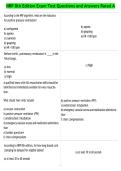
NRP 8th Edition Exam Test Questions and Answers Rated A
According to the NRP algorithm, what are the indicators
for positive pressure ventilation?
b) apnea
a) tachypnea
d) gasping
b) apnea
e) HR <100 bpm
c) cyanosis
d) gasping
e) HR <100 bpm
Before birth, pulmonary resistance is in the
fetal lungs.
c) high
a) low
b) normal
c) high
A qualified team with full resuscitation skills should be
identified and immediately available for every resuscita-
tion.
What should their skills include? b) positive pressure ventilation (PPV)
c) endotracheal intubation
a) vacuum extraction d) emergency vascular access and medication administra-
b) positive pressure ventilation (PPV) tion
c) endotracheal intubation f) chest compressions
d) emergency vascular access and medication administra-
tion
e) lumbar puncture
f) chest compressions
According to NRP 8th edition, for how long should cord
clamping be delayed for eligible babies?
a) at least 30 to 60 seconds
a) at least 30 to 60 seconds
1/6
, NRP 8th Edition Exam Test Questions and Answers Rated A
b) at least 15 to 30 seconds
c) at least 2 minutes
d) at least 5 minutes
During initial steps, if the baby is weeks gestation,
do not dry the baby.
a) less than 32
a) less than 32
b) more than 34
c) 36
When the baby stays with the mother for initial steps
after birth, what should be monitored to determine if
additional interventions are required?
a) temperature
b) breathing
a) temperature
d) color
b) breathing
e) tone and activity
c) blood pressure
d) color
e) tone and activity
When providing PPV, what is the correct ventilation rate?
a) 80-100 breaths/min
b) 40-60 breaths/min
b) 40-60 breaths/min
c) 60-80 breaths/min
d) 20-30 breaths/min
It can be diflcult to deliver PEEP (positive end-expiratory
pressure) with a self-inflating bag. A T-piece resuscitator
delivers consistent inspiratory pressure and PEEP. a) removes fluid
b) prevents air spaces from collapsing during exhalation
What does PEEP help achieve? d) stable lung inflation
a) removes fluid
2/6
According to the NRP algorithm, what are the indicators
for positive pressure ventilation?
b) apnea
a) tachypnea
d) gasping
b) apnea
e) HR <100 bpm
c) cyanosis
d) gasping
e) HR <100 bpm
Before birth, pulmonary resistance is in the
fetal lungs.
c) high
a) low
b) normal
c) high
A qualified team with full resuscitation skills should be
identified and immediately available for every resuscita-
tion.
What should their skills include? b) positive pressure ventilation (PPV)
c) endotracheal intubation
a) vacuum extraction d) emergency vascular access and medication administra-
b) positive pressure ventilation (PPV) tion
c) endotracheal intubation f) chest compressions
d) emergency vascular access and medication administra-
tion
e) lumbar puncture
f) chest compressions
According to NRP 8th edition, for how long should cord
clamping be delayed for eligible babies?
a) at least 30 to 60 seconds
a) at least 30 to 60 seconds
1/6
, NRP 8th Edition Exam Test Questions and Answers Rated A
b) at least 15 to 30 seconds
c) at least 2 minutes
d) at least 5 minutes
During initial steps, if the baby is weeks gestation,
do not dry the baby.
a) less than 32
a) less than 32
b) more than 34
c) 36
When the baby stays with the mother for initial steps
after birth, what should be monitored to determine if
additional interventions are required?
a) temperature
b) breathing
a) temperature
d) color
b) breathing
e) tone and activity
c) blood pressure
d) color
e) tone and activity
When providing PPV, what is the correct ventilation rate?
a) 80-100 breaths/min
b) 40-60 breaths/min
b) 40-60 breaths/min
c) 60-80 breaths/min
d) 20-30 breaths/min
It can be diflcult to deliver PEEP (positive end-expiratory
pressure) with a self-inflating bag. A T-piece resuscitator
delivers consistent inspiratory pressure and PEEP. a) removes fluid
b) prevents air spaces from collapsing during exhalation
What does PEEP help achieve? d) stable lung inflation
a) removes fluid
2/6