

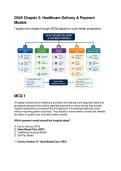
D545 Chapter 2: Healthcare Delivery & Payment
Models
I explain this chapter through MCQs based for exam better preparation
MCQ 1
A hospital notices that its healthcare providers are ordering more diagnostic tests and
procedures because they receive separate payments for every service they provide.
Hospital leadership is concerned that this approach is increasing healthcare costs
without improving patient outcomes. They decide to move toward a model that rewards
providers for quality care and better patient results.
Which payment model should the hospital adopt?
A. Fee-for-Service (FFS)
B. Value-Based Care (VBC)
C. Traditional Insurance Model
D. Self-Pay Model
✅ Correct Answer: B. Value-Based Care (VBC)
,Explanation:
The situation describes a problem with the Fee-for-Service model, where providers are
paid based on the number of services they deliver. This can sometimes encourage
unnecessary tests or procedures because more services mean more payment.
Value-Based Care (VBC) solves this issue by changing the focus from quantity to
quality. Under this model, healthcare providers are rewarded for:
Improving patient health outcomes
Providing safe and effective care
Reducing unnecessary healthcare costs
Increasing patient satisfaction
The main goal is not to provide more services, but to provide better healthcare
results.
Why other options are incorrect:
Fee-for-Service: Pays for each service separately and focuses on volume.
Traditional Insurance Model: Describes how insurance works, not a quality-
based payment approach.
Self-Pay Model: Patient pays directly and does not relate to quality incentives.
MCQ 2
A group of physicians participates in a healthcare program. They successfully reduce
unnecessary hospital admissions while maintaining high-quality patient care. Because
they lowered costs and improved efficiency, the healthcare organization gives them a
portion of the money saved.
Which payment approach is being used?
A. Fee-for-Service
B. Shared Savings Program
C. Patient-Centered Care
D. Capitation
✅ Correct Answer: B. Shared Savings Program
Explanation:
Shared Savings is a payment model designed to encourage healthcare providers to
control costs while maintaining or improving quality.
, In this situation:
Physicians reduced unnecessary admissions.
Patient care quality remained high.
Healthcare spending decreased.
Providers received part of the savings.
This creates an incentive for organizations to provide efficient and effective care.
Why other options are incorrect:
Fee-for-Service: Rewards more services, not cost reduction.
Patient-Centered Care: Focuses on patient involvement, not financial savings.
Capitation: Pays a fixed amount per patient and is a different payment method.
MCQ 3
A doctor is treating a patient with diabetes. Instead of deciding the treatment plan alone,
the doctor explains different options, discusses benefits and risks, and asks the patient
which option fits their lifestyle and personal goals.
Which healthcare approach is demonstrated in this situation?
A. Fee-for-Service
B. Patient-Centered Care
C. Volume-Based Care
D. Shared Savings
✅ Correct Answer: B. Patient-Centered Care
Explanation:
Patient-Centered Care focuses on involving patients in their own healthcare decisions.
The healthcare provider considers:
Patient preferences
Personal values
Lifestyle needs
Individual health goals
The patient becomes an active partner instead of only receiving instructions from the
provider.
Why other options are incorrect:
Models
I explain this chapter through MCQs based for exam better preparation
MCQ 1
A hospital notices that its healthcare providers are ordering more diagnostic tests and
procedures because they receive separate payments for every service they provide.
Hospital leadership is concerned that this approach is increasing healthcare costs
without improving patient outcomes. They decide to move toward a model that rewards
providers for quality care and better patient results.
Which payment model should the hospital adopt?
A. Fee-for-Service (FFS)
B. Value-Based Care (VBC)
C. Traditional Insurance Model
D. Self-Pay Model
✅ Correct Answer: B. Value-Based Care (VBC)
,Explanation:
The situation describes a problem with the Fee-for-Service model, where providers are
paid based on the number of services they deliver. This can sometimes encourage
unnecessary tests or procedures because more services mean more payment.
Value-Based Care (VBC) solves this issue by changing the focus from quantity to
quality. Under this model, healthcare providers are rewarded for:
Improving patient health outcomes
Providing safe and effective care
Reducing unnecessary healthcare costs
Increasing patient satisfaction
The main goal is not to provide more services, but to provide better healthcare
results.
Why other options are incorrect:
Fee-for-Service: Pays for each service separately and focuses on volume.
Traditional Insurance Model: Describes how insurance works, not a quality-
based payment approach.
Self-Pay Model: Patient pays directly and does not relate to quality incentives.
MCQ 2
A group of physicians participates in a healthcare program. They successfully reduce
unnecessary hospital admissions while maintaining high-quality patient care. Because
they lowered costs and improved efficiency, the healthcare organization gives them a
portion of the money saved.
Which payment approach is being used?
A. Fee-for-Service
B. Shared Savings Program
C. Patient-Centered Care
D. Capitation
✅ Correct Answer: B. Shared Savings Program
Explanation:
Shared Savings is a payment model designed to encourage healthcare providers to
control costs while maintaining or improving quality.
, In this situation:
Physicians reduced unnecessary admissions.
Patient care quality remained high.
Healthcare spending decreased.
Providers received part of the savings.
This creates an incentive for organizations to provide efficient and effective care.
Why other options are incorrect:
Fee-for-Service: Rewards more services, not cost reduction.
Patient-Centered Care: Focuses on patient involvement, not financial savings.
Capitation: Pays a fixed amount per patient and is a different payment method.
MCQ 3
A doctor is treating a patient with diabetes. Instead of deciding the treatment plan alone,
the doctor explains different options, discusses benefits and risks, and asks the patient
which option fits their lifestyle and personal goals.
Which healthcare approach is demonstrated in this situation?
A. Fee-for-Service
B. Patient-Centered Care
C. Volume-Based Care
D. Shared Savings
✅ Correct Answer: B. Patient-Centered Care
Explanation:
Patient-Centered Care focuses on involving patients in their own healthcare decisions.
The healthcare provider considers:
Patient preferences
Personal values
Lifestyle needs
Individual health goals
The patient becomes an active partner instead of only receiving instructions from the
provider.
Why other options are incorrect:


