

Comprehensive Illinois Insurance Licensing and Policy Content
Study online at https://quizlet.com/_jqvsi7
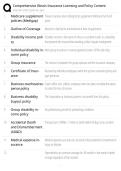
1. Medicare supplement Private insurance plans designed to supplement Medicare Part A & B
policies (Medigap) plans.
2. Outline of Coverage Must be in bold print and delivered at time of application.
3. Disability income poli- Provides income in the event an illness or accident results in a disability
cy that prevents the insured from working at their regular employment.
4. Individual disability in- Most group insurance is nonoccupational (covers off the job only).
come policy
5. Group insurance The contract is between the group sponsor and the insurance company.
6. Certificate of Insur- Received by individual employees while the sponsor maintains policy and
ance pays premium.
7. Business overhead ex- Covers office rent, utilities, employee labor but does not allow the owner
pense policy to collect for loss of income.
8. Business disability The Corporation or business partners can benefit from this policy.
buyout policy
9. Group disability in- No probationary period for preexisting conditions.
come policy
10. Accidental Death Principal sum (100%) = 2 limbs or death within 90 days of an accident.
and Dismemberment
(AD&D)
11. Medical expense in- Medical expenses are any costs incurred in the prevention or treatment of
surance injury or disease.
12. Dependents can continue coverage for 36 months in the event of death
or legal separation of the insured.
, Comprehensive Illinois Insurance Licensing and Policy Content
Study online at https://quizlet.com/_jqvsi7
Basic hospital, med-
ical, and surgical poli-
cies
13. Long Term Care (LTC) Covers events expected to last 12 months, including diagnostic, preven-
tive, therapeutic, and rehabilitative services.
14. Dental insurance Not designed to provide coverage for catastrophic losses and has no
deductible 'First Dollar' coverage.
15. Major medical policies Cover catastrophic and prolonged injury or illness with high maximum
limits.
16. Cancer plans Cover experimental treatments that traditional insurance excludes.
17. Critical illness or spec- Benefits are payable similar to a cancer policy but are designated for a
ified disease policy major illness or specified disease.
18. Family Deductible A maximum of 2 - 3 deductibles will satisfy the deductible requirement for
the entire family per calendar year.
19. Health Maintenance Subscribers must live within the service area and primary care physicians
Organizations (HMOs) act as gatekeepers.
20. Preferred Provider Or- Pays directly to the insured a specified dollar amount per day without
ganizations (PPOs) regard to the actual medical expenses incurred.
21. Point of Service (POS) Combine PPO and HMO benefits into the same plan.
plans
22. Flexible Spending Ac- Contributions are 'use it or lose it' and self-employed people are not
counts (FSAs) eligible.
23. Related to Health Savings Accounts.
Study online at https://quizlet.com/_jqvsi7
1. Medicare supplement Private insurance plans designed to supplement Medicare Part A & B
policies (Medigap) plans.
2. Outline of Coverage Must be in bold print and delivered at time of application.
3. Disability income poli- Provides income in the event an illness or accident results in a disability
cy that prevents the insured from working at their regular employment.
4. Individual disability in- Most group insurance is nonoccupational (covers off the job only).
come policy
5. Group insurance The contract is between the group sponsor and the insurance company.
6. Certificate of Insur- Received by individual employees while the sponsor maintains policy and
ance pays premium.
7. Business overhead ex- Covers office rent, utilities, employee labor but does not allow the owner
pense policy to collect for loss of income.
8. Business disability The Corporation or business partners can benefit from this policy.
buyout policy
9. Group disability in- No probationary period for preexisting conditions.
come policy
10. Accidental Death Principal sum (100%) = 2 limbs or death within 90 days of an accident.
and Dismemberment
(AD&D)
11. Medical expense in- Medical expenses are any costs incurred in the prevention or treatment of
surance injury or disease.
12. Dependents can continue coverage for 36 months in the event of death
or legal separation of the insured.
, Comprehensive Illinois Insurance Licensing and Policy Content
Study online at https://quizlet.com/_jqvsi7
Basic hospital, med-
ical, and surgical poli-
cies
13. Long Term Care (LTC) Covers events expected to last 12 months, including diagnostic, preven-
tive, therapeutic, and rehabilitative services.
14. Dental insurance Not designed to provide coverage for catastrophic losses and has no
deductible 'First Dollar' coverage.
15. Major medical policies Cover catastrophic and prolonged injury or illness with high maximum
limits.
16. Cancer plans Cover experimental treatments that traditional insurance excludes.
17. Critical illness or spec- Benefits are payable similar to a cancer policy but are designated for a
ified disease policy major illness or specified disease.
18. Family Deductible A maximum of 2 - 3 deductibles will satisfy the deductible requirement for
the entire family per calendar year.
19. Health Maintenance Subscribers must live within the service area and primary care physicians
Organizations (HMOs) act as gatekeepers.
20. Preferred Provider Or- Pays directly to the insured a specified dollar amount per day without
ganizations (PPOs) regard to the actual medical expenses incurred.
21. Point of Service (POS) Combine PPO and HMO benefits into the same plan.
plans
22. Flexible Spending Ac- Contributions are 'use it or lose it' and self-employed people are not
counts (FSAs) eligible.
23. Related to Health Savings Accounts.


