

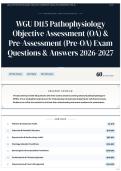
WGU D115 PATHOPHYSIOLOGY OBJECTIVE ASSESSMENT (OA) & PRE-ASSESSMENT (PRE-O… EXAM
P R O F E S S I O N A L P R A C T I C E M AT E R I A L S
WGU D115 Pathophysiology
Objective Assessment (OA) &
Pre-Assessment (Pre-OA) Exam
Questions & Answers 2026-2027
Verified Answers Exam Ready With Rationales
60 QUESTIONS
DOCUMENT OVERVIEW
This document provides 60 questions with their correct answers covering advanced pathophysiology for
APRNs. It is an invaluable study resource for reviewing key concepts and preparing for certification exams.
Students can utilize this material to reinforce their understanding and ensure readiness for assessments.
CONTENTS
01 Pediatric & Adolescent Health Q1–Q18
02 Endocrine & Metabolic Disorders Q19–Q26
03 Reproductive & Genitourinary Health Q27–Q31
04 Oncology & Genetic Conditions Q32–Q35
05 Neurological & Musculoskeletal Conditions Q36–Q42
06 Cardiovascular & Pulmonary Systems Q43–Q53
07 Integumentary & Trauma Management Q54–Q59
Page 1
, 08 Gastrointestinal & Renal Issues Q60–Q60
E XA M Q U EST I O N S
Q1 QUESTION 1 OF 60
An advanced practice registered nurse (APRN) is consulting with a teen patient who has recently learned that she is
pregnant. The APRN knows that a certain medication taken by the patient can contribute to the development of congenital
malformations in the fetus. The APRN reviews the patient's current medication list and finds one medication that is a
concern.
Which medication is the APRN concerned about?
CORRECT ANSWER
Retinoic acid
Q2 QUESTION 2 OF 60
A newborn's screening for cystic fibrosis is positive. An advanced practice registered nurse (APRN) is reviewing screening
results and taking a comprehensive genetic screening of the parents. The APRN asks the parents questions to help
determine the transmission of this disease.
Which question should the APRN ask?
CORRECT ANSWER
"Are you both the genetic donor parents?"
Q3 QUESTION 3 OF 60
A 30-day-old infant presents to the emergency room with decreased oral intake, decreased urine output, and a fever of
101.8. The infant is admitted for further evaluation with a workup to include a blood culture, a urine culture, a spinal tap, and
a chest X-ray.
Which issue of innate immunity, as it relates to neonates, is of concern?
CORRECT ANSWER
Relative deficiency of factor B
Q4 QUESTION 4 OF 60
A 12-year-old African American patient presents with unilateral eye swelling and lower lip swelling. The patient's parent
reports that the swelling is spontaneous and resolves over several days. The patient does not have complaints of fever,
hives, or vomiting. Serum lab results show hyperactivation of three plasma protein systems. The APRN suspects hereditary
Page 2
, angioedema.
What is the cause of the genetic defect suspected in this situation?
CORRECT ANSWER
C1 esterase inhibitor
Q5 QUESTION 5 OF 60
The parent of a child diagnosed with Down syndrome expresses concerns about the child's recurrent respiratory tract
infections to an advanced practice registered nurse (APRN). The infections have occurred regularly since birth.
What should the APRN tell the parent is the underlying cause of this illness?
CORRECT ANSWER
Gastroesophageal reflux disease causes aspiration of thin fluids.
Q6 QUESTION 6 OF 60
A child presents to a clinic with a white pupillary reflex noted in the right eye. The child is constantly crying and rubbing her
eyes. An advanced practice registered nurse (APRN) performs a complete ophthalmologic examination and orders several
diagnostic tests. Based on the findings, a diagnosis of retinoblastoma is confirmed.
What is the pathological mechanism of this disorder?
CORRECT ANSWER
Mutations of a gene on chromosome 13q14 lead to neoplastic proliferation of cells
Q7 QUESTION 7 OF 60
An advanced practice registered nurse (APRN) is examining an adolescent patient who describes hearing voices telling her
to gather weapons because the government is trying to control her. The patient also describes feelings of happiness related
to a tragic personal event.
What is the probable diagnosis?
CORRECT ANSWER
Schizophrenia
Q8 QUESTION 8 OF 60
An advanced practice registered nurse (APRN) is caring for a patient complaining of pelvic pain. Assessment findings
include a fever of 39°C (102.2° F), vaginal discharge, low bilateral abdominal pain that is dull and steady that developed
Page 3
P R O F E S S I O N A L P R A C T I C E M AT E R I A L S
WGU D115 Pathophysiology
Objective Assessment (OA) &
Pre-Assessment (Pre-OA) Exam
Questions & Answers 2026-2027
Verified Answers Exam Ready With Rationales
60 QUESTIONS
DOCUMENT OVERVIEW
This document provides 60 questions with their correct answers covering advanced pathophysiology for
APRNs. It is an invaluable study resource for reviewing key concepts and preparing for certification exams.
Students can utilize this material to reinforce their understanding and ensure readiness for assessments.
CONTENTS
01 Pediatric & Adolescent Health Q1–Q18
02 Endocrine & Metabolic Disorders Q19–Q26
03 Reproductive & Genitourinary Health Q27–Q31
04 Oncology & Genetic Conditions Q32–Q35
05 Neurological & Musculoskeletal Conditions Q36–Q42
06 Cardiovascular & Pulmonary Systems Q43–Q53
07 Integumentary & Trauma Management Q54–Q59
Page 1
, 08 Gastrointestinal & Renal Issues Q60–Q60
E XA M Q U EST I O N S
Q1 QUESTION 1 OF 60
An advanced practice registered nurse (APRN) is consulting with a teen patient who has recently learned that she is
pregnant. The APRN knows that a certain medication taken by the patient can contribute to the development of congenital
malformations in the fetus. The APRN reviews the patient's current medication list and finds one medication that is a
concern.
Which medication is the APRN concerned about?
CORRECT ANSWER
Retinoic acid
Q2 QUESTION 2 OF 60
A newborn's screening for cystic fibrosis is positive. An advanced practice registered nurse (APRN) is reviewing screening
results and taking a comprehensive genetic screening of the parents. The APRN asks the parents questions to help
determine the transmission of this disease.
Which question should the APRN ask?
CORRECT ANSWER
"Are you both the genetic donor parents?"
Q3 QUESTION 3 OF 60
A 30-day-old infant presents to the emergency room with decreased oral intake, decreased urine output, and a fever of
101.8. The infant is admitted for further evaluation with a workup to include a blood culture, a urine culture, a spinal tap, and
a chest X-ray.
Which issue of innate immunity, as it relates to neonates, is of concern?
CORRECT ANSWER
Relative deficiency of factor B
Q4 QUESTION 4 OF 60
A 12-year-old African American patient presents with unilateral eye swelling and lower lip swelling. The patient's parent
reports that the swelling is spontaneous and resolves over several days. The patient does not have complaints of fever,
hives, or vomiting. Serum lab results show hyperactivation of three plasma protein systems. The APRN suspects hereditary
Page 2
, angioedema.
What is the cause of the genetic defect suspected in this situation?
CORRECT ANSWER
C1 esterase inhibitor
Q5 QUESTION 5 OF 60
The parent of a child diagnosed with Down syndrome expresses concerns about the child's recurrent respiratory tract
infections to an advanced practice registered nurse (APRN). The infections have occurred regularly since birth.
What should the APRN tell the parent is the underlying cause of this illness?
CORRECT ANSWER
Gastroesophageal reflux disease causes aspiration of thin fluids.
Q6 QUESTION 6 OF 60
A child presents to a clinic with a white pupillary reflex noted in the right eye. The child is constantly crying and rubbing her
eyes. An advanced practice registered nurse (APRN) performs a complete ophthalmologic examination and orders several
diagnostic tests. Based on the findings, a diagnosis of retinoblastoma is confirmed.
What is the pathological mechanism of this disorder?
CORRECT ANSWER
Mutations of a gene on chromosome 13q14 lead to neoplastic proliferation of cells
Q7 QUESTION 7 OF 60
An advanced practice registered nurse (APRN) is examining an adolescent patient who describes hearing voices telling her
to gather weapons because the government is trying to control her. The patient also describes feelings of happiness related
to a tragic personal event.
What is the probable diagnosis?
CORRECT ANSWER
Schizophrenia
Q8 QUESTION 8 OF 60
An advanced practice registered nurse (APRN) is caring for a patient complaining of pelvic pain. Assessment findings
include a fever of 39°C (102.2° F), vaginal discharge, low bilateral abdominal pain that is dull and steady that developed
Page 3


