

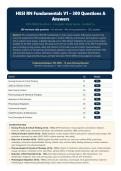
HESI RN Fundamentals V1 – 300 Questions &
Answers
With NGN Questions – Complete Study Guide – Graded A+
300 real exam-style questions · Full rationales · Why wrong explanations · 2026 updated
Abstract: This comprehensive HESI RN Fundamentals V1 Exam review contains 300 practice questions that
mirror the actual Evolve HESI Fundamentals exam in content, difficulty, and structure. Each question is paired
with a verified correct answer, a detailed rationale, and a "Why Wrong" breakdown for every incorrect option.
Updated for the 2026 academic year, this guide covers all core content areas tested on the HESI Fundamentals
exam, including nursing process, safety and infection control, basic care and comfort, pharmacological
therapies, reduction of risk potential, physiological adaptation, psychosocial integrity, health promotion, fluid
and electrolyte balance, nutrition, elimination, mobility, hygiene, vital signs, medication administration,
documentation, legal and ethical issues, and Next Generation NCLEX (NGN) clinical judgment concepts.
FundamentalsExpert, RN, MSN – 15 years Nursing Educator
HESI RN Fundamentals V1: 100% | Verified: 2026 Academic Year
Section Qs Weight
Nursing Process & Critical Thinking 35 12%
Safety & Infection Control 35 12%
Basic Care & Comfort 40 13%
Pharmacological & Parenteral Therapies 35 12%
Reduction of Risk Potential 30 10%
Physiological Adaptation 40 13%
Psychosocial Integrity 30 10%
Health Promotion & Maintenance 25 8%
Fluid, Electrolyte & Nutrition 30 10%
Content Overview
Nursing Process & Critical Thinking (35 Qs - 12%): ADPIE framework, clinical judgment, prioritization, Maslow's
hierarchy, SMART goals, assessment techniques, documentation standards, SBAR communication.
Safety & Infection Control (35 Qs - 12%): Standard, contact, droplet, airborne precautions; medical/surgical asepsis; falls
prevention; restraints; fire safety (RACE, PASS); incident reporting; client safety.
Basic Care & Comfort (40 Qs - 13%): Hygiene (bed bath, perineal care, oral care), mobility (ROM, positioning,
ambulation), elimination (bowel/bladder training, catheter care), nutrition (diets, feeding assistance), comfort measures,
pain management (non-pharmacological).
Pharmacological & Parenteral Therapies (35 Qs - 12%): 6 Rights of medication administration, routes of administration,
dosage calculation, medication errors, side effects, adverse effects, IV therapy, blood transfusion, high-alert medications.
Reduction of Risk Potential (30 Qs - 10%): Electrolyte imbalances, acid-base balance, ABG interpretation, risk
identification, diagnostic tests, early warning signs, post-op complications, fall risk, DVT prevention.
Physiological Adaptation (40 Qs - 13%): Cardiovascular, respiratory, neurological, renal, gastrointestinal, endocrine,
hematological, integumentary pathophysiology; shock; sepsis; wound healing; pressure injuries.
, Psychosocial Integrity (30 Qs - 10%): Therapeutic communication, grief and loss, stress and coping, anxiety, depression,
suicidal ideation, dementia, schizophrenia, substance abuse, family dynamics, cultural competence.
Health Promotion & Maintenance (25 Qs - 8%): Growth and development, immunizations, screening, health education,
nutrition, prenatal care, well-baby care, lifestyle modifications, disease prevention.
Fluid, Electrolyte & Nutrition (30 Qs - 10%): Fluid balance, dehydration, overhydration, electrolytes (sodium, potassium),
nutrition assessment, therapeutic diets, enteral nutrition, NPO status, dietary modifications.
Nursing Process & Critical Thinking (35 questions)
Q1. A nurse is caring for a client who is 2 days post-operative and reports severe pain despite
receiving pain medication. Which step of the nursing process is the nurse using when deciding to
assess the client's pain level and consider alternative interventions?
A Assessment
B Diagnosis
C Planning
D Implementation
E Evaluation
Correct answer: A. Assessment
Rationale: The nurse is reassessing the client's pain to gather new data. Assessment is the first and ongoing step of
the nursing process.
Why wrong:
B: Diagnosis identifies problems.
C: Planning develops interventions.
D: Implementation carries out interventions.
E: Evaluation determines if goals were met.
Reference: HESI Fundamentals V1 · Evolve HESI · Potter & Perry · ATI Fundamentals · NGN.
Q2. A nurse notes that a client's wound is not healing as expected. The nurse reviews the care plan
and decides to change the wound care approach. Which phase of the nursing process is the nurse
implementing?
A Assessment
B Diagnosis
C Planning
D Implementation
E Evaluation
Correct answer: C. Planning
Rationale: Planning is the phase where the nurse determines interventions to achieve client outcomes. Changing
the wound care approach involves developing a new plan.
Why wrong:
A: Assessment collects data.
B: Diagnosis identifies problems.
D: Implementation carries out interventions.
E: Evaluation determines if interventions are effective.
Reference: HESI Fundamentals V1 · Evolve HESI · Potter & Perry · ATI Fundamentals · NGN.
,Q3. A nurse observes that a client's blood pressure has decreased from 140/90 to 110/70. The nurse
documents this finding and continues to monitor. This is an example of which phase of the nursing
process?
A Assessment
B Diagnosis
C Planning
D Implementation
E Evaluation
Correct answer: A. Assessment
Rationale: Assessment involves collecting, organizing, and documenting data. Observing the blood pressure
change is ongoing data collection.
Why wrong:
B: Diagnosis interprets data.
C: Planning develops interventions.
D: Implementation carries out interventions.
E: Evaluation determines if goals were met.
Reference: HESI Fundamentals V1 · Evolve HESI · Potter & Perry · ATI Fundamentals · NGN.
Q4. A nurse is prioritizing care for four clients. Which client should the nurse assess first?
A Client with diabetes needing insulin
B Client post-op day 3 with temp 99.2°F
C Client with new onset confusion and bounding pulse
D Client with colostomy pouch change
E Client requesting pain medication
Correct answer: C. Client with new onset confusion and bounding pulse
Rationale: New onset confusion with bounding pulse indicates a potential change in neurological or
cardiovascular status, which is life-threatening.
Why wrong:
A: Insulin is important but not priority.
B: Low-grade fever is expected post-op.
D: Colostomy change can wait.
E: Pain medication is important but not priority over a change in status.
Reference: HESI Fundamentals V1 · Evolve HESI · Potter & Perry · ATI Fundamentals · NGN.
, Q5. A nurse is developing a care plan for a client with impaired mobility. Which goal is written
correctly using SMART criteria?
A The client will walk
B The client will ambulate without assistance within 3 days
C The client will ambulate 50 feet with a walker by discharge
D The client will not fall
E The client will walk 100 feet with minimal assistance within 48 hours
Correct answer: E. The client will walk 100 feet with minimal assistance within 48 hours
Rationale: SMART goals are Specific, Measurable, Achievable, Relevant, and Time-bound. "Walk 100 feet with
minimal assistance within 48 hours" meets all criteria.
Why wrong:
A: Not specific or measurable.
B: Not specific or measurable.
C: Not time-bound.
D: Not specific or measurable.
Reference: HESI Fundamentals V1 · Evolve HESI · Potter & Perry · ATI Fundamentals · NGN.
Q6. A nurse is using the nursing process to care for a client. Which action demonstrates the
"Implementation" phase?
A Assessing pain level
B Administering prescribed pain medication
C Identifying problem as acute pain
D Creating goal of reducing pain to 3/10
E Evaluating pain level after medication
Correct answer: B. Administering prescribed pain medication
Rationale: Implementation is the phase where the nurse carries out the planned interventions.
Why wrong:
A: Assessment collects data.
C: Diagnosis identifies problems.
D: Planning creates goals.
E: Evaluation determines if goals were met.
Reference: HESI Fundamentals V1 · Evolve HESI · Potter & Perry · ATI Fundamentals · NGN.
Answers
With NGN Questions – Complete Study Guide – Graded A+
300 real exam-style questions · Full rationales · Why wrong explanations · 2026 updated
Abstract: This comprehensive HESI RN Fundamentals V1 Exam review contains 300 practice questions that
mirror the actual Evolve HESI Fundamentals exam in content, difficulty, and structure. Each question is paired
with a verified correct answer, a detailed rationale, and a "Why Wrong" breakdown for every incorrect option.
Updated for the 2026 academic year, this guide covers all core content areas tested on the HESI Fundamentals
exam, including nursing process, safety and infection control, basic care and comfort, pharmacological
therapies, reduction of risk potential, physiological adaptation, psychosocial integrity, health promotion, fluid
and electrolyte balance, nutrition, elimination, mobility, hygiene, vital signs, medication administration,
documentation, legal and ethical issues, and Next Generation NCLEX (NGN) clinical judgment concepts.
FundamentalsExpert, RN, MSN – 15 years Nursing Educator
HESI RN Fundamentals V1: 100% | Verified: 2026 Academic Year
Section Qs Weight
Nursing Process & Critical Thinking 35 12%
Safety & Infection Control 35 12%
Basic Care & Comfort 40 13%
Pharmacological & Parenteral Therapies 35 12%
Reduction of Risk Potential 30 10%
Physiological Adaptation 40 13%
Psychosocial Integrity 30 10%
Health Promotion & Maintenance 25 8%
Fluid, Electrolyte & Nutrition 30 10%
Content Overview
Nursing Process & Critical Thinking (35 Qs - 12%): ADPIE framework, clinical judgment, prioritization, Maslow's
hierarchy, SMART goals, assessment techniques, documentation standards, SBAR communication.
Safety & Infection Control (35 Qs - 12%): Standard, contact, droplet, airborne precautions; medical/surgical asepsis; falls
prevention; restraints; fire safety (RACE, PASS); incident reporting; client safety.
Basic Care & Comfort (40 Qs - 13%): Hygiene (bed bath, perineal care, oral care), mobility (ROM, positioning,
ambulation), elimination (bowel/bladder training, catheter care), nutrition (diets, feeding assistance), comfort measures,
pain management (non-pharmacological).
Pharmacological & Parenteral Therapies (35 Qs - 12%): 6 Rights of medication administration, routes of administration,
dosage calculation, medication errors, side effects, adverse effects, IV therapy, blood transfusion, high-alert medications.
Reduction of Risk Potential (30 Qs - 10%): Electrolyte imbalances, acid-base balance, ABG interpretation, risk
identification, diagnostic tests, early warning signs, post-op complications, fall risk, DVT prevention.
Physiological Adaptation (40 Qs - 13%): Cardiovascular, respiratory, neurological, renal, gastrointestinal, endocrine,
hematological, integumentary pathophysiology; shock; sepsis; wound healing; pressure injuries.
, Psychosocial Integrity (30 Qs - 10%): Therapeutic communication, grief and loss, stress and coping, anxiety, depression,
suicidal ideation, dementia, schizophrenia, substance abuse, family dynamics, cultural competence.
Health Promotion & Maintenance (25 Qs - 8%): Growth and development, immunizations, screening, health education,
nutrition, prenatal care, well-baby care, lifestyle modifications, disease prevention.
Fluid, Electrolyte & Nutrition (30 Qs - 10%): Fluid balance, dehydration, overhydration, electrolytes (sodium, potassium),
nutrition assessment, therapeutic diets, enteral nutrition, NPO status, dietary modifications.
Nursing Process & Critical Thinking (35 questions)
Q1. A nurse is caring for a client who is 2 days post-operative and reports severe pain despite
receiving pain medication. Which step of the nursing process is the nurse using when deciding to
assess the client's pain level and consider alternative interventions?
A Assessment
B Diagnosis
C Planning
D Implementation
E Evaluation
Correct answer: A. Assessment
Rationale: The nurse is reassessing the client's pain to gather new data. Assessment is the first and ongoing step of
the nursing process.
Why wrong:
B: Diagnosis identifies problems.
C: Planning develops interventions.
D: Implementation carries out interventions.
E: Evaluation determines if goals were met.
Reference: HESI Fundamentals V1 · Evolve HESI · Potter & Perry · ATI Fundamentals · NGN.
Q2. A nurse notes that a client's wound is not healing as expected. The nurse reviews the care plan
and decides to change the wound care approach. Which phase of the nursing process is the nurse
implementing?
A Assessment
B Diagnosis
C Planning
D Implementation
E Evaluation
Correct answer: C. Planning
Rationale: Planning is the phase where the nurse determines interventions to achieve client outcomes. Changing
the wound care approach involves developing a new plan.
Why wrong:
A: Assessment collects data.
B: Diagnosis identifies problems.
D: Implementation carries out interventions.
E: Evaluation determines if interventions are effective.
Reference: HESI Fundamentals V1 · Evolve HESI · Potter & Perry · ATI Fundamentals · NGN.
,Q3. A nurse observes that a client's blood pressure has decreased from 140/90 to 110/70. The nurse
documents this finding and continues to monitor. This is an example of which phase of the nursing
process?
A Assessment
B Diagnosis
C Planning
D Implementation
E Evaluation
Correct answer: A. Assessment
Rationale: Assessment involves collecting, organizing, and documenting data. Observing the blood pressure
change is ongoing data collection.
Why wrong:
B: Diagnosis interprets data.
C: Planning develops interventions.
D: Implementation carries out interventions.
E: Evaluation determines if goals were met.
Reference: HESI Fundamentals V1 · Evolve HESI · Potter & Perry · ATI Fundamentals · NGN.
Q4. A nurse is prioritizing care for four clients. Which client should the nurse assess first?
A Client with diabetes needing insulin
B Client post-op day 3 with temp 99.2°F
C Client with new onset confusion and bounding pulse
D Client with colostomy pouch change
E Client requesting pain medication
Correct answer: C. Client with new onset confusion and bounding pulse
Rationale: New onset confusion with bounding pulse indicates a potential change in neurological or
cardiovascular status, which is life-threatening.
Why wrong:
A: Insulin is important but not priority.
B: Low-grade fever is expected post-op.
D: Colostomy change can wait.
E: Pain medication is important but not priority over a change in status.
Reference: HESI Fundamentals V1 · Evolve HESI · Potter & Perry · ATI Fundamentals · NGN.
, Q5. A nurse is developing a care plan for a client with impaired mobility. Which goal is written
correctly using SMART criteria?
A The client will walk
B The client will ambulate without assistance within 3 days
C The client will ambulate 50 feet with a walker by discharge
D The client will not fall
E The client will walk 100 feet with minimal assistance within 48 hours
Correct answer: E. The client will walk 100 feet with minimal assistance within 48 hours
Rationale: SMART goals are Specific, Measurable, Achievable, Relevant, and Time-bound. "Walk 100 feet with
minimal assistance within 48 hours" meets all criteria.
Why wrong:
A: Not specific or measurable.
B: Not specific or measurable.
C: Not time-bound.
D: Not specific or measurable.
Reference: HESI Fundamentals V1 · Evolve HESI · Potter & Perry · ATI Fundamentals · NGN.
Q6. A nurse is using the nursing process to care for a client. Which action demonstrates the
"Implementation" phase?
A Assessing pain level
B Administering prescribed pain medication
C Identifying problem as acute pain
D Creating goal of reducing pain to 3/10
E Evaluating pain level after medication
Correct answer: B. Administering prescribed pain medication
Rationale: Implementation is the phase where the nurse carries out the planned interventions.
Why wrong:
A: Assessment collects data.
C: Diagnosis identifies problems.
D: Planning creates goals.
E: Evaluation determines if goals were met.
Reference: HESI Fundamentals V1 · Evolve HESI · Potter & Perry · ATI Fundamentals · NGN.


