

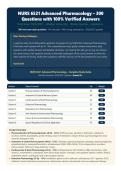
NURS 6521 Advanced Pharmacology – 300
Questions with 100% Verified Answers
Final Exam 2026/2027 – Walden University – Winter Quarter – Graded A+
300 real exam-style questions · Full rationales · Why wrong explanations · 2026/2027 updated
Dear Nursing Colleague,
I used this exact set of 300 practice questions to prepare for my NURS 6521 Advanced Pharmacology
Final Exam, and I passed with an A+. This comprehensive study guide contains actual exam-style
questions with verified answers and detailed rationales. I am sharing this with you so you can achieve
the same success. Each question includes a thorough explanation of the correct answer and why the
other options are wrong. Study these questions carefully, and you will be fully prepared for your exam.
Good luck!
NURS 6521 Advanced Pharmacology – Complete Study Guide
Verified Solutions | 2026/2027 Updated | Graded A+
Section Topics Covered Qs Weight
Section 1 Pharmacokinetics & Pharmacodynamics 40 13%
Section 2 Autonomic & Central Nervous System 40 13%
Section 3 Cardiovascular & Renal Pharmacology 45 15%
Section 4 Endocrine Pharmacology 35 12%
Section 5 Respiratory & GI Pharmacology 30 10%
Section 6 Anti-infective & Antimicrobial Pharmacology 35 12%
Section 7 Cancer & Immunomodulatory Pharmacology 30 10%
Section 8 Special Populations & Clinical Application 45 15%
Content Overview
Pharmacokinetics & Pharmacodynamics (40 Qs - 13%): ADME processes, absorption, distribution, metabolism,
excretion, half-life, bioavailability, protein binding, volume of distribution, receptor theory, agonists/antagonists, dose-
response, therapeutic index.
Autonomic & Central Nervous System (40 Qs - 13%): Cholinergic agonists/antagonists, adrenergic agonists/antagonists,
sympathomimetics, parasympathomimetics, antidepressants (SSRIs, SNRIs, MAOIs, TCAs), antipsychotics, anxiolytics,
anticonvulsants, Parkinson's drugs, Alzheimer's drugs.
Cardiovascular & Renal Pharmacology (45 Qs - 15%): Antihypertensives (ACE inhibitors, ARBs, beta-blockers, CCBs,
diuretics), antiarrhythmics, antianginals, heart failure drugs (digoxin, inotropes), anticoagulants (heparin, warfarin, DOACs),
antiplatelets (aspirin, clopidogrel), lipid-lowering agents (statins).
Endocrine Pharmacology (35 Qs - 12%): Antidiabetic agents (insulin, metformin, sulfonylureas, GLP-1 agonists, SGLT2
inhibitors), thyroid medications (levothyroxine, methimazole), adrenal corticosteroids, hormone replacement therapy,
, osteoporosis drugs (bisphosphonates).
Respiratory & GI Pharmacology (30 Qs - 10%): Bronchodilators (beta-agonists, anticholinergics), corticosteroids,
leukotriene modifiers, proton pump inhibitors, H2 blockers, antacids, antiemetics, laxatives, antidiarrheals, IBD drugs.
Anti-infective & Antimicrobial (35 Qs - 12%): Antibiotics (penicillins, cephalosporins, macrolides, tetracyclines,
aminoglycosides, fluoroquinolones), antivirals, antifungals, antiparasitics, antimicrobial stewardship, resistance mechanisms.
Cancer & Immunomodulatory (30 Qs - 10%): Chemotherapy agents, targeted therapy, immunotherapy, monoclonal
antibodies, TKIs, hormonal therapy, cytotoxic agents, adverse effects, supportive care.
Special Populations & Clinical Application (45 Qs - 15%): Geriatric pharmacology, pediatric pharmacology,
pregnancy/lactation, renal/hepatic dosing, polypharmacy, drug interactions, adverse drug reactions, medication safety,
patient education.
Section 1: Pharmacokinetics & Pharmacodynamics (40 questions)
Q1. A patient is prescribed a medication that is a weak base. Which statement best describes the
absorption of this medication in the stomach (pH 1.5)?
A The medication will be non-ionized and well absorbed
B The medication will be ionized and poorly absorbed
C The medication will be completely ionized
D The medication will be metabolized in the stomach
E The medication will be excreted in the stomach
Correct answer: A. The medication will be non-ionized and well absorbed
Rationale: Weak bases are more non-ionized (lipid-soluble) in acidic environments like the stomach (pH 1.5),
allowing them to cross cell membranes and be absorbed. Weak acids are ionized in acidic environments and poorly
absorbed. This is based on the pH-partition hypothesis.
Why wrong:
B: Weak bases are non-ionized in acidic pH.
C: Weak bases are not completely ionized.
D: Metabolism in the stomach is not the primary factor.
E: Excretion does not occur in the stomach.
Reference: Lehne's Pharmacology · Katzung's Pharmacology · Walden NURS 6521 Course Materials.
,Q2. A patient is prescribed a medication with high protein binding (95%). Which statement best
describes the clinical significance of this property?
A The medication has a longer half-life and potential for drug interactions
B The medication is more readily excreted by the kidneys
C The medication has a larger volume of distribution
D The medication is more water-soluble
E The medication is more rapidly metabolized
Correct answer: A. The medication has a longer half-life and potential for drug interactions
Rationale: High protein binding (95%) means only 5% of the drug is free (active). This results in a longer half-life
because bound drug is protected from metabolism and excretion. Drug interactions can occur when another drug
displaces the first from protein binding sites, increasing free drug levels.
Why wrong:
B: High protein binding decreases renal excretion.
C: High protein binding decreases volume of distribution.
D: Protein binding is not related to water solubility.
E: High protein binding decreases metabolism.
Reference: Lehne's Pharmacology · Katzung's Pharmacology · Walden NURS 6521 Course Materials.
Q3. A patient is receiving a medication with a half-life of 4 hours. How long will it take for the
medication to reach steady state if administered at regular intervals?
A 4 hours
B 8 hours
C 16 hours
D 20 hours
E 24 hours
Correct answer: C. 16 hours
Rationale: Steady state is reached after approximately 4-5 half-lives. With a half-life of 4 hours, steady state is
reached in approximately 16-20 hours (4 half-lives = 16 hours, 5 half-lives = 20 hours). The correct answer is 16
hours (4 half-lives).
Why wrong:
A: 4 hours is one half-life.
B: 8 hours is two half-lives.
D: 20 hours is five half-lives.
E: 24 hours is six half-lives.
Reference: Lehne's Pharmacology · Katzung's Pharmacology · Walden NURS 6521 Course Materials.
, Q4. A patient is prescribed a drug metabolized by CYP3A4 and also takes a CYP3A4 inhibitor. Which
effect would the nurse expect?
A Increased drug levels and increased effect
B Decreased drug levels and decreased effect
C No change in drug levels
D Increased metabolism of the drug
E Decreased absorption of the drug
Correct answer: A. Increased drug levels and increased effect
Rationale: CYP3A4 inhibitors decrease metabolism of drugs that are substrates of this enzyme, leading to
increased drug levels and increased therapeutic and adverse effects. This is a common mechanism of drug-drug
interactions.
Why wrong:
B: Inhibition decreases metabolism, increasing drug levels.
C: Inhibition changes drug levels.
D: Inhibition decreases metabolism.
E: Inhibition affects metabolism, not absorption.
Reference: Lehne's Pharmacology · Katzung's Pharmacology · Walden NURS 6521 Course Materials.
Q5. A medication has a high volume of distribution (Vd). Which statement best describes this
property?
A The medication is extensively distributed to tissues
B The medication is highly protein bound
C The medication is primarily distributed to the plasma
D The medication is rapidly cleared from the body
E The medication has a short half-life
Correct answer: A. The medication is extensively distributed to tissues
Rationale: A high volume of distribution indicates that the medication is extensively distributed into tissues and is
not confined to the plasma. This is common for lipophilic drugs that cross cell membranes. The Vd is a
proportionality constant relating drug amount in the body to plasma concentration.
Why wrong:
B: High Vd is not directly related to protein binding.
C: High Vd indicates distribution to tissues.
D: High Vd does not necessarily indicate rapid clearance.
E: High Vd may be associated with a longer half-life.
Reference: Lehne's Pharmacology · Katzung's Pharmacology · Walden NURS 6521 Course Materials.
Questions with 100% Verified Answers
Final Exam 2026/2027 – Walden University – Winter Quarter – Graded A+
300 real exam-style questions · Full rationales · Why wrong explanations · 2026/2027 updated
Dear Nursing Colleague,
I used this exact set of 300 practice questions to prepare for my NURS 6521 Advanced Pharmacology
Final Exam, and I passed with an A+. This comprehensive study guide contains actual exam-style
questions with verified answers and detailed rationales. I am sharing this with you so you can achieve
the same success. Each question includes a thorough explanation of the correct answer and why the
other options are wrong. Study these questions carefully, and you will be fully prepared for your exam.
Good luck!
NURS 6521 Advanced Pharmacology – Complete Study Guide
Verified Solutions | 2026/2027 Updated | Graded A+
Section Topics Covered Qs Weight
Section 1 Pharmacokinetics & Pharmacodynamics 40 13%
Section 2 Autonomic & Central Nervous System 40 13%
Section 3 Cardiovascular & Renal Pharmacology 45 15%
Section 4 Endocrine Pharmacology 35 12%
Section 5 Respiratory & GI Pharmacology 30 10%
Section 6 Anti-infective & Antimicrobial Pharmacology 35 12%
Section 7 Cancer & Immunomodulatory Pharmacology 30 10%
Section 8 Special Populations & Clinical Application 45 15%
Content Overview
Pharmacokinetics & Pharmacodynamics (40 Qs - 13%): ADME processes, absorption, distribution, metabolism,
excretion, half-life, bioavailability, protein binding, volume of distribution, receptor theory, agonists/antagonists, dose-
response, therapeutic index.
Autonomic & Central Nervous System (40 Qs - 13%): Cholinergic agonists/antagonists, adrenergic agonists/antagonists,
sympathomimetics, parasympathomimetics, antidepressants (SSRIs, SNRIs, MAOIs, TCAs), antipsychotics, anxiolytics,
anticonvulsants, Parkinson's drugs, Alzheimer's drugs.
Cardiovascular & Renal Pharmacology (45 Qs - 15%): Antihypertensives (ACE inhibitors, ARBs, beta-blockers, CCBs,
diuretics), antiarrhythmics, antianginals, heart failure drugs (digoxin, inotropes), anticoagulants (heparin, warfarin, DOACs),
antiplatelets (aspirin, clopidogrel), lipid-lowering agents (statins).
Endocrine Pharmacology (35 Qs - 12%): Antidiabetic agents (insulin, metformin, sulfonylureas, GLP-1 agonists, SGLT2
inhibitors), thyroid medications (levothyroxine, methimazole), adrenal corticosteroids, hormone replacement therapy,
, osteoporosis drugs (bisphosphonates).
Respiratory & GI Pharmacology (30 Qs - 10%): Bronchodilators (beta-agonists, anticholinergics), corticosteroids,
leukotriene modifiers, proton pump inhibitors, H2 blockers, antacids, antiemetics, laxatives, antidiarrheals, IBD drugs.
Anti-infective & Antimicrobial (35 Qs - 12%): Antibiotics (penicillins, cephalosporins, macrolides, tetracyclines,
aminoglycosides, fluoroquinolones), antivirals, antifungals, antiparasitics, antimicrobial stewardship, resistance mechanisms.
Cancer & Immunomodulatory (30 Qs - 10%): Chemotherapy agents, targeted therapy, immunotherapy, monoclonal
antibodies, TKIs, hormonal therapy, cytotoxic agents, adverse effects, supportive care.
Special Populations & Clinical Application (45 Qs - 15%): Geriatric pharmacology, pediatric pharmacology,
pregnancy/lactation, renal/hepatic dosing, polypharmacy, drug interactions, adverse drug reactions, medication safety,
patient education.
Section 1: Pharmacokinetics & Pharmacodynamics (40 questions)
Q1. A patient is prescribed a medication that is a weak base. Which statement best describes the
absorption of this medication in the stomach (pH 1.5)?
A The medication will be non-ionized and well absorbed
B The medication will be ionized and poorly absorbed
C The medication will be completely ionized
D The medication will be metabolized in the stomach
E The medication will be excreted in the stomach
Correct answer: A. The medication will be non-ionized and well absorbed
Rationale: Weak bases are more non-ionized (lipid-soluble) in acidic environments like the stomach (pH 1.5),
allowing them to cross cell membranes and be absorbed. Weak acids are ionized in acidic environments and poorly
absorbed. This is based on the pH-partition hypothesis.
Why wrong:
B: Weak bases are non-ionized in acidic pH.
C: Weak bases are not completely ionized.
D: Metabolism in the stomach is not the primary factor.
E: Excretion does not occur in the stomach.
Reference: Lehne's Pharmacology · Katzung's Pharmacology · Walden NURS 6521 Course Materials.
,Q2. A patient is prescribed a medication with high protein binding (95%). Which statement best
describes the clinical significance of this property?
A The medication has a longer half-life and potential for drug interactions
B The medication is more readily excreted by the kidneys
C The medication has a larger volume of distribution
D The medication is more water-soluble
E The medication is more rapidly metabolized
Correct answer: A. The medication has a longer half-life and potential for drug interactions
Rationale: High protein binding (95%) means only 5% of the drug is free (active). This results in a longer half-life
because bound drug is protected from metabolism and excretion. Drug interactions can occur when another drug
displaces the first from protein binding sites, increasing free drug levels.
Why wrong:
B: High protein binding decreases renal excretion.
C: High protein binding decreases volume of distribution.
D: Protein binding is not related to water solubility.
E: High protein binding decreases metabolism.
Reference: Lehne's Pharmacology · Katzung's Pharmacology · Walden NURS 6521 Course Materials.
Q3. A patient is receiving a medication with a half-life of 4 hours. How long will it take for the
medication to reach steady state if administered at regular intervals?
A 4 hours
B 8 hours
C 16 hours
D 20 hours
E 24 hours
Correct answer: C. 16 hours
Rationale: Steady state is reached after approximately 4-5 half-lives. With a half-life of 4 hours, steady state is
reached in approximately 16-20 hours (4 half-lives = 16 hours, 5 half-lives = 20 hours). The correct answer is 16
hours (4 half-lives).
Why wrong:
A: 4 hours is one half-life.
B: 8 hours is two half-lives.
D: 20 hours is five half-lives.
E: 24 hours is six half-lives.
Reference: Lehne's Pharmacology · Katzung's Pharmacology · Walden NURS 6521 Course Materials.
, Q4. A patient is prescribed a drug metabolized by CYP3A4 and also takes a CYP3A4 inhibitor. Which
effect would the nurse expect?
A Increased drug levels and increased effect
B Decreased drug levels and decreased effect
C No change in drug levels
D Increased metabolism of the drug
E Decreased absorption of the drug
Correct answer: A. Increased drug levels and increased effect
Rationale: CYP3A4 inhibitors decrease metabolism of drugs that are substrates of this enzyme, leading to
increased drug levels and increased therapeutic and adverse effects. This is a common mechanism of drug-drug
interactions.
Why wrong:
B: Inhibition decreases metabolism, increasing drug levels.
C: Inhibition changes drug levels.
D: Inhibition decreases metabolism.
E: Inhibition affects metabolism, not absorption.
Reference: Lehne's Pharmacology · Katzung's Pharmacology · Walden NURS 6521 Course Materials.
Q5. A medication has a high volume of distribution (Vd). Which statement best describes this
property?
A The medication is extensively distributed to tissues
B The medication is highly protein bound
C The medication is primarily distributed to the plasma
D The medication is rapidly cleared from the body
E The medication has a short half-life
Correct answer: A. The medication is extensively distributed to tissues
Rationale: A high volume of distribution indicates that the medication is extensively distributed into tissues and is
not confined to the plasma. This is common for lipophilic drugs that cross cell membranes. The Vd is a
proportionality constant relating drug amount in the body to plasma concentration.
Why wrong:
B: High Vd is not directly related to protein binding.
C: High Vd indicates distribution to tissues.
D: High Vd does not necessarily indicate rapid clearance.
E: High Vd may be associated with a longer half-life.
Reference: Lehne's Pharmacology · Katzung's Pharmacology · Walden NURS 6521 Course Materials.


