

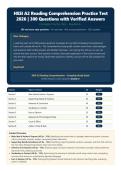
HESI A2 Reading Comprehension Practice Test
2026 | 300 Questions with Verified Answers
Complete Practice Test – Graded A+
300 real exam-style questions · Full rationales · Why wrong explanations · 2026 updated
Dear Colleague,
I used this exact set of 300 practice questions to prepare for my HESI A2 Reading Comprehension
Exam, and I passed with an A+. This comprehensive study guide contains actual exam-style passages
and questions with verified answers and detailed rationales. I am sharing this with you so you can
achieve the same success. Each question includes a thorough explanation of the correct answer and
why the other options are wrong. Study these questions carefully, and you will be fully prepared for
your exam.
Good luck!
HESI A2 Reading Comprehension – Complete Study Guide
Verified Solutions | 2026 Updated | Graded A+
Section Topics Covered Qs Weight
Section 1 Main Idea & Author's Purpose 45 15%
Section 2 Supporting Details & Evidence 45 15%
Section 3 Inference & Conclusion 45 15%
Section 4 Vocabulary in Context 40 13%
Section 5 Fact vs Opinion 35 12%
Section 6 Sequence & Chronological Order 30 10%
Section 7 Cause & Effect 30 10%
Section 8 Author's Tone & Style 30 10%
Content Overview
Main Idea & Author's Purpose (45 Qs - 15%): Identifying the central idea of a passage, determining author's purpose
(inform, persuade, entertain, explain), recognizing thesis statements.
Supporting Details & Evidence (45 Qs - 15%): Identifying supporting details, evidence, examples, and facts that reinforce
the main idea, distinguishing between major and minor details.
Inference & Conclusion (45 Qs - 15%): Drawing logical conclusions based on information provided, making inferences
beyond the text, predicting outcomes.
Vocabulary in Context (40 Qs - 13%): Determining the meaning of unfamiliar words using context clues, recognizing
synonyms and antonyms, understanding figurative language.
Fact vs Opinion (35 Qs - 12%): Distinguishing between factual statements and opinions, identifying bias, evaluating
author's credibility.
, Sequence & Chronological Order (30 Qs - 10%): Understanding the order of events, recognizing signal words (first, next,
then, finally), following step-by-step procedures.
Cause & Effect (30 Qs - 10%): Identifying cause-and-effect relationships, recognizing signal words (because, therefore, as
a result), understanding consequences.
Author's Tone & Style (30 Qs - 10%): Identifying author's tone (formal, informal, humorous, serious, sarcastic),
recognizing literary devices, understanding stylistic choices.
Section 1: Main Idea & Author's Purpose (45 questions)
Q1. The main idea of a passage is best defined as:
A The central thought or message the author wants to convey
B The title of the passage
C The first sentence of each paragraph
D A supporting detail that explains the topic
E The conclusion of the passage
Correct answer: A. The central thought or message the author wants to convey
Rationale: The main idea is the central thought or message the author wants to convey. It is the overarching point
that all other details support. The title may indicate the topic, but the main idea is the specific message about that
topic.
Why wrong:
B: The title of the passage is incorrect
C: The first sentence of each paragraph is incorrect
D: A supporting detail that explains the topic is incorrect
E: The conclusion of the passage is incorrect
Reference: HESI A2 Reading Study Guide · Kaplan HESI A2 Reading Review.
Q2. When determining the author's purpose, ask yourself:
A What is the author trying to achieve?
B What is the title of the passage?
C How many paragraphs are in the passage?
D What is the length of the passage?
E Who published the passage?
Correct answer: A. What is the author trying to achieve?
Rationale: The author's purpose is the reason the author wrote the passage—to inform, persuade, entertain, or
explain. Asking "What is the author trying to achieve?" helps identify the purpose. The title, length, and publication
details do not reveal the author's purpose.
Why wrong:
B: What is the title of the passage? is incorrect
C: How many paragraphs are in the passage? is incorrect
D: What is the length of the passage? is incorrect
E: Who published the passage? is incorrect
Reference: HESI A2 Reading Study Guide · Kaplan HESI A2 Reading Review.
,Q3. Which of the following is a clue that the author's purpose is to persuade?
A Emotional language and appeals to the reader
B Objective presentation of facts
C Neutral tone
D Use of statistics only
E Formal language without opinion
Correct answer: A. Emotional language and appeals to the reader
Rationale: Persuasive writing often uses emotional language and appeals to the reader's feelings to convince them
to adopt a certain viewpoint. Objective presentation of facts, neutral tone, and formal language without opinion
are characteristic of informative writing.
Why wrong:
B: Objective presentation of facts is incorrect
C: Neutral tone is incorrect
D: Use of statistics only is incorrect
E: Formal language without opinion is incorrect
Reference: HESI A2 Reading Study Guide · Kaplan HESI A2 Reading Review.
Q4. The main idea is often found in:
A The first sentence of the passage
B The last sentence of the passage
C Both the introduction and conclusion
D Only the body paragraphs
E The title
Correct answer: C. Both the introduction and conclusion
Rationale: The main idea is often stated in the introduction and restated in the conclusion. While it can appear
elsewhere, these positions are common for explicit main idea statements. The title may indicate the topic but not
necessarily the main idea.
Why wrong:
A: The first sentence of the passage is incorrect
B: The last sentence of the passage is incorrect
D: Only the body paragraphs is incorrect
E: The title is incorrect
Reference: HESI A2 Reading Study Guide · Kaplan HESI A2 Reading Review.
, Q5. When the main idea is implied, the reader must:
A Use clues to infer the central message
B Look for the title
C Read only the first sentence
D Skip to the conclusion
E Ignore supporting details
Correct answer: A. Use clues to infer the central message
Rationale: When the main idea is implied, the reader must use clues and supporting details to infer the central
message. The author does not state the main idea directly, so the reader must synthesize information from the
passage.
Why wrong:
B: Look for the title is incorrect
C: Read only the first sentence is incorrect
D: Skip to the conclusion is incorrect
E: Ignore supporting details is incorrect
Reference: HESI A2 Reading Study Guide · Kaplan HESI A2 Reading Review.
Q6. The author's purpose in a passage that explains how to perform a procedure is to:
A Inform
B Persuade
C Entertain
D Describe
E Argue
Correct answer: A. Inform
Rationale: A passage that explains how to perform a procedure is informative. The author's purpose is to provide
instructions or explain a process. Persuasive writing tries to convince; entertaining writing is for enjoyment.
Why wrong:
B: Persuade is incorrect
C: Entertain is incorrect
D: Describe is incorrect
E: Argue is incorrect
Reference: HESI A2 Reading Study Guide · Kaplan HESI A2 Reading Review.
2026 | 300 Questions with Verified Answers
Complete Practice Test – Graded A+
300 real exam-style questions · Full rationales · Why wrong explanations · 2026 updated
Dear Colleague,
I used this exact set of 300 practice questions to prepare for my HESI A2 Reading Comprehension
Exam, and I passed with an A+. This comprehensive study guide contains actual exam-style passages
and questions with verified answers and detailed rationales. I am sharing this with you so you can
achieve the same success. Each question includes a thorough explanation of the correct answer and
why the other options are wrong. Study these questions carefully, and you will be fully prepared for
your exam.
Good luck!
HESI A2 Reading Comprehension – Complete Study Guide
Verified Solutions | 2026 Updated | Graded A+
Section Topics Covered Qs Weight
Section 1 Main Idea & Author's Purpose 45 15%
Section 2 Supporting Details & Evidence 45 15%
Section 3 Inference & Conclusion 45 15%
Section 4 Vocabulary in Context 40 13%
Section 5 Fact vs Opinion 35 12%
Section 6 Sequence & Chronological Order 30 10%
Section 7 Cause & Effect 30 10%
Section 8 Author's Tone & Style 30 10%
Content Overview
Main Idea & Author's Purpose (45 Qs - 15%): Identifying the central idea of a passage, determining author's purpose
(inform, persuade, entertain, explain), recognizing thesis statements.
Supporting Details & Evidence (45 Qs - 15%): Identifying supporting details, evidence, examples, and facts that reinforce
the main idea, distinguishing between major and minor details.
Inference & Conclusion (45 Qs - 15%): Drawing logical conclusions based on information provided, making inferences
beyond the text, predicting outcomes.
Vocabulary in Context (40 Qs - 13%): Determining the meaning of unfamiliar words using context clues, recognizing
synonyms and antonyms, understanding figurative language.
Fact vs Opinion (35 Qs - 12%): Distinguishing between factual statements and opinions, identifying bias, evaluating
author's credibility.
, Sequence & Chronological Order (30 Qs - 10%): Understanding the order of events, recognizing signal words (first, next,
then, finally), following step-by-step procedures.
Cause & Effect (30 Qs - 10%): Identifying cause-and-effect relationships, recognizing signal words (because, therefore, as
a result), understanding consequences.
Author's Tone & Style (30 Qs - 10%): Identifying author's tone (formal, informal, humorous, serious, sarcastic),
recognizing literary devices, understanding stylistic choices.
Section 1: Main Idea & Author's Purpose (45 questions)
Q1. The main idea of a passage is best defined as:
A The central thought or message the author wants to convey
B The title of the passage
C The first sentence of each paragraph
D A supporting detail that explains the topic
E The conclusion of the passage
Correct answer: A. The central thought or message the author wants to convey
Rationale: The main idea is the central thought or message the author wants to convey. It is the overarching point
that all other details support. The title may indicate the topic, but the main idea is the specific message about that
topic.
Why wrong:
B: The title of the passage is incorrect
C: The first sentence of each paragraph is incorrect
D: A supporting detail that explains the topic is incorrect
E: The conclusion of the passage is incorrect
Reference: HESI A2 Reading Study Guide · Kaplan HESI A2 Reading Review.
Q2. When determining the author's purpose, ask yourself:
A What is the author trying to achieve?
B What is the title of the passage?
C How many paragraphs are in the passage?
D What is the length of the passage?
E Who published the passage?
Correct answer: A. What is the author trying to achieve?
Rationale: The author's purpose is the reason the author wrote the passage—to inform, persuade, entertain, or
explain. Asking "What is the author trying to achieve?" helps identify the purpose. The title, length, and publication
details do not reveal the author's purpose.
Why wrong:
B: What is the title of the passage? is incorrect
C: How many paragraphs are in the passage? is incorrect
D: What is the length of the passage? is incorrect
E: Who published the passage? is incorrect
Reference: HESI A2 Reading Study Guide · Kaplan HESI A2 Reading Review.
,Q3. Which of the following is a clue that the author's purpose is to persuade?
A Emotional language and appeals to the reader
B Objective presentation of facts
C Neutral tone
D Use of statistics only
E Formal language without opinion
Correct answer: A. Emotional language and appeals to the reader
Rationale: Persuasive writing often uses emotional language and appeals to the reader's feelings to convince them
to adopt a certain viewpoint. Objective presentation of facts, neutral tone, and formal language without opinion
are characteristic of informative writing.
Why wrong:
B: Objective presentation of facts is incorrect
C: Neutral tone is incorrect
D: Use of statistics only is incorrect
E: Formal language without opinion is incorrect
Reference: HESI A2 Reading Study Guide · Kaplan HESI A2 Reading Review.
Q4. The main idea is often found in:
A The first sentence of the passage
B The last sentence of the passage
C Both the introduction and conclusion
D Only the body paragraphs
E The title
Correct answer: C. Both the introduction and conclusion
Rationale: The main idea is often stated in the introduction and restated in the conclusion. While it can appear
elsewhere, these positions are common for explicit main idea statements. The title may indicate the topic but not
necessarily the main idea.
Why wrong:
A: The first sentence of the passage is incorrect
B: The last sentence of the passage is incorrect
D: Only the body paragraphs is incorrect
E: The title is incorrect
Reference: HESI A2 Reading Study Guide · Kaplan HESI A2 Reading Review.
, Q5. When the main idea is implied, the reader must:
A Use clues to infer the central message
B Look for the title
C Read only the first sentence
D Skip to the conclusion
E Ignore supporting details
Correct answer: A. Use clues to infer the central message
Rationale: When the main idea is implied, the reader must use clues and supporting details to infer the central
message. The author does not state the main idea directly, so the reader must synthesize information from the
passage.
Why wrong:
B: Look for the title is incorrect
C: Read only the first sentence is incorrect
D: Skip to the conclusion is incorrect
E: Ignore supporting details is incorrect
Reference: HESI A2 Reading Study Guide · Kaplan HESI A2 Reading Review.
Q6. The author's purpose in a passage that explains how to perform a procedure is to:
A Inform
B Persuade
C Entertain
D Describe
E Argue
Correct answer: A. Inform
Rationale: A passage that explains how to perform a procedure is informative. The author's purpose is to provide
instructions or explain a process. Persuasive writing tries to convince; entertaining writing is for enjoyment.
Why wrong:
B: Persuade is incorrect
C: Entertain is incorrect
D: Describe is incorrect
E: Argue is incorrect
Reference: HESI A2 Reading Study Guide · Kaplan HESI A2 Reading Review.


