

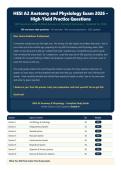
HESI A2 Anatomy and Physiology Exam 2026 –
High-Yield Practice Questions
300 Questions with Verified Answers & Detailed Rationales | Updated for 2026
300 real exam-style questions · Full rationales · Why wrong explanations · 2026 updated
Dear Future Healthcare Professional,
I remember exactly how you feel right now. The anxiety, the late nights, the endless flashcards. I was in
your shoes just a few months ago, preparing for my HESI A2 Anatomy and Physiology exam. After
weeks of searching and studying, I realized that what I needed was a comprehensive practice guide
that mimicked the actual exam. So I created one. I used this exact set of 300 questions to prepare, and
I walked into my exam feeling confident and prepared. I passed with flying colors, and now I want to
share this resource with you.
This study guide contains the most frequently tested concepts, the tricky questions that seem to
appear on every exam, and the detailed rationales that help you understand the "why" behind each
answer. I have carefully selected and refined these questions based on what I saw on my own exam
and what my peers reported.
I believe in you. Trust the process, trust your preparation, and trust yourself. You've got this!
Good luck!
HESI A2 Anatomy & Physiology – Complete Study Guide
Verified Solutions | 2026 Updated | Graded A+
Section Topics Covered Qs Weight
Section 1 Cell Biology & Histology 40 13%
Section 2 Integumentary System 30 10%
Section 3 Skeletal System 30 10%
Section 4 Muscular System 30 10%
Section 5 Cardiovascular System 40 13%
Section 6 Respiratory System 30 10%
Section 7 Digestive & Urinary Systems 40 13%
Section 8 Nervous & Endocrine Systems 60 21%
What You Will Find Inside This Study Guide
, Cell Biology & Histology (40 Qs - 13%): Organelles, cellular transport, mitosis and meiosis, tissues types including
epithelial, connective, muscle, and nervous tissue.
Integumentary System (30 Qs - 10%): Skin layers, hair, nails, glands, wound healing, thermoregulation, and protective
functions.
Skeletal System (30 Qs - 10%): Bone anatomy, bone tissue, axial and appendicular skeleton, joints, and fractures.
Muscular System (30 Qs - 10%): Muscle types, contraction mechanism, neuromuscular junction, and major muscle
groups.
Cardiovascular System (40 Qs - 13%): Heart anatomy, cardiac cycle, blood vessels, circulation pathways, blood
composition, and conduction system.
Respiratory System (30 Qs - 10%): Lung anatomy, gas exchange, ventilation mechanics, respiratory volumes, and oxygen
transport.
Digestive & Urinary Systems (40 Qs - 13%): Gastrointestinal organs, accessory organs, digestion processes, nephron
structure, urine formation, and electrolyte balance.
Nervous & Endocrine Systems (60 Qs - 21%): Brain anatomy, spinal cord, neurons, synaptic transmission,
neurotransmitters, major endocrine glands, hormones, and feedback loops.
Section 1: Cell Biology & Histology (40 questions)
Q1. A patient with a mitochondrial disorder would most likely experience which of the following
symptoms?
A Muscle weakness and fatigue
B Excessive hair growth
C Rapid weight gain
D Increased bone density
E Enhanced memory
Correct answer: A. Muscle weakness and fatigue
Rationale: Mitochondria produce ATP through cellular respiration. A mitochondrial disorder would impair ATP
production, leading to muscle weakness and fatigue because muscles require significant energy.
Why wrong:
B: Excessive hair growth is incorrect
C: Rapid weight gain is incorrect
D: Increased bone density is incorrect
E: Enhanced memory is incorrect
Reference: HESI A2 Anatomy & Physiology Study Guide · Elsevier HESI Admission Assessment Exam Review, 6th Edition.
,Q2. Which organelle contains hydrolytic enzymes and is responsible for digesting cellular waste and
pathogens?
A Mitochondria
B Ribosomes
C Golgi apparatus
D Lysosomes
E Peroxisomes
Correct answer: D. Lysosomes
Rationale: Lysosomes contain hydrolytic enzymes that break down cellular debris, worn-out organelles, and
foreign materials through phagocytosis.
Why wrong:
A: Mitochondria is incorrect
B: Ribosomes is incorrect
C: Golgi apparatus is incorrect
E: Peroxisomes is incorrect
Reference: HESI A2 Anatomy & Physiology Study Guide · Elsevier HESI Admission Assessment Exam Review, 6th Edition.
Q3. A researcher observes a cell under a microscope and notices it lacks a nucleus. Which type of cell
is this most likely?
A Red blood cell
B White blood cell
C Neuron
D Epithelial cell
E Smooth muscle cell
Correct answer: A. Red blood cell
Rationale: Mature red blood cells (erythrocytes) lack a nucleus to maximize space for hemoglobin and oxygen
transport.
Why wrong:
B: White blood cell is incorrect
C: Neuron is incorrect
D: Epithelial cell is incorrect
E: Smooth muscle cell is incorrect
Reference: HESI A2 Anatomy & Physiology Study Guide · Elsevier HESI Admission Assessment Exam Review, 6th Edition.
, Q4. Which organelle is responsible for synthesizing and modifying proteins and lipids?
A Endoplasmic reticulum
B Mitochondria
C Lysosomes
D Peroxisomes
E Centrioles
Correct answer: A. Endoplasmic reticulum
Rationale: The endoplasmic reticulum is responsible for synthesizing proteins (rough ER with ribosomes) and lipids
(smooth ER).
Why wrong:
B: Mitochondria is incorrect
C: Lysosomes is incorrect
D: Peroxisomes is incorrect
E: Centrioles is incorrect
Reference: HESI A2 Anatomy & Physiology Study Guide · Elsevier HESI Admission Assessment Exam Review, 6th Edition.
Q5. A patient is diagnosed with a condition that affects the Golgi apparatus. Which of the following
cellular functions would be most directly compromised?
A Protein packaging and secretion
B ATP production
C Lipid synthesis
D Waste digestion
E Cell division
Correct answer: A. Protein packaging and secretion
Rationale: The Golgi apparatus modifies, sorts, and packages proteins for secretion or use within the cell. A
dysfunction would directly affect protein packaging and secretion.
Why wrong:
B: ATP production is incorrect
C: Lipid synthesis is incorrect
D: Waste digestion is incorrect
E: Cell division is incorrect
Reference: HESI A2 Anatomy & Physiology Study Guide · Elsevier HESI Admission Assessment Exam Review, 6th Edition.
High-Yield Practice Questions
300 Questions with Verified Answers & Detailed Rationales | Updated for 2026
300 real exam-style questions · Full rationales · Why wrong explanations · 2026 updated
Dear Future Healthcare Professional,
I remember exactly how you feel right now. The anxiety, the late nights, the endless flashcards. I was in
your shoes just a few months ago, preparing for my HESI A2 Anatomy and Physiology exam. After
weeks of searching and studying, I realized that what I needed was a comprehensive practice guide
that mimicked the actual exam. So I created one. I used this exact set of 300 questions to prepare, and
I walked into my exam feeling confident and prepared. I passed with flying colors, and now I want to
share this resource with you.
This study guide contains the most frequently tested concepts, the tricky questions that seem to
appear on every exam, and the detailed rationales that help you understand the "why" behind each
answer. I have carefully selected and refined these questions based on what I saw on my own exam
and what my peers reported.
I believe in you. Trust the process, trust your preparation, and trust yourself. You've got this!
Good luck!
HESI A2 Anatomy & Physiology – Complete Study Guide
Verified Solutions | 2026 Updated | Graded A+
Section Topics Covered Qs Weight
Section 1 Cell Biology & Histology 40 13%
Section 2 Integumentary System 30 10%
Section 3 Skeletal System 30 10%
Section 4 Muscular System 30 10%
Section 5 Cardiovascular System 40 13%
Section 6 Respiratory System 30 10%
Section 7 Digestive & Urinary Systems 40 13%
Section 8 Nervous & Endocrine Systems 60 21%
What You Will Find Inside This Study Guide
, Cell Biology & Histology (40 Qs - 13%): Organelles, cellular transport, mitosis and meiosis, tissues types including
epithelial, connective, muscle, and nervous tissue.
Integumentary System (30 Qs - 10%): Skin layers, hair, nails, glands, wound healing, thermoregulation, and protective
functions.
Skeletal System (30 Qs - 10%): Bone anatomy, bone tissue, axial and appendicular skeleton, joints, and fractures.
Muscular System (30 Qs - 10%): Muscle types, contraction mechanism, neuromuscular junction, and major muscle
groups.
Cardiovascular System (40 Qs - 13%): Heart anatomy, cardiac cycle, blood vessels, circulation pathways, blood
composition, and conduction system.
Respiratory System (30 Qs - 10%): Lung anatomy, gas exchange, ventilation mechanics, respiratory volumes, and oxygen
transport.
Digestive & Urinary Systems (40 Qs - 13%): Gastrointestinal organs, accessory organs, digestion processes, nephron
structure, urine formation, and electrolyte balance.
Nervous & Endocrine Systems (60 Qs - 21%): Brain anatomy, spinal cord, neurons, synaptic transmission,
neurotransmitters, major endocrine glands, hormones, and feedback loops.
Section 1: Cell Biology & Histology (40 questions)
Q1. A patient with a mitochondrial disorder would most likely experience which of the following
symptoms?
A Muscle weakness and fatigue
B Excessive hair growth
C Rapid weight gain
D Increased bone density
E Enhanced memory
Correct answer: A. Muscle weakness and fatigue
Rationale: Mitochondria produce ATP through cellular respiration. A mitochondrial disorder would impair ATP
production, leading to muscle weakness and fatigue because muscles require significant energy.
Why wrong:
B: Excessive hair growth is incorrect
C: Rapid weight gain is incorrect
D: Increased bone density is incorrect
E: Enhanced memory is incorrect
Reference: HESI A2 Anatomy & Physiology Study Guide · Elsevier HESI Admission Assessment Exam Review, 6th Edition.
,Q2. Which organelle contains hydrolytic enzymes and is responsible for digesting cellular waste and
pathogens?
A Mitochondria
B Ribosomes
C Golgi apparatus
D Lysosomes
E Peroxisomes
Correct answer: D. Lysosomes
Rationale: Lysosomes contain hydrolytic enzymes that break down cellular debris, worn-out organelles, and
foreign materials through phagocytosis.
Why wrong:
A: Mitochondria is incorrect
B: Ribosomes is incorrect
C: Golgi apparatus is incorrect
E: Peroxisomes is incorrect
Reference: HESI A2 Anatomy & Physiology Study Guide · Elsevier HESI Admission Assessment Exam Review, 6th Edition.
Q3. A researcher observes a cell under a microscope and notices it lacks a nucleus. Which type of cell
is this most likely?
A Red blood cell
B White blood cell
C Neuron
D Epithelial cell
E Smooth muscle cell
Correct answer: A. Red blood cell
Rationale: Mature red blood cells (erythrocytes) lack a nucleus to maximize space for hemoglobin and oxygen
transport.
Why wrong:
B: White blood cell is incorrect
C: Neuron is incorrect
D: Epithelial cell is incorrect
E: Smooth muscle cell is incorrect
Reference: HESI A2 Anatomy & Physiology Study Guide · Elsevier HESI Admission Assessment Exam Review, 6th Edition.
, Q4. Which organelle is responsible for synthesizing and modifying proteins and lipids?
A Endoplasmic reticulum
B Mitochondria
C Lysosomes
D Peroxisomes
E Centrioles
Correct answer: A. Endoplasmic reticulum
Rationale: The endoplasmic reticulum is responsible for synthesizing proteins (rough ER with ribosomes) and lipids
(smooth ER).
Why wrong:
B: Mitochondria is incorrect
C: Lysosomes is incorrect
D: Peroxisomes is incorrect
E: Centrioles is incorrect
Reference: HESI A2 Anatomy & Physiology Study Guide · Elsevier HESI Admission Assessment Exam Review, 6th Edition.
Q5. A patient is diagnosed with a condition that affects the Golgi apparatus. Which of the following
cellular functions would be most directly compromised?
A Protein packaging and secretion
B ATP production
C Lipid synthesis
D Waste digestion
E Cell division
Correct answer: A. Protein packaging and secretion
Rationale: The Golgi apparatus modifies, sorts, and packages proteins for secretion or use within the cell. A
dysfunction would directly affect protein packaging and secretion.
Why wrong:
B: ATP production is incorrect
C: Lipid synthesis is incorrect
D: Waste digestion is incorrect
E: Cell division is incorrect
Reference: HESI A2 Anatomy & Physiology Study Guide · Elsevier HESI Admission Assessment Exam Review, 6th Edition.


