

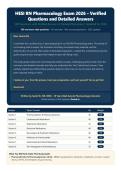
HESI RN Pharmacology Exam 2026 – Verified
Questions and Detailed Answers
300 Questions with Verified Answers & Detailed Rationales | Updated for 2026
300 real exam-style questions · Full rationales · Why wrong explanations · 2026 updated
Dear Future RN,
I remember the countless hours I spent preparing for my HESI RN Pharmacology exam. The anxiety of
not knowing what to expect, the frustration of finding incomplete study materials, and the
determination to succeed. After weeks of dedicated preparation, I created this comprehensive practice
guide using the exact strategies that helped me pass with flying colors.
This study guide contains the most frequently tested concepts, challenging questions that mirror the
real exam, and detailed rationales that help you understand the "why" behind each answer. I have
carefully selected and refined these questions based on what I saw on my own exam and what my
peers reported seeing on theirs.
I believe in you. Trust the process, trust your preparation, and trust yourself. You've got this!
Good luck!
Written by Sarah M., RN, MSN – 10 Years Med-Surg & Pharmacology Instructor
Verified Solutions | 2026 Updated | Graded A+
Section Topics Covered Qs Weight
Section 1 Pharmacokinetics & Pharmacodynamics 40 13%
Section 2 Cardiovascular Medications 40 13%
Section 3 Respiratory Medications 35 12%
Section 4 Endocrine Medications 40 13%
Section 5 Neurological & Psychiatric Medications 40 13%
Section 6 Antibiotics & Antimicrobials 40 13%
Section 7 Gastrointestinal & Renal Medications 35 12%
Section 8 Pain Management & Miscellaneous 30 11%
What You Will Find Inside This Study Guide
Pharmacokinetics & Pharmacodynamics (40 Qs - 13%): Drug absorption, distribution, metabolism, excretion, receptor
theory, half-life, and therapeutic drug monitoring.
, Cardiovascular Medications (40 Qs - 13%): Antihypertensives, antiarrhythmics, diuretics, anticoagulants, antiplatelets, and
heart failure medications.
Respiratory Medications (35 Qs - 12%): Bronchodilators, corticosteroids, antihistamines, mucolytics, and medications for
asthma and COPD.
Endocrine Medications (40 Qs - 13%): Insulin, oral antidiabetics, thyroid medications, corticosteroids, and hormone
replacements.
Neurological & Psychiatric Medications (40 Qs - 13%): Antidepressants, antipsychotics, anti-anxiety medications,
anticonvulsants, and Parkinson's medications.
Antibiotics & Antimicrobials (40 Qs - 13%): Penicillins, cephalosporins, aminoglycosides, tetracyclines, fluoroquinolones,
and antivirals.
Gastrointestinal & Renal Medications (35 Qs - 12%): Antacids, H2 blockers, PPIs, antiemetics, laxatives, and diuretics.
Pain Management & Miscellaneous (30 Qs - 11%): Opioids, NSAIDs, local anesthetics, immunosuppressants, and
chemotherapeutic agents.
Section 1: Pharmacokinetics & Pharmacodynamics (40 questions)
Q1. A patient is prescribed a medication that undergoes extensive first-pass metabolism. Which route
of administration would be most appropriate to bypass this effect?
A Sublingual
B Oral
C Rectal
D Intramuscular
E Subcutaneous
Correct answer: A. Sublingual
Rationale: Sublingual administration bypasses first-pass metabolism because the drug is absorbed directly into the
systemic circulation through the sublingual mucosa, avoiding the portal circulation and liver.
Why wrong:
B: Oral is incorrect
C: Rectal is incorrect
D: Intramuscular is incorrect
E: Subcutaneous is incorrect
Reference: HESI RN Pharmacology Study Guide · Lehne's Pharmacology for Nursing Care · Davis Drug Guide for
Nurses.
,Q2. A patient receives a loading dose of a medication. What is the primary purpose of a loading
dose?
A To quickly achieve therapeutic drug levels
B To maintain steady-state drug levels
C To reduce the risk of toxicity
D To increase drug excretion
E To minimize drug interactions
Correct answer: A. To quickly achieve therapeutic drug levels
Rationale: A loading dose is a larger initial dose given to rapidly achieve therapeutic drug levels in the blood. It is
followed by maintenance doses to keep the drug concentration in the therapeutic range.
Why wrong:
B: To maintain steady-state drug levels is incorrect
C: To reduce the risk of toxicity is incorrect
D: To increase drug excretion is incorrect
E: To minimize drug interactions is incorrect
Reference: HESI RN Pharmacology Study Guide · Lehne's Pharmacology for Nursing Care · Davis Drug Guide for
Nurses.
Q3. A medication has a half-life of 4 hours. How many hours will it take for 75% of the medication to
be eliminated from the body?
A 8 hours
B 4 hours
C 12 hours
D 16 hours
E 6 hours
Correct answer: A. 8 hours
Rationale: After one half-life (4 hours), 50% remains. After two half-lives (8 hours), 25% remains, meaning 75%
has been eliminated.
Why wrong:
B: 4 hours is incorrect
C: 12 hours is incorrect
D: 16 hours is incorrect
E: 6 hours is incorrect
Reference: HESI RN Pharmacology Study Guide · Lehne's Pharmacology for Nursing Care · Davis Drug Guide for
Nurses.
, Q4. Which route of administration has the fastest onset of action?
A Intravenous
B Intramuscular
C Subcutaneous
D Oral
E Topical
Correct answer: A. Intravenous
Rationale: Intravenous (IV) administration provides the fastest onset of action because the drug is delivered
directly into the bloodstream, bypassing all absorption barriers. Onset is immediate.
Why wrong:
B: Intramuscular is incorrect
C: Subcutaneous is incorrect
D: Oral is incorrect
E: Topical is incorrect
Reference: HESI RN Pharmacology Study Guide · Lehne's Pharmacology for Nursing Care · Davis Drug Guide for
Nurses.
Q5. A patient is taking a drug that is highly protein-bound. Which laboratory value is most important
to monitor?
A Serum albumin level
B Serum creatinine
C Hemoglobin
D White blood cell count
E Platelet count
Correct answer: A. Serum albumin level
Rationale: Serum albumin is the primary binding protein in the blood. Low albumin levels can increase the free
fraction of highly protein-bound drugs, potentially leading to toxicity.
Why wrong:
B: Serum creatinine is incorrect
C: Hemoglobin is incorrect
D: White blood cell count is incorrect
E: Platelet count is incorrect
Reference: HESI RN Pharmacology Study Guide · Lehne's Pharmacology for Nursing Care · Davis Drug Guide for
Nurses.
Questions and Detailed Answers
300 Questions with Verified Answers & Detailed Rationales | Updated for 2026
300 real exam-style questions · Full rationales · Why wrong explanations · 2026 updated
Dear Future RN,
I remember the countless hours I spent preparing for my HESI RN Pharmacology exam. The anxiety of
not knowing what to expect, the frustration of finding incomplete study materials, and the
determination to succeed. After weeks of dedicated preparation, I created this comprehensive practice
guide using the exact strategies that helped me pass with flying colors.
This study guide contains the most frequently tested concepts, challenging questions that mirror the
real exam, and detailed rationales that help you understand the "why" behind each answer. I have
carefully selected and refined these questions based on what I saw on my own exam and what my
peers reported seeing on theirs.
I believe in you. Trust the process, trust your preparation, and trust yourself. You've got this!
Good luck!
Written by Sarah M., RN, MSN – 10 Years Med-Surg & Pharmacology Instructor
Verified Solutions | 2026 Updated | Graded A+
Section Topics Covered Qs Weight
Section 1 Pharmacokinetics & Pharmacodynamics 40 13%
Section 2 Cardiovascular Medications 40 13%
Section 3 Respiratory Medications 35 12%
Section 4 Endocrine Medications 40 13%
Section 5 Neurological & Psychiatric Medications 40 13%
Section 6 Antibiotics & Antimicrobials 40 13%
Section 7 Gastrointestinal & Renal Medications 35 12%
Section 8 Pain Management & Miscellaneous 30 11%
What You Will Find Inside This Study Guide
Pharmacokinetics & Pharmacodynamics (40 Qs - 13%): Drug absorption, distribution, metabolism, excretion, receptor
theory, half-life, and therapeutic drug monitoring.
, Cardiovascular Medications (40 Qs - 13%): Antihypertensives, antiarrhythmics, diuretics, anticoagulants, antiplatelets, and
heart failure medications.
Respiratory Medications (35 Qs - 12%): Bronchodilators, corticosteroids, antihistamines, mucolytics, and medications for
asthma and COPD.
Endocrine Medications (40 Qs - 13%): Insulin, oral antidiabetics, thyroid medications, corticosteroids, and hormone
replacements.
Neurological & Psychiatric Medications (40 Qs - 13%): Antidepressants, antipsychotics, anti-anxiety medications,
anticonvulsants, and Parkinson's medications.
Antibiotics & Antimicrobials (40 Qs - 13%): Penicillins, cephalosporins, aminoglycosides, tetracyclines, fluoroquinolones,
and antivirals.
Gastrointestinal & Renal Medications (35 Qs - 12%): Antacids, H2 blockers, PPIs, antiemetics, laxatives, and diuretics.
Pain Management & Miscellaneous (30 Qs - 11%): Opioids, NSAIDs, local anesthetics, immunosuppressants, and
chemotherapeutic agents.
Section 1: Pharmacokinetics & Pharmacodynamics (40 questions)
Q1. A patient is prescribed a medication that undergoes extensive first-pass metabolism. Which route
of administration would be most appropriate to bypass this effect?
A Sublingual
B Oral
C Rectal
D Intramuscular
E Subcutaneous
Correct answer: A. Sublingual
Rationale: Sublingual administration bypasses first-pass metabolism because the drug is absorbed directly into the
systemic circulation through the sublingual mucosa, avoiding the portal circulation and liver.
Why wrong:
B: Oral is incorrect
C: Rectal is incorrect
D: Intramuscular is incorrect
E: Subcutaneous is incorrect
Reference: HESI RN Pharmacology Study Guide · Lehne's Pharmacology for Nursing Care · Davis Drug Guide for
Nurses.
,Q2. A patient receives a loading dose of a medication. What is the primary purpose of a loading
dose?
A To quickly achieve therapeutic drug levels
B To maintain steady-state drug levels
C To reduce the risk of toxicity
D To increase drug excretion
E To minimize drug interactions
Correct answer: A. To quickly achieve therapeutic drug levels
Rationale: A loading dose is a larger initial dose given to rapidly achieve therapeutic drug levels in the blood. It is
followed by maintenance doses to keep the drug concentration in the therapeutic range.
Why wrong:
B: To maintain steady-state drug levels is incorrect
C: To reduce the risk of toxicity is incorrect
D: To increase drug excretion is incorrect
E: To minimize drug interactions is incorrect
Reference: HESI RN Pharmacology Study Guide · Lehne's Pharmacology for Nursing Care · Davis Drug Guide for
Nurses.
Q3. A medication has a half-life of 4 hours. How many hours will it take for 75% of the medication to
be eliminated from the body?
A 8 hours
B 4 hours
C 12 hours
D 16 hours
E 6 hours
Correct answer: A. 8 hours
Rationale: After one half-life (4 hours), 50% remains. After two half-lives (8 hours), 25% remains, meaning 75%
has been eliminated.
Why wrong:
B: 4 hours is incorrect
C: 12 hours is incorrect
D: 16 hours is incorrect
E: 6 hours is incorrect
Reference: HESI RN Pharmacology Study Guide · Lehne's Pharmacology for Nursing Care · Davis Drug Guide for
Nurses.
, Q4. Which route of administration has the fastest onset of action?
A Intravenous
B Intramuscular
C Subcutaneous
D Oral
E Topical
Correct answer: A. Intravenous
Rationale: Intravenous (IV) administration provides the fastest onset of action because the drug is delivered
directly into the bloodstream, bypassing all absorption barriers. Onset is immediate.
Why wrong:
B: Intramuscular is incorrect
C: Subcutaneous is incorrect
D: Oral is incorrect
E: Topical is incorrect
Reference: HESI RN Pharmacology Study Guide · Lehne's Pharmacology for Nursing Care · Davis Drug Guide for
Nurses.
Q5. A patient is taking a drug that is highly protein-bound. Which laboratory value is most important
to monitor?
A Serum albumin level
B Serum creatinine
C Hemoglobin
D White blood cell count
E Platelet count
Correct answer: A. Serum albumin level
Rationale: Serum albumin is the primary binding protein in the blood. Low albumin levels can increase the free
fraction of highly protein-bound drugs, potentially leading to toxicity.
Why wrong:
B: Serum creatinine is incorrect
C: Hemoglobin is incorrect
D: White blood cell count is incorrect
E: Platelet count is incorrect
Reference: HESI RN Pharmacology Study Guide · Lehne's Pharmacology for Nursing Care · Davis Drug Guide for
Nurses.


