

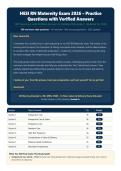
HESI RN Maternity Exam 2026 – Practice
Questions with Verified Answers
300 Questions with Verified Answers & Detailed Rationales | Updated for 2026
300 real exam-style questions · Full rationales · Why wrong explanations · 2026 updated
Dear Future RN,
I remember the countless hours I spent preparing for my HESI RN Maternity exam. The anxiety of not
knowing what to expect, the frustration of finding incomplete study materials, and the determination
to succeed. After weeks of dedicated preparation, I created this comprehensive practice guide using
the exact strategies that helped me pass with flying colors.
This study guide contains the most frequently tested concepts, challenging questions that mirror the
real exam, and detailed rationales that help you understand the "why" behind each answer. I have
carefully selected and refined these questions based on what I saw on my own exam and what my
peers reported seeing on theirs.
I believe in you. Trust the process, trust your preparation, and trust yourself. You've got this!
Good luck!
Written by Amanda S., RN, MSN, CNM – 14 Years Labor & Delivery Nurse Educator
Verified Solutions | 2026 Updated | Graded A+
Section Topics Covered Qs Weight
Section 1 Antepartum Care 45 15%
Section 2 Intrapartum Care & Labor 45 15%
Section 3 Postpartum Care 40 13%
Section 4 Newborn Care 45 15%
Section 5 High-Risk Pregnancy 40 13%
Section 6 Complications of Labor & Delivery 35 12%
Section 7 Maternal Health & Wellness 25 8%
Section 8 Neonatal Complications 25 9%
What You Will Find Inside This Study Guide
Antepartum Care (45 Qs - 15%): Prenatal care, fetal development, maternal changes, prenatal testing, and common
discomforts of pregnancy.
, Intrapartum Care & Labor (45 Qs - 15%): Stages of labor, fetal monitoring, pain management, interventions, and nursing
care during labor.
Postpartum Care (40 Qs - 13%): Recovery, lactation, postpartum assessment, maternal bonding, and postpartum
complications.
Newborn Care (45 Qs - 15%): Newborn assessment, APGAR scoring, feeding, newborn reflexes, and routine care.
High-Risk Pregnancy (40 Qs - 13%): Gestational diabetes, preeclampsia, multiple gestation, placenta previa, and preterm
labor.
Complications of Labor & Delivery (35 Qs - 12%): Dystocia, shoulder dystocia, umbilical cord complications, and
postpartum hemorrhage.
Maternal Health & Wellness (25 Qs - 8%): Nutrition, exercise, mental health, and prenatal education.
Neonatal Complications (25 Qs - 9%): Jaundice, respiratory distress syndrome, hypoglycemia, and birth injuries.
Section 1: Antepartum Care (45 questions)
Q1. A patient at 12 weeks gestation comes to the clinic complaining of nausea and vomiting. Which
intervention would be most appropriate to recommend?
A Eat small, frequent meals throughout the day
B Avoid fluids with meals
C Increase intake of high-fat foods
D Wait 3 hours between meals
E Take antacids with meals
Correct answer: A. Eat small, frequent meals throughout the day
Rationale: Small, frequent meals help prevent hypoglycemia and reduce nausea. Eating small amounts throughout
the day keeps blood sugar stable and helps manage nausea. Avoiding fluids with meals, high-fat foods, and long
gaps between meals can worsen symptoms.
Why wrong:
B: Avoid fluids with meals is incorrect
C: Increase intake of high-fat foods is incorrect
D: Wait 3 hours between meals is incorrect
E: Take antacids with meals is incorrect
Reference: HESI RN Maternity Study Guide · Lowdermilk's Maternity & Women's Health Care.
,Q2. A patient at 28 weeks gestation reports feeling dizzy and lightheaded when standing quickly.
What is the most likely cause of this symptom?
A Supine hypotensive syndrome
B Gestational diabetes
C Preeclampsia
D Anemia
E Hyperemesis gravidarum
Correct answer: A. Supine hypotensive syndrome
Rationale: Supine hypotensive syndrome is caused by compression of the vena cava from the enlarged uterus
when lying flat. This reduces venous return and cardiac output, causing dizziness and lightheadedness.
Why wrong:
B: Gestational diabetes is incorrect
C: Preeclampsia is incorrect
D: Anemia is incorrect
E: Hyperemesis gravidarum is incorrect
Reference: HESI RN Maternity Study Guide · Lowdermilk's Maternity & Women's Health Care.
Q3. A patient at 16 weeks gestation asks about screenings for chromosomal abnormalities. What test
should the nurse mention as a second-trimester screening option?
A Maternal serum alpha-fetoprotein (MSAFP)
B Chorionic villus sampling (CVS)
C Amniocentesis
D Non-invasive prenatal testing (NIPT)
E First-trimester screening
Correct answer: A. Maternal serum alpha-fetoprotein (MSAFP)
Rationale: Maternal serum alpha-fetoprotein (MSAFP) is a second-trimester screening test (typically at 15-20
weeks) that screens for neural tube defects and chromosomal abnormalities.
Why wrong:
B: Chorionic villus sampling (CVS) is incorrect
C: Amniocentesis is incorrect
D: Non-invasive prenatal testing (NIPT) is incorrect
E: First-trimester screening is incorrect
Reference: HESI RN Maternity Study Guide · Lowdermilk's Maternity & Women's Health Care.
, Q4. A patient at 32 weeks gestation is at risk for preterm labor. Which assessment finding would
indicate a potential problem?
A Regular uterine contractions
B Increased fetal movement
C Decreased back pain
D Weight gain of 1 pound
E Mild ankle swelling
Correct answer: A. Regular uterine contractions
Rationale: Regular uterine contractions before 37 weeks may indicate preterm labor. The patient should be
assessed for contraction frequency, duration, and intensity.
Why wrong:
B: Increased fetal movement is incorrect
C: Decreased back pain is incorrect
D: Weight gain of 1 pound is incorrect
E: Mild ankle swelling is incorrect
Reference: HESI RN Maternity Study Guide · Lowdermilk's Maternity & Women's Health Care.
Q5. A patient at 20 weeks gestation has experienced increased urinary frequency. What is the nurse's
best response?
A This is a normal symptom due to the expanding uterus
B This may indicate a urinary tract infection
C You should limit fluid intake after 6 PM
D This is a sign of gestational diabetes
E You should avoid caffeine completely
Correct answer: A. This is a normal symptom due to the expanding uterus
Rationale: Increased urinary frequency is a normal symptom in the second trimester due to the growing uterus
pressing on the bladder. It is not necessarily a sign of infection or diabetes.
Why wrong:
B: This may indicate a urinary tract infection is incorrect
C: You should limit fluid intake after 6 PM is incorrect
D: This is a sign of gestational diabetes is incorrect
E: You should avoid caffeine completely is incorrect
Reference: HESI RN Maternity Study Guide · Lowdermilk's Maternity & Women's Health Care.
Questions with Verified Answers
300 Questions with Verified Answers & Detailed Rationales | Updated for 2026
300 real exam-style questions · Full rationales · Why wrong explanations · 2026 updated
Dear Future RN,
I remember the countless hours I spent preparing for my HESI RN Maternity exam. The anxiety of not
knowing what to expect, the frustration of finding incomplete study materials, and the determination
to succeed. After weeks of dedicated preparation, I created this comprehensive practice guide using
the exact strategies that helped me pass with flying colors.
This study guide contains the most frequently tested concepts, challenging questions that mirror the
real exam, and detailed rationales that help you understand the "why" behind each answer. I have
carefully selected and refined these questions based on what I saw on my own exam and what my
peers reported seeing on theirs.
I believe in you. Trust the process, trust your preparation, and trust yourself. You've got this!
Good luck!
Written by Amanda S., RN, MSN, CNM – 14 Years Labor & Delivery Nurse Educator
Verified Solutions | 2026 Updated | Graded A+
Section Topics Covered Qs Weight
Section 1 Antepartum Care 45 15%
Section 2 Intrapartum Care & Labor 45 15%
Section 3 Postpartum Care 40 13%
Section 4 Newborn Care 45 15%
Section 5 High-Risk Pregnancy 40 13%
Section 6 Complications of Labor & Delivery 35 12%
Section 7 Maternal Health & Wellness 25 8%
Section 8 Neonatal Complications 25 9%
What You Will Find Inside This Study Guide
Antepartum Care (45 Qs - 15%): Prenatal care, fetal development, maternal changes, prenatal testing, and common
discomforts of pregnancy.
, Intrapartum Care & Labor (45 Qs - 15%): Stages of labor, fetal monitoring, pain management, interventions, and nursing
care during labor.
Postpartum Care (40 Qs - 13%): Recovery, lactation, postpartum assessment, maternal bonding, and postpartum
complications.
Newborn Care (45 Qs - 15%): Newborn assessment, APGAR scoring, feeding, newborn reflexes, and routine care.
High-Risk Pregnancy (40 Qs - 13%): Gestational diabetes, preeclampsia, multiple gestation, placenta previa, and preterm
labor.
Complications of Labor & Delivery (35 Qs - 12%): Dystocia, shoulder dystocia, umbilical cord complications, and
postpartum hemorrhage.
Maternal Health & Wellness (25 Qs - 8%): Nutrition, exercise, mental health, and prenatal education.
Neonatal Complications (25 Qs - 9%): Jaundice, respiratory distress syndrome, hypoglycemia, and birth injuries.
Section 1: Antepartum Care (45 questions)
Q1. A patient at 12 weeks gestation comes to the clinic complaining of nausea and vomiting. Which
intervention would be most appropriate to recommend?
A Eat small, frequent meals throughout the day
B Avoid fluids with meals
C Increase intake of high-fat foods
D Wait 3 hours between meals
E Take antacids with meals
Correct answer: A. Eat small, frequent meals throughout the day
Rationale: Small, frequent meals help prevent hypoglycemia and reduce nausea. Eating small amounts throughout
the day keeps blood sugar stable and helps manage nausea. Avoiding fluids with meals, high-fat foods, and long
gaps between meals can worsen symptoms.
Why wrong:
B: Avoid fluids with meals is incorrect
C: Increase intake of high-fat foods is incorrect
D: Wait 3 hours between meals is incorrect
E: Take antacids with meals is incorrect
Reference: HESI RN Maternity Study Guide · Lowdermilk's Maternity & Women's Health Care.
,Q2. A patient at 28 weeks gestation reports feeling dizzy and lightheaded when standing quickly.
What is the most likely cause of this symptom?
A Supine hypotensive syndrome
B Gestational diabetes
C Preeclampsia
D Anemia
E Hyperemesis gravidarum
Correct answer: A. Supine hypotensive syndrome
Rationale: Supine hypotensive syndrome is caused by compression of the vena cava from the enlarged uterus
when lying flat. This reduces venous return and cardiac output, causing dizziness and lightheadedness.
Why wrong:
B: Gestational diabetes is incorrect
C: Preeclampsia is incorrect
D: Anemia is incorrect
E: Hyperemesis gravidarum is incorrect
Reference: HESI RN Maternity Study Guide · Lowdermilk's Maternity & Women's Health Care.
Q3. A patient at 16 weeks gestation asks about screenings for chromosomal abnormalities. What test
should the nurse mention as a second-trimester screening option?
A Maternal serum alpha-fetoprotein (MSAFP)
B Chorionic villus sampling (CVS)
C Amniocentesis
D Non-invasive prenatal testing (NIPT)
E First-trimester screening
Correct answer: A. Maternal serum alpha-fetoprotein (MSAFP)
Rationale: Maternal serum alpha-fetoprotein (MSAFP) is a second-trimester screening test (typically at 15-20
weeks) that screens for neural tube defects and chromosomal abnormalities.
Why wrong:
B: Chorionic villus sampling (CVS) is incorrect
C: Amniocentesis is incorrect
D: Non-invasive prenatal testing (NIPT) is incorrect
E: First-trimester screening is incorrect
Reference: HESI RN Maternity Study Guide · Lowdermilk's Maternity & Women's Health Care.
, Q4. A patient at 32 weeks gestation is at risk for preterm labor. Which assessment finding would
indicate a potential problem?
A Regular uterine contractions
B Increased fetal movement
C Decreased back pain
D Weight gain of 1 pound
E Mild ankle swelling
Correct answer: A. Regular uterine contractions
Rationale: Regular uterine contractions before 37 weeks may indicate preterm labor. The patient should be
assessed for contraction frequency, duration, and intensity.
Why wrong:
B: Increased fetal movement is incorrect
C: Decreased back pain is incorrect
D: Weight gain of 1 pound is incorrect
E: Mild ankle swelling is incorrect
Reference: HESI RN Maternity Study Guide · Lowdermilk's Maternity & Women's Health Care.
Q5. A patient at 20 weeks gestation has experienced increased urinary frequency. What is the nurse's
best response?
A This is a normal symptom due to the expanding uterus
B This may indicate a urinary tract infection
C You should limit fluid intake after 6 PM
D This is a sign of gestational diabetes
E You should avoid caffeine completely
Correct answer: A. This is a normal symptom due to the expanding uterus
Rationale: Increased urinary frequency is a normal symptom in the second trimester due to the growing uterus
pressing on the bladder. It is not necessarily a sign of infection or diabetes.
Why wrong:
B: This may indicate a urinary tract infection is incorrect
C: You should limit fluid intake after 6 PM is incorrect
D: This is a sign of gestational diabetes is incorrect
E: You should avoid caffeine completely is incorrect
Reference: HESI RN Maternity Study Guide · Lowdermilk's Maternity & Women's Health Care.


