

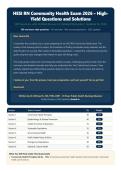
HESI RN Community Health Exam 2026 – High-
Yield Questions and Solutions
300 Questions with Verified Answers & Detailed Rationales | Updated for 2026
300 real exam-style questions · Full rationales · Why wrong explanations · 2026 updated
Dear Future RN,
I remember the countless hours I spent preparing for my HESI RN Community Health exam. The
anxiety of not knowing what to expect, the frustration of finding incomplete study materials, and the
determination to succeed. After weeks of dedicated preparation, I created this comprehensive practice
guide using the exact strategies that helped me pass with flying colors.
This study guide contains the most frequently tested concepts, challenging questions that mirror the
real exam, and detailed rationales that help you understand the "why" behind each answer. I have
carefully selected and refined these questions based on what I saw on my own exam and what my
peers reported seeing on theirs.
I believe in you. Trust the process, trust your preparation, and trust yourself. You've got this!
Good luck!
Written by Dr. Michael R., RN, PHN, DNP – 18 Years Public Health Nursing Educator
Verified Solutions | 2026 Updated | Graded A+
Section Topics Covered Qs Weight
Section 1 Community Health Principles 40 13%
Section 2 Epidemiology & Disease Prevention 40 13%
Section 3 Health Promotion & Education 35 12%
Section 4 Vulnerable Populations 35 12%
Section 5 Environmental Health 30 10%
Section 6 Public Health Policy & Ethics 30 10%
Section 7 Emergency Preparedness 30 10%
Section 8 Global & Cultural Health 60 20%
What You Will Find Inside This Study Guide
Community Health Principles (40 Qs - 13%): Community assessment, health systems, levels of prevention, and public
health core functions.
, Epidemiology & Disease Prevention (40 Qs - 13%): Epidemiological principles, disease transmission, outbreak
investigation, surveillance, and prevention strategies.
Health Promotion & Education (35 Qs - 12%): Health education models, program planning, behavior change, and
community partnerships.
Vulnerable Populations (35 Qs - 12%): Homelessness, poverty, minority health, rural health, and disparities in healthcare.
Environmental Health (30 Qs - 10%): Environmental hazards, occupational health, sanitation, food safety, and
environmental justice.
Public Health Policy & Ethics (30 Qs - 10%): Healthcare policy, funding, legal issues, ethical dilemmas, and advocacy.
Emergency Preparedness (30 Qs - 10%): Disaster response, bioterrorism, emergency planning, and mass casualty
incidents.
Global & Cultural Health (60 Qs - 20%): Cultural competence, global health issues, health equity, and international
healthcare systems.
Section 1: Community Health Principles (40 questions)
Q1. A community health nurse is conducting a windshield survey. What is the purpose of this
assessment method?
A Observing the community through direct visual assessment
B Conducting interviews with community leaders
C Analyzing epidemiological data
D Surveying households by mail
E Collecting health statistics from hospitals
Correct answer: A. Observing the community through direct visual assessment
Rationale: A windshield survey is an observational assessment method where the nurse drives or walks through
the community to visually assess environmental conditions, housing, health resources, and community
characteristics.
Why wrong:
B: Conducting interviews with community leaders is incorrect
C: Analyzing epidemiological data is incorrect
D: Surveying households by mail is incorrect
E: Collecting health statistics from hospitals is incorrect
Reference: HESI RN Community Health Study Guide · Stanhope & Lancaster's Community Health Nursing.
,Q2. What is the primary focus of primary prevention in community health?
A Preventing disease before it occurs
B Early detection and treatment of disease
C Rehabilitation and restoration of health
D Monitoring disease trends
E Providing palliative care
Correct answer: A. Preventing disease before it occurs
Rationale: Primary prevention focuses on preventing disease before it occurs through interventions such as
immunizations, health education, and environmental modifications. Secondary prevention focuses on early
detection, and tertiary prevention focuses on rehabilitation.
Why wrong:
B: Early detection and treatment of disease is incorrect
C: Rehabilitation and restoration of health is incorrect
D: Monitoring disease trends is incorrect
E: Providing palliative care is incorrect
Reference: HESI RN Community Health Study Guide · Stanhope & Lancaster's Community Health Nursing.
Q3. A community health nurse is using the epidemiological triad to assess an outbreak. What are the
three components of this model?
A Agent, host, environment
B Person, place, time
C Susceptibility, virulence, transmission
D Exposure, disease, outcome
E Pathogen, vector, reservoir
Correct answer: A. Agent, host, environment
Rationale: The epidemiological triad consists of the agent (cause of disease), host (susceptible person), and
environment (external factors). This model helps explain disease causation and transmission.
Why wrong:
B: Person, place, time is incorrect
C: Susceptibility, virulence, transmission is incorrect
D: Exposure, disease, outcome is incorrect
E: Pathogen, vector, reservoir is incorrect
Reference: HESI RN Community Health Study Guide · Stanhope & Lancaster's Community Health Nursing.
, Q4. A nurse is conducting a community assessment. Which data source would provide demographic
information about the community?
A U.S. Census Bureau
B Hospital discharge data
C Vital statistics
D Disease registries
E Police reports
Correct answer: A. U.S. Census Bureau
Rationale: The U.S. Census Bureau provides comprehensive demographic data including population size, age
distribution, race, ethnicity, income, and education levels. This is essential for community health assessments.
Why wrong:
B: Hospital discharge data is incorrect
C: Vital statistics is incorrect
D: Disease registries is incorrect
E: Police reports is incorrect
Reference: HESI RN Community Health Study Guide · Stanhope & Lancaster's Community Health Nursing.
Q5. A community health nurse is implementing a program to reduce obesity in children. This is an
example of which level of prevention?
A Primary prevention
B Secondary prevention
C Tertiary prevention
D Quaternary prevention
E Health promotion only
Correct answer: A. Primary prevention
Rationale: Implementing a program to reduce obesity before it develops is primary prevention. This intervention
aims to prevent the disease from occurring through health education and lifestyle modifications.
Why wrong:
B: Secondary prevention is incorrect
C: Tertiary prevention is incorrect
D: Quaternary prevention is incorrect
E: Health promotion only is incorrect
Reference: HESI RN Community Health Study Guide · Stanhope & Lancaster's Community Health Nursing.
Yield Questions and Solutions
300 Questions with Verified Answers & Detailed Rationales | Updated for 2026
300 real exam-style questions · Full rationales · Why wrong explanations · 2026 updated
Dear Future RN,
I remember the countless hours I spent preparing for my HESI RN Community Health exam. The
anxiety of not knowing what to expect, the frustration of finding incomplete study materials, and the
determination to succeed. After weeks of dedicated preparation, I created this comprehensive practice
guide using the exact strategies that helped me pass with flying colors.
This study guide contains the most frequently tested concepts, challenging questions that mirror the
real exam, and detailed rationales that help you understand the "why" behind each answer. I have
carefully selected and refined these questions based on what I saw on my own exam and what my
peers reported seeing on theirs.
I believe in you. Trust the process, trust your preparation, and trust yourself. You've got this!
Good luck!
Written by Dr. Michael R., RN, PHN, DNP – 18 Years Public Health Nursing Educator
Verified Solutions | 2026 Updated | Graded A+
Section Topics Covered Qs Weight
Section 1 Community Health Principles 40 13%
Section 2 Epidemiology & Disease Prevention 40 13%
Section 3 Health Promotion & Education 35 12%
Section 4 Vulnerable Populations 35 12%
Section 5 Environmental Health 30 10%
Section 6 Public Health Policy & Ethics 30 10%
Section 7 Emergency Preparedness 30 10%
Section 8 Global & Cultural Health 60 20%
What You Will Find Inside This Study Guide
Community Health Principles (40 Qs - 13%): Community assessment, health systems, levels of prevention, and public
health core functions.
, Epidemiology & Disease Prevention (40 Qs - 13%): Epidemiological principles, disease transmission, outbreak
investigation, surveillance, and prevention strategies.
Health Promotion & Education (35 Qs - 12%): Health education models, program planning, behavior change, and
community partnerships.
Vulnerable Populations (35 Qs - 12%): Homelessness, poverty, minority health, rural health, and disparities in healthcare.
Environmental Health (30 Qs - 10%): Environmental hazards, occupational health, sanitation, food safety, and
environmental justice.
Public Health Policy & Ethics (30 Qs - 10%): Healthcare policy, funding, legal issues, ethical dilemmas, and advocacy.
Emergency Preparedness (30 Qs - 10%): Disaster response, bioterrorism, emergency planning, and mass casualty
incidents.
Global & Cultural Health (60 Qs - 20%): Cultural competence, global health issues, health equity, and international
healthcare systems.
Section 1: Community Health Principles (40 questions)
Q1. A community health nurse is conducting a windshield survey. What is the purpose of this
assessment method?
A Observing the community through direct visual assessment
B Conducting interviews with community leaders
C Analyzing epidemiological data
D Surveying households by mail
E Collecting health statistics from hospitals
Correct answer: A. Observing the community through direct visual assessment
Rationale: A windshield survey is an observational assessment method where the nurse drives or walks through
the community to visually assess environmental conditions, housing, health resources, and community
characteristics.
Why wrong:
B: Conducting interviews with community leaders is incorrect
C: Analyzing epidemiological data is incorrect
D: Surveying households by mail is incorrect
E: Collecting health statistics from hospitals is incorrect
Reference: HESI RN Community Health Study Guide · Stanhope & Lancaster's Community Health Nursing.
,Q2. What is the primary focus of primary prevention in community health?
A Preventing disease before it occurs
B Early detection and treatment of disease
C Rehabilitation and restoration of health
D Monitoring disease trends
E Providing palliative care
Correct answer: A. Preventing disease before it occurs
Rationale: Primary prevention focuses on preventing disease before it occurs through interventions such as
immunizations, health education, and environmental modifications. Secondary prevention focuses on early
detection, and tertiary prevention focuses on rehabilitation.
Why wrong:
B: Early detection and treatment of disease is incorrect
C: Rehabilitation and restoration of health is incorrect
D: Monitoring disease trends is incorrect
E: Providing palliative care is incorrect
Reference: HESI RN Community Health Study Guide · Stanhope & Lancaster's Community Health Nursing.
Q3. A community health nurse is using the epidemiological triad to assess an outbreak. What are the
three components of this model?
A Agent, host, environment
B Person, place, time
C Susceptibility, virulence, transmission
D Exposure, disease, outcome
E Pathogen, vector, reservoir
Correct answer: A. Agent, host, environment
Rationale: The epidemiological triad consists of the agent (cause of disease), host (susceptible person), and
environment (external factors). This model helps explain disease causation and transmission.
Why wrong:
B: Person, place, time is incorrect
C: Susceptibility, virulence, transmission is incorrect
D: Exposure, disease, outcome is incorrect
E: Pathogen, vector, reservoir is incorrect
Reference: HESI RN Community Health Study Guide · Stanhope & Lancaster's Community Health Nursing.
, Q4. A nurse is conducting a community assessment. Which data source would provide demographic
information about the community?
A U.S. Census Bureau
B Hospital discharge data
C Vital statistics
D Disease registries
E Police reports
Correct answer: A. U.S. Census Bureau
Rationale: The U.S. Census Bureau provides comprehensive demographic data including population size, age
distribution, race, ethnicity, income, and education levels. This is essential for community health assessments.
Why wrong:
B: Hospital discharge data is incorrect
C: Vital statistics is incorrect
D: Disease registries is incorrect
E: Police reports is incorrect
Reference: HESI RN Community Health Study Guide · Stanhope & Lancaster's Community Health Nursing.
Q5. A community health nurse is implementing a program to reduce obesity in children. This is an
example of which level of prevention?
A Primary prevention
B Secondary prevention
C Tertiary prevention
D Quaternary prevention
E Health promotion only
Correct answer: A. Primary prevention
Rationale: Implementing a program to reduce obesity before it develops is primary prevention. This intervention
aims to prevent the disease from occurring through health education and lifestyle modifications.
Why wrong:
B: Secondary prevention is incorrect
C: Tertiary prevention is incorrect
D: Quaternary prevention is incorrect
E: Health promotion only is incorrect
Reference: HESI RN Community Health Study Guide · Stanhope & Lancaster's Community Health Nursing.


