

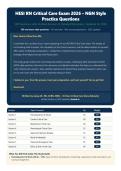
HESI RN Critical Care Exam 2026 – NGN Style
Practice Questions
300 Questions with Verified Answers & Detailed Rationales | Updated for 2026
300 real exam-style questions · Full rationales · Why wrong explanations · 2026 updated
Dear Future Critical Care RN,
I remember the countless hours I spent preparing for my HESI RN Critical Care exam. The anxiety of
not knowing what to expect, the complexity of the clinical scenarios, and the determination to succeed.
After weeks of dedicated preparation, I created this comprehensive practice guide using the exact
strategies that helped me pass with flying colors.
This study guide contains the most frequently tested concepts, challenging Next Generation NCLEX
(NGN) style questions that mirror the real exam, and detailed rationales that help you understand the
"why" behind each answer. I have carefully selected and refined these questions based on what I saw
on my own exam and what my peers reported seeing on theirs.
I believe in you. Trust the process, trust your preparation, and trust yourself. You've got this!
Good luck!
Written by James W., RN, CCRN, MSN – 16 Years Critical Care Nurse Educator
Verified Solutions | 2026 Updated | Graded A+
Section Topics Covered Qs Weight
Section 1 Hemodynamics & Shock 40 13%
Section 2 Cardiac Critical Care 40 13%
Section 3 Respiratory Critical Care 40 13%
Section 4 Neurological Critical Care 35 12%
Section 5 Sepsis & Infectious Disease 35 12%
Section 6 Renal & Metabolic 35 12%
Section 7 Trauma & Emergency Care 35 12%
Section 8 Ethics & End-of-Life Care 40 13%
What You Will Find Inside This Study Guide
Hemodynamics & Shock (40 Qs - 13%): Types of shock, hemodynamic monitoring, vasopressors, fluid resuscitation, and
nursing management.
, Cardiac Critical Care (40 Qs - 13%): Acute MI, heart failure, arrhythmias, cardiac arrest, post-cardiac surgery, and
advanced cardiac life support.
Respiratory Critical Care (40 Qs - 13%): ARDS, mechanical ventilation, respiratory failure, pulmonary embolism, and ABG
interpretation.
Neurological Critical Care (35 Qs - 12%): Stroke, traumatic brain injury, ICP monitoring, status epilepticus, and spinal cord
injury.
Sepsis & Infectious Disease (35 Qs - 12%): Sepsis recognition, septic shock, antibiotic management, and infection
prevention in the ICU.
Renal & Metabolic (35 Qs - 12%): Acute kidney injury, renal replacement therapy, electrolyte imbalances, and acid-base
disorders.
Trauma & Emergency Care (35 Qs - 12%): Multiple trauma, burns, rapid sequence intubation, and initial assessment in
emergency situations.
Ethics & End-of-Life Care (40 Qs - 13%): Ethical dilemmas, advance directives, palliative care, DNR discussions, and family
support.
Section 1: Hemodynamics & Shock (40 questions)
Q1. A patient with septic shock has a cardiac output of 8 L/min and a systemic vascular resistance of
400 dynes/sec/cm⁻⁵. Which hemodynamic pattern does this represent?
A Warm shock
B Cold shock
C Cardiogenic shock
D Obstructive shock
E Hypovolemic shock
Correct answer: A. Warm shock
Rationale: This is the classic pattern of warm shock (hyperdynamic septic shock) with high cardiac output and low
SVR. Vasodilation from inflammatory mediators causes the low SVR, and the heart responds with increased cardiac
output.
Why wrong:
B: Cold shock is incorrect
C: Cardiogenic shock is incorrect
D: Obstructive shock is incorrect
E: Hypovolemic shock is incorrect
Reference: HESI RN Critical Care Study Guide · AACN Critical Care Nursing · ACLS Provider Manual.
,Q2. A patient in cardiogenic shock has the following parameters: CVP 12 mmHg, PAOP 18 mmHg, CO
2.5 L/min, SVR 1800 dynes/sec/cm⁻⁵. Which intervention is most appropriate?
A Administer dobutamine
B Administer nitroprusside
C Administer isotonic fluids
D Administer epinephrine
E Prepare for pericardiocentesis
Correct answer: A. Administer dobutamine
Rationale: The patient has elevated filling pressures (CVP, PAOP) and low cardiac output with high SVR, consistent
with cardiogenic shock. Dobutamine, an inotrope with vasodilatory properties, is indicated to increase cardiac
output while reducing afterload.
Why wrong:
B: Administer nitroprusside is incorrect
C: Administer isotonic fluids is incorrect
D: Administer epinephrine is incorrect
E: Prepare for pericardiocentesis is incorrect
Reference: HESI RN Critical Care Study Guide · AACN Critical Care Nursing · ACLS Provider Manual.
Q3. A patient with hemorrhagic shock has a MAP of 60 mmHg. Which of the following interventions
should the nurse prepare to implement first?
A Administer crystalloid fluid bolus
B Administer vasopressors
C Initiate massive transfusion protocol
D Prepare for surgical intervention
E Administer blood products
Correct answer: A. Administer crystalloid fluid bolus
Rationale: In hemorrhagic shock, the first priority is fluid resuscitation with crystalloids to restore intravascular
volume. Vasopressors may be added if fluid resuscitation is insufficient. Blood products should be administered
when available.
Why wrong:
B: Administer vasopressors is incorrect
C: Initiate massive transfusion protocol is incorrect
D: Prepare for surgical intervention is incorrect
E: Administer blood products is incorrect
Reference: HESI RN Critical Care Study Guide · AACN Critical Care Nursing · ACLS Provider Manual.
, Q4. A patient is being monitored with an arterial line. The nurse notes a dampened waveform. What
is the priority action?
A Check the system for air bubbles, clots, or loose connections
B Zero the transducer
C Reposition the patient
D Replace the transducer
E Notify the provider
Correct answer: A. Check the system for air bubbles, clots, or loose connections
Rationale: A dampened waveform indicates a problem with the arterial line system such as air bubbles, clots, loose
connections, or kinking of the tubing. The nurse should check for these issues first before other interventions.
Why wrong:
B: Zero the transducer is incorrect
C: Reposition the patient is incorrect
D: Replace the transducer is incorrect
E: Notify the provider is incorrect
Reference: HESI RN Critical Care Study Guide · AACN Critical Care Nursing · ACLS Provider Manual.
Q5. A patient in shock has a lactate level of 6 mmol/L. What does this value indicate?
A Tissue hypoperfusion and anaerobic metabolism
B Adequate tissue oxygenation
C Liver dysfunction
D Kidney failure
E Normal finding in ICU patients
Correct answer: A. Tissue hypoperfusion and anaerobic metabolism
Rationale: An elevated lactate level (>2 mmol/L) indicates tissue hypoperfusion and anaerobic metabolism, which
is a sign of shock. Lactate levels are used as a marker of severity and response to treatment in shock.
Why wrong:
B: Adequate tissue oxygenation is incorrect
C: Liver dysfunction is incorrect
D: Kidney failure is incorrect
E: Normal finding in ICU patients is incorrect
Reference: HESI RN Critical Care Study Guide · AACN Critical Care Nursing · ACLS Provider Manual.
Practice Questions
300 Questions with Verified Answers & Detailed Rationales | Updated for 2026
300 real exam-style questions · Full rationales · Why wrong explanations · 2026 updated
Dear Future Critical Care RN,
I remember the countless hours I spent preparing for my HESI RN Critical Care exam. The anxiety of
not knowing what to expect, the complexity of the clinical scenarios, and the determination to succeed.
After weeks of dedicated preparation, I created this comprehensive practice guide using the exact
strategies that helped me pass with flying colors.
This study guide contains the most frequently tested concepts, challenging Next Generation NCLEX
(NGN) style questions that mirror the real exam, and detailed rationales that help you understand the
"why" behind each answer. I have carefully selected and refined these questions based on what I saw
on my own exam and what my peers reported seeing on theirs.
I believe in you. Trust the process, trust your preparation, and trust yourself. You've got this!
Good luck!
Written by James W., RN, CCRN, MSN – 16 Years Critical Care Nurse Educator
Verified Solutions | 2026 Updated | Graded A+
Section Topics Covered Qs Weight
Section 1 Hemodynamics & Shock 40 13%
Section 2 Cardiac Critical Care 40 13%
Section 3 Respiratory Critical Care 40 13%
Section 4 Neurological Critical Care 35 12%
Section 5 Sepsis & Infectious Disease 35 12%
Section 6 Renal & Metabolic 35 12%
Section 7 Trauma & Emergency Care 35 12%
Section 8 Ethics & End-of-Life Care 40 13%
What You Will Find Inside This Study Guide
Hemodynamics & Shock (40 Qs - 13%): Types of shock, hemodynamic monitoring, vasopressors, fluid resuscitation, and
nursing management.
, Cardiac Critical Care (40 Qs - 13%): Acute MI, heart failure, arrhythmias, cardiac arrest, post-cardiac surgery, and
advanced cardiac life support.
Respiratory Critical Care (40 Qs - 13%): ARDS, mechanical ventilation, respiratory failure, pulmonary embolism, and ABG
interpretation.
Neurological Critical Care (35 Qs - 12%): Stroke, traumatic brain injury, ICP monitoring, status epilepticus, and spinal cord
injury.
Sepsis & Infectious Disease (35 Qs - 12%): Sepsis recognition, septic shock, antibiotic management, and infection
prevention in the ICU.
Renal & Metabolic (35 Qs - 12%): Acute kidney injury, renal replacement therapy, electrolyte imbalances, and acid-base
disorders.
Trauma & Emergency Care (35 Qs - 12%): Multiple trauma, burns, rapid sequence intubation, and initial assessment in
emergency situations.
Ethics & End-of-Life Care (40 Qs - 13%): Ethical dilemmas, advance directives, palliative care, DNR discussions, and family
support.
Section 1: Hemodynamics & Shock (40 questions)
Q1. A patient with septic shock has a cardiac output of 8 L/min and a systemic vascular resistance of
400 dynes/sec/cm⁻⁵. Which hemodynamic pattern does this represent?
A Warm shock
B Cold shock
C Cardiogenic shock
D Obstructive shock
E Hypovolemic shock
Correct answer: A. Warm shock
Rationale: This is the classic pattern of warm shock (hyperdynamic septic shock) with high cardiac output and low
SVR. Vasodilation from inflammatory mediators causes the low SVR, and the heart responds with increased cardiac
output.
Why wrong:
B: Cold shock is incorrect
C: Cardiogenic shock is incorrect
D: Obstructive shock is incorrect
E: Hypovolemic shock is incorrect
Reference: HESI RN Critical Care Study Guide · AACN Critical Care Nursing · ACLS Provider Manual.
,Q2. A patient in cardiogenic shock has the following parameters: CVP 12 mmHg, PAOP 18 mmHg, CO
2.5 L/min, SVR 1800 dynes/sec/cm⁻⁵. Which intervention is most appropriate?
A Administer dobutamine
B Administer nitroprusside
C Administer isotonic fluids
D Administer epinephrine
E Prepare for pericardiocentesis
Correct answer: A. Administer dobutamine
Rationale: The patient has elevated filling pressures (CVP, PAOP) and low cardiac output with high SVR, consistent
with cardiogenic shock. Dobutamine, an inotrope with vasodilatory properties, is indicated to increase cardiac
output while reducing afterload.
Why wrong:
B: Administer nitroprusside is incorrect
C: Administer isotonic fluids is incorrect
D: Administer epinephrine is incorrect
E: Prepare for pericardiocentesis is incorrect
Reference: HESI RN Critical Care Study Guide · AACN Critical Care Nursing · ACLS Provider Manual.
Q3. A patient with hemorrhagic shock has a MAP of 60 mmHg. Which of the following interventions
should the nurse prepare to implement first?
A Administer crystalloid fluid bolus
B Administer vasopressors
C Initiate massive transfusion protocol
D Prepare for surgical intervention
E Administer blood products
Correct answer: A. Administer crystalloid fluid bolus
Rationale: In hemorrhagic shock, the first priority is fluid resuscitation with crystalloids to restore intravascular
volume. Vasopressors may be added if fluid resuscitation is insufficient. Blood products should be administered
when available.
Why wrong:
B: Administer vasopressors is incorrect
C: Initiate massive transfusion protocol is incorrect
D: Prepare for surgical intervention is incorrect
E: Administer blood products is incorrect
Reference: HESI RN Critical Care Study Guide · AACN Critical Care Nursing · ACLS Provider Manual.
, Q4. A patient is being monitored with an arterial line. The nurse notes a dampened waveform. What
is the priority action?
A Check the system for air bubbles, clots, or loose connections
B Zero the transducer
C Reposition the patient
D Replace the transducer
E Notify the provider
Correct answer: A. Check the system for air bubbles, clots, or loose connections
Rationale: A dampened waveform indicates a problem with the arterial line system such as air bubbles, clots, loose
connections, or kinking of the tubing. The nurse should check for these issues first before other interventions.
Why wrong:
B: Zero the transducer is incorrect
C: Reposition the patient is incorrect
D: Replace the transducer is incorrect
E: Notify the provider is incorrect
Reference: HESI RN Critical Care Study Guide · AACN Critical Care Nursing · ACLS Provider Manual.
Q5. A patient in shock has a lactate level of 6 mmol/L. What does this value indicate?
A Tissue hypoperfusion and anaerobic metabolism
B Adequate tissue oxygenation
C Liver dysfunction
D Kidney failure
E Normal finding in ICU patients
Correct answer: A. Tissue hypoperfusion and anaerobic metabolism
Rationale: An elevated lactate level (>2 mmol/L) indicates tissue hypoperfusion and anaerobic metabolism, which
is a sign of shock. Lactate levels are used as a marker of severity and response to treatment in shock.
Why wrong:
B: Adequate tissue oxygenation is incorrect
C: Liver dysfunction is incorrect
D: Kidney failure is incorrect
E: Normal finding in ICU patients is incorrect
Reference: HESI RN Critical Care Study Guide · AACN Critical Care Nursing · ACLS Provider Manual.


