

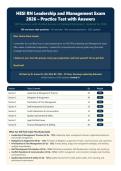
HESI RN Leadership and Management Exam
2026 – Practice Test with Answers
300 Questions with Verified Answers & Detailed Rationales | Updated for 2026
300 real exam-style questions · Full rationales · Why wrong explanations · 2026 updated
Dear Future Nurse Leader,
I remember the countless hours I spent preparing for my HESI RN Leadership and Management exam.
After weeks of dedicated preparation, I created this comprehensive practice guide using the exact
strategies that helped me pass with flying colors.
I believe in you. Trust the process, trust your preparation, and trust yourself. You've got this!
Good luck!
Written by Dr. Susan M., RN, NEA-BC, PhD – 20 Years Nursing Leadership Educator
Verified Solutions | 2026 Updated | Graded A+
Section Topics Covered Qs Weight
Section 1 Leadership & Management Theories 40 13%
Section 2 Delegation & Assignment 40 13%
Section 3 Prioritization & Time Management 35 12%
Section 4 Staff Development & Evaluation 35 12%
Section 5 Conflict Resolution & Communication 35 12%
Section 6 Quality Improvement & Safety 35 12%
Section 7 Legal & Ethical Issues 40 13%
Section 8 Financial Management & Staffing 40 13%
What You Will Find Inside This Study Guide
Leadership & Management Theories (40 Qs - 13%): Leadership styles, management theories, organizational behavior,
and change management.
Delegation & Assignment (40 Qs - 13%): Principles of delegation, assignment of tasks, scope of practice, and supervision.
Prioritization & Time Management (35 Qs - 12%): Priority setting, triage, time management strategies, and handling
multiple responsibilities.
Staff Development & Evaluation (35 Qs - 12%): Performance evaluation, staff development, coaching, and mentoring.
Conflict Resolution & Communication (35 Qs - 12%): Conflict management, communication strategies, team building,
and assertiveness.
Quality Improvement & Safety (35 Qs - 12%): Quality improvement models, patient safety, error reporting, and
performance improvement.
, Legal & Ethical Issues (40 Qs - 13%): Nursing law, ethics, informed consent, advanced directives, and professional
boundaries.
Financial Management & Staffing (40 Qs - 13%): Budgeting, staffing models, resource allocation, and productivity
measurement.
Section 1: Leadership & Management Theories (40 questions)
Q1. A nurse manager is implementing a change on the unit. Staff members are resistant and
questioning the need for change. Which leadership style would be most effective in this situation?
A Transformational leadership
B Autocratic leadership
C Laissez-faire leadership
D Transactional leadership
E Passive leadership
Correct answer: A. Transformational leadership
Rationale: Transformational leadership is most effective when implementing change because it inspires and
motivates staff to embrace change. It involves communicating the vision, building trust, and supporting staff
through the change process.
Why wrong:
B: Autocratic leadership is incorrect
C: Laissez-faire leadership is incorrect
D: Transactional leadership is incorrect
E: Passive leadership is incorrect
Reference: HESI RN Leadership & Management Study Guide · Sullivan's Effective Leadership and Management in
Nursing.
Q2. A nurse manager uses a leadership style that involves staff in decision-making and seeks input
from the team. This is an example of which leadership style?
A Democratic leadership
B Autocratic leadership
C Laissez-faire leadership
D Bureaucratic leadership
E Transactional leadership
Correct answer: A. Democratic leadership
Rationale: Democratic leadership involves staff participation in decision-making and values input from team
members. This style fosters collaboration and empowers staff.
Why wrong:
B: Autocratic leadership is incorrect
C: Laissez-faire leadership is incorrect
D: Bureaucratic leadership is incorrect
E: Transactional leadership is incorrect
Reference: HESI RN Leadership & Management Study Guide · Sullivan's Effective Leadership and Management in
Nursing.
,Q3. A nurse manager is responsible for overseeing a unit with high turnover. Which management
theory would best address staff retention?
A Human resource management theory
B Classical management theory
C Scientific management theory
D Bureaucratic management theory
E Total quality management
Correct answer: A. Human resource management theory
Rationale: Human resource management theory focuses on employee well-being, motivation, and satisfaction.
This approach addresses the root causes of turnover by improving working conditions and staff satisfaction.
Why wrong:
B: Classical management theory is incorrect
C: Scientific management theory is incorrect
D: Bureaucratic management theory is incorrect
E: Total quality management is incorrect
Reference: HESI RN Leadership & Management Study Guide · Sullivan's Effective Leadership and Management in
Nursing.
Q4. A nurse manager is leading a quality improvement initiative. Which leadership style would be
most effective for motivating staff to participate?
A Transformational leadership
B Autocratic leadership
C Laissez-faire leadership
D Transactional leadership
E Laissez-faire leadership
Correct answer: A. Transformational leadership
Rationale: Transformational leadership is most effective for motivating staff participation in quality improvement.
This style inspires commitment and empowers staff to take ownership of quality initiatives.
Why wrong:
B: Autocratic leadership is incorrect
C: Laissez-faire leadership is incorrect
D: Transactional leadership is incorrect
E: Laissez-faire leadership is incorrect
Reference: HESI RN Leadership & Management Study Guide · Sullivan's Effective Leadership and Management in
Nursing.
, Q5. A nurse manager notices that a staff nurse is frequently late to work and appears disengaged.
What is the most appropriate initial management action?
A Schedule a private meeting to discuss the behavior
B Write up the staff nurse immediately
C Ignore the behavior
D Discuss the issue with other staff
E Send a memo to all staff about punctuality
Correct answer: A. Schedule a private meeting to discuss the behavior
Rationale: The most appropriate initial action is to schedule a private meeting to discuss the behavior. This allows
the manager to understand the cause of the behavior and address it constructively.
Why wrong:
B: Write up the staff nurse immediately is incorrect
C: Ignore the behavior is incorrect
D: Discuss the issue with other staff is incorrect
E: Send a memo to all staff about punctuality is incorrect
Reference: HESI RN Leadership & Management Study Guide · Sullivan's Effective Leadership and Management in
Nursing.
Q6. A nurse manager uses rewards and consequences to influence staff behavior. This is an example
of which leadership style?
A Transactional leadership
B Transformational leadership
C Laissez-faire leadership
D Democratic leadership
E Servant leadership
Correct answer: A. Transactional leadership
Rationale: Transactional leadership focuses on supervision, organization, and performance monitoring. It uses
rewards and consequences to motivate staff.
Why wrong:
B: Transformational leadership is incorrect
C: Laissez-faire leadership is incorrect
D: Democratic leadership is incorrect
E: Servant leadership is incorrect
Reference: HESI RN Leadership & Management Study Guide · Sullivan's Effective Leadership and Management in
Nursing.
2026 – Practice Test with Answers
300 Questions with Verified Answers & Detailed Rationales | Updated for 2026
300 real exam-style questions · Full rationales · Why wrong explanations · 2026 updated
Dear Future Nurse Leader,
I remember the countless hours I spent preparing for my HESI RN Leadership and Management exam.
After weeks of dedicated preparation, I created this comprehensive practice guide using the exact
strategies that helped me pass with flying colors.
I believe in you. Trust the process, trust your preparation, and trust yourself. You've got this!
Good luck!
Written by Dr. Susan M., RN, NEA-BC, PhD – 20 Years Nursing Leadership Educator
Verified Solutions | 2026 Updated | Graded A+
Section Topics Covered Qs Weight
Section 1 Leadership & Management Theories 40 13%
Section 2 Delegation & Assignment 40 13%
Section 3 Prioritization & Time Management 35 12%
Section 4 Staff Development & Evaluation 35 12%
Section 5 Conflict Resolution & Communication 35 12%
Section 6 Quality Improvement & Safety 35 12%
Section 7 Legal & Ethical Issues 40 13%
Section 8 Financial Management & Staffing 40 13%
What You Will Find Inside This Study Guide
Leadership & Management Theories (40 Qs - 13%): Leadership styles, management theories, organizational behavior,
and change management.
Delegation & Assignment (40 Qs - 13%): Principles of delegation, assignment of tasks, scope of practice, and supervision.
Prioritization & Time Management (35 Qs - 12%): Priority setting, triage, time management strategies, and handling
multiple responsibilities.
Staff Development & Evaluation (35 Qs - 12%): Performance evaluation, staff development, coaching, and mentoring.
Conflict Resolution & Communication (35 Qs - 12%): Conflict management, communication strategies, team building,
and assertiveness.
Quality Improvement & Safety (35 Qs - 12%): Quality improvement models, patient safety, error reporting, and
performance improvement.
, Legal & Ethical Issues (40 Qs - 13%): Nursing law, ethics, informed consent, advanced directives, and professional
boundaries.
Financial Management & Staffing (40 Qs - 13%): Budgeting, staffing models, resource allocation, and productivity
measurement.
Section 1: Leadership & Management Theories (40 questions)
Q1. A nurse manager is implementing a change on the unit. Staff members are resistant and
questioning the need for change. Which leadership style would be most effective in this situation?
A Transformational leadership
B Autocratic leadership
C Laissez-faire leadership
D Transactional leadership
E Passive leadership
Correct answer: A. Transformational leadership
Rationale: Transformational leadership is most effective when implementing change because it inspires and
motivates staff to embrace change. It involves communicating the vision, building trust, and supporting staff
through the change process.
Why wrong:
B: Autocratic leadership is incorrect
C: Laissez-faire leadership is incorrect
D: Transactional leadership is incorrect
E: Passive leadership is incorrect
Reference: HESI RN Leadership & Management Study Guide · Sullivan's Effective Leadership and Management in
Nursing.
Q2. A nurse manager uses a leadership style that involves staff in decision-making and seeks input
from the team. This is an example of which leadership style?
A Democratic leadership
B Autocratic leadership
C Laissez-faire leadership
D Bureaucratic leadership
E Transactional leadership
Correct answer: A. Democratic leadership
Rationale: Democratic leadership involves staff participation in decision-making and values input from team
members. This style fosters collaboration and empowers staff.
Why wrong:
B: Autocratic leadership is incorrect
C: Laissez-faire leadership is incorrect
D: Bureaucratic leadership is incorrect
E: Transactional leadership is incorrect
Reference: HESI RN Leadership & Management Study Guide · Sullivan's Effective Leadership and Management in
Nursing.
,Q3. A nurse manager is responsible for overseeing a unit with high turnover. Which management
theory would best address staff retention?
A Human resource management theory
B Classical management theory
C Scientific management theory
D Bureaucratic management theory
E Total quality management
Correct answer: A. Human resource management theory
Rationale: Human resource management theory focuses on employee well-being, motivation, and satisfaction.
This approach addresses the root causes of turnover by improving working conditions and staff satisfaction.
Why wrong:
B: Classical management theory is incorrect
C: Scientific management theory is incorrect
D: Bureaucratic management theory is incorrect
E: Total quality management is incorrect
Reference: HESI RN Leadership & Management Study Guide · Sullivan's Effective Leadership and Management in
Nursing.
Q4. A nurse manager is leading a quality improvement initiative. Which leadership style would be
most effective for motivating staff to participate?
A Transformational leadership
B Autocratic leadership
C Laissez-faire leadership
D Transactional leadership
E Laissez-faire leadership
Correct answer: A. Transformational leadership
Rationale: Transformational leadership is most effective for motivating staff participation in quality improvement.
This style inspires commitment and empowers staff to take ownership of quality initiatives.
Why wrong:
B: Autocratic leadership is incorrect
C: Laissez-faire leadership is incorrect
D: Transactional leadership is incorrect
E: Laissez-faire leadership is incorrect
Reference: HESI RN Leadership & Management Study Guide · Sullivan's Effective Leadership and Management in
Nursing.
, Q5. A nurse manager notices that a staff nurse is frequently late to work and appears disengaged.
What is the most appropriate initial management action?
A Schedule a private meeting to discuss the behavior
B Write up the staff nurse immediately
C Ignore the behavior
D Discuss the issue with other staff
E Send a memo to all staff about punctuality
Correct answer: A. Schedule a private meeting to discuss the behavior
Rationale: The most appropriate initial action is to schedule a private meeting to discuss the behavior. This allows
the manager to understand the cause of the behavior and address it constructively.
Why wrong:
B: Write up the staff nurse immediately is incorrect
C: Ignore the behavior is incorrect
D: Discuss the issue with other staff is incorrect
E: Send a memo to all staff about punctuality is incorrect
Reference: HESI RN Leadership & Management Study Guide · Sullivan's Effective Leadership and Management in
Nursing.
Q6. A nurse manager uses rewards and consequences to influence staff behavior. This is an example
of which leadership style?
A Transactional leadership
B Transformational leadership
C Laissez-faire leadership
D Democratic leadership
E Servant leadership
Correct answer: A. Transactional leadership
Rationale: Transactional leadership focuses on supervision, organization, and performance monitoring. It uses
rewards and consequences to motivate staff.
Why wrong:
B: Transformational leadership is incorrect
C: Laissez-faire leadership is incorrect
D: Democratic leadership is incorrect
E: Servant leadership is incorrect
Reference: HESI RN Leadership & Management Study Guide · Sullivan's Effective Leadership and Management in
Nursing.


