

Developmental disabilities 2
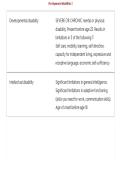
Developmental disability SEVERE OR CHRONIC mental or physical
disability. Present before age 22. Results in
limitations in 3 of the following 7:
Self care, mobility, learning, self direction,
capacity for independent living, expressive and
receptive language, economic self-sufficiency
Intellectual disability Significant limitations in general intelligence.
Significant limitations in adaptive functioning
(skills you need for work, communication skills).
Age of onset before age 18
, Developmental disabilities 2
Early attitudes toward disability -Disability not clearly defined/recognized.
- "demonological" explanations ( explanation
was that it was a curse, lot of evil)
- Aristotle "let there be a law that no deformed
child shall live"
- Plato " the best of either sex should be united
with the best as often, and the inferior with the
inferior as seldom as possible"
- some began to recognize physical causes
(Hippocrates, Galen)
- some increased sympathy- rise of Christianity
, Developmental disabilities 2
Middle Ages/ Renaissance - dominated by the idea of God
- first asylum created by Roman Catholic
Church
- Renaissance-- gains in understanding of
disability
-John Locke- mind as "tabula rasa" (blank state)
Emergence of a Field (1700s- -French revolution (1792-1802) stress on the
1800s) worth and divinity of all human beings
- Philip Pinel: French psychiatrist. Led
movement to manage people in institutions
more humanely, end physical abuse and
confinement
, Developmental disabilities 2
Notable efforts in the 1700s and -Jeane-Marc Itard: "wild boy of Aveyron"
1800s Europe (victor). Believed Victors skill deficits were due
to environment and could be developed by
systematic training. Made considerable gain
with a child considered "severely limited" but
was not able to achieve typical functioning
- Edouard Seguin: started program for
"educating the feeble minded". Some elements
similar to programs used today
-Johann Guggenbuhl: established residential
facility for comprehensive services to those
with ID. Goal of re-entry into normal living.
Developmental disability SEVERE OR CHRONIC mental or physical
disability. Present before age 22. Results in
limitations in 3 of the following 7:
Self care, mobility, learning, self direction,
capacity for independent living, expressive and
receptive language, economic self-sufficiency
Intellectual disability Significant limitations in general intelligence.
Significant limitations in adaptive functioning
(skills you need for work, communication skills).
Age of onset before age 18
, Developmental disabilities 2
Early attitudes toward disability -Disability not clearly defined/recognized.
- "demonological" explanations ( explanation
was that it was a curse, lot of evil)
- Aristotle "let there be a law that no deformed
child shall live"
- Plato " the best of either sex should be united
with the best as often, and the inferior with the
inferior as seldom as possible"
- some began to recognize physical causes
(Hippocrates, Galen)
- some increased sympathy- rise of Christianity
, Developmental disabilities 2
Middle Ages/ Renaissance - dominated by the idea of God
- first asylum created by Roman Catholic
Church
- Renaissance-- gains in understanding of
disability
-John Locke- mind as "tabula rasa" (blank state)
Emergence of a Field (1700s- -French revolution (1792-1802) stress on the
1800s) worth and divinity of all human beings
- Philip Pinel: French psychiatrist. Led
movement to manage people in institutions
more humanely, end physical abuse and
confinement
, Developmental disabilities 2
Notable efforts in the 1700s and -Jeane-Marc Itard: "wild boy of Aveyron"
1800s Europe (victor). Believed Victors skill deficits were due
to environment and could be developed by
systematic training. Made considerable gain
with a child considered "severely limited" but
was not able to achieve typical functioning
- Edouard Seguin: started program for
"educating the feeble minded". Some elements
similar to programs used today
-Johann Guggenbuhl: established residential
facility for comprehensive services to those
with ID. Goal of re-entry into normal living.


