

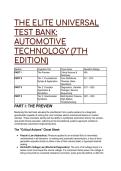
THE ELITE UNIVERSAL
TEST BANK:
AUTOMOTIVE
TECHNOLOGY (7TH
EDITION)
Section Cognitive Tier Focus Area Question Range
PART I The Preview Critical Axioms & N/A
Directives
PART II Tier 1: Foundational Core Definitions, Q1 – Q10
Syntax & Application Theories, Base
Operations
PART II Tier 2: Complex Diagnostics, Variable Q11 – Q20
Application & Changes, Service
Simulation Sequencing
PART II Tier 3: Grandmaster Multi-System Failures, Q21 – Q30
Synthesis High-Stakes
Troubleshooting
PART I: THE PREVIEW
Mastering this test bank elevates the practitioner from a parts-replacer to a diagnostic
grandmaster capable of solving the most complex electro-mechanical failures in modern
vehicles. These scenarios strictly test the ability to synthesize automotive theory into precise,
real-world clinical execution, adhering to the foundational systems approach outlined in
contemporary automotive engineering texts.
The "Critical Axioms" Cheat Sheet
● Pascal’s Law (Hydraulics): Pressure applied to an enclosed fluid is transmitted
undiminished in all directions. In braking and automatic transmissions, a loss of force
generation equates strictly to either a loss of fluid volume (leak) or bypassed internal
sealing.
● Kirchhoff’s Voltage Law (Electrical Diagnostics): The sum of all voltage drops in a
series circuit must equal the source voltage. If a component lacks power, the voltage is
being consumed by unwanted resistance (corrosion, loose grounds) before or after the
, load.
● Gear Ratio Torque Multiplication: Output torque is inversely proportional to output
speed. A smaller drive gear turning a larger driven gear multiplies torque but divides
speed.
● Ackermann Steering Geometry: In a turn, the inner wheel must travel a path of a
smaller radius than the outer wheel. Discrepancies in tire wear or cornering squeal point
directly to toe-angle or steering arm geometry failures.
● The Diagnostic Triad: A modern internal combustion engine requires exactly three
elements to run: cylinder compression, a stoichiometric air/fuel mixture, and precisely
timed spark/ignition. Isolate which leg of the triad is missing FIRST before dismantling
systems.
PART II: THE ELITE TEST BANK
Tier 1: Foundational Syntax & Application
Q1: A technician is diagnosing a vehicle with a spongy brake pedal. The master cylinder was
recently replaced, and there are no external fluid leaks. Based on the principles of Pascal's Law
and hydraulic brake systems, which action is the FIRST logical step? A) Replace the brake
booster diaphragm to restore vacuum assist. B) Adjust the brake pedal pushrod to increase the
stroke length into the primary piston. C) Bleed the hydraulic system to remove entrapped air
compressing within the fluid lines. D) Replace the ABS hydraulic control unit due to an internal
bypass valve failure.
● The Answer: C (Bleed the hydraulic system to remove entrapped air compressing within
the fluid lines.)
● Distractor Analysis:
○ A is incorrect: A failed brake booster results in a hard pedal due to a lack of assist,
not a spongy pedal. The vacuum diaphragm assists the mechanical push, but does
not affect the fluid column.
○ B is incorrect: Adjusting the pushrod alters pedal height and free-play, but it does
not solve the underlying compressibility of the fluid column.
○ D is incorrect: While an internal ABS bypass can cause a sinking pedal, it is an
advanced diagnostic step that must only be pursued after verifying the fluid is free
of compressible air, especially following a master cylinder replacement where air
introduction is guaranteed.
The Mentor's Analysis: Pascal’s Law dictates that hydraulic fluid is essentially incompressible,
transmitting force equally. Air, however, is highly compressible. When a spongy pedal occurs
after breaking the hydraulic seal, air entrapment is the primary culprit. By utilizing systematic
hydraulic bleeding, the practitioner bypasses the common trap of misdiagnosing expensive ABS
or booster components. Professional/Academic Intuition: Never diagnose a complex
hydraulic component failure until the integrity and purity of the fluid medium are
absolutely verified.
Q2: During a wheel alignment, a vehicle exhibits a severe pull to the right while driving on a flat,
straight road. The tire pressures are equal, and the toe angle is within specification. Based on
the principles of steering geometry, which conclusion is the MOST ACCURATE? A) The right
front wheel has significantly more positive camber than the left front wheel. B) The right front
wheel has significantly more positive caster than the left front wheel. C) The vehicle has a bent
, tie-rod end causing dynamic toe-out on the right side. D) The steering axis inclination (SAI) is
perfectly equal on both sides, negating camber thrust.
● The Answer: A (The right front wheel has significantly more positive camber than the left
front wheel.)
● Distractor Analysis:
○ B is incorrect: A vehicle will pull to the side with the least amount of positive caster,
not the most. More positive caster increases directional stability and resistance to
turning.
○ C is incorrect: A bent tie-rod affecting toe will cause an off-center steering wheel
and rapid tire wear, but toe angles generally do not cause a directional pull because
the steering rack equalizes the forces while driving.
○ D is incorrect: If SAI and all other angles were equal, the vehicle would track
straight. The presence of a pull indicates a severe imbalance in alignment angles.
The Mentor's Analysis: Vehicles naturally pull toward the side with the most positive camber
and the least positive caster. When facing a directional pull, the immediate priority is analyzing
the cross-camber and cross-caster measurements. By utilizing camber thrust principles, the
technician bypasses the common trap of endlessly adjusting toe to fix a pull.
Professional/Academic Intuition: A vehicle will always drift toward the side with the most
positive camber and the least positive caster.
Q3: A digital multimeter (ohmmeter) is utilized to test a high-current starter relay. The relay coil
reads 75 ohms, and the switch contacts read 0.1 ohms when manually closed. However, the
starter will not engage when the relay is installed and commanded on. Which conclusion is the
MOST ACCURATE? A) The relay coil is shorted to ground and must be replaced immediately.
B) The ohmmeter cannot simulate the dynamic current load, meaning the contacts may be
burning open under a high-amperage load. C) The switch contacts are functioning perfectly,
indicating a failed starter motor. D) The resistance of the relay coil is too high, preventing the
magnetic field from forming.
● The Answer: B (The ohmmeter cannot simulate the dynamic current load, meaning the
contacts may be burning open under a high-amperage load.)
● Distractor Analysis:
○ A is incorrect: A 75-ohm coil reading is standard for an automotive relay; a dead
short would read near 0 ohms.
○ C is incorrect: Assuming the contacts are perfect based solely on a static ohmmeter
test is a fundamental analytical error. Resistance checks do not stress the physical
contact points.
○ D is incorrect: 75 ohms is a standard, healthy resistance for a standard 12V relay
coil (drawing approximately 0.16 amps).
The Mentor's Analysis: Ohmmeters apply a microscopic amount of voltage to measure
resistance, which is useless for determining how a switch behaves under a massive electrical
load. When facing intermittent or high-current electrical failures, the immediate priority is
dynamic testing. By utilizing voltage drop testing under load, the technician bypasses the
common trap of trusting static resistance measurements. Professional/Academic Intuition: A
static continuity test only proves that a single strand of wire is intact; it never guarantees
the circuit can carry a working current.
Q4: In a standard Otto cycle internal combustion engine, volumetric efficiency refers to the ratio
of air drawn into the cylinder compared to its maximum theoretical capacity. Which modification
or condition will IMMEDIATELY decrease volumetric efficiency? A) Installing a turbocharger or
supercharger. B) Advancing the ignition timing by 5 degrees. C) A restriction in the exhaust
TEST BANK:
AUTOMOTIVE
TECHNOLOGY (7TH
EDITION)
Section Cognitive Tier Focus Area Question Range
PART I The Preview Critical Axioms & N/A
Directives
PART II Tier 1: Foundational Core Definitions, Q1 – Q10
Syntax & Application Theories, Base
Operations
PART II Tier 2: Complex Diagnostics, Variable Q11 – Q20
Application & Changes, Service
Simulation Sequencing
PART II Tier 3: Grandmaster Multi-System Failures, Q21 – Q30
Synthesis High-Stakes
Troubleshooting
PART I: THE PREVIEW
Mastering this test bank elevates the practitioner from a parts-replacer to a diagnostic
grandmaster capable of solving the most complex electro-mechanical failures in modern
vehicles. These scenarios strictly test the ability to synthesize automotive theory into precise,
real-world clinical execution, adhering to the foundational systems approach outlined in
contemporary automotive engineering texts.
The "Critical Axioms" Cheat Sheet
● Pascal’s Law (Hydraulics): Pressure applied to an enclosed fluid is transmitted
undiminished in all directions. In braking and automatic transmissions, a loss of force
generation equates strictly to either a loss of fluid volume (leak) or bypassed internal
sealing.
● Kirchhoff’s Voltage Law (Electrical Diagnostics): The sum of all voltage drops in a
series circuit must equal the source voltage. If a component lacks power, the voltage is
being consumed by unwanted resistance (corrosion, loose grounds) before or after the
, load.
● Gear Ratio Torque Multiplication: Output torque is inversely proportional to output
speed. A smaller drive gear turning a larger driven gear multiplies torque but divides
speed.
● Ackermann Steering Geometry: In a turn, the inner wheel must travel a path of a
smaller radius than the outer wheel. Discrepancies in tire wear or cornering squeal point
directly to toe-angle or steering arm geometry failures.
● The Diagnostic Triad: A modern internal combustion engine requires exactly three
elements to run: cylinder compression, a stoichiometric air/fuel mixture, and precisely
timed spark/ignition. Isolate which leg of the triad is missing FIRST before dismantling
systems.
PART II: THE ELITE TEST BANK
Tier 1: Foundational Syntax & Application
Q1: A technician is diagnosing a vehicle with a spongy brake pedal. The master cylinder was
recently replaced, and there are no external fluid leaks. Based on the principles of Pascal's Law
and hydraulic brake systems, which action is the FIRST logical step? A) Replace the brake
booster diaphragm to restore vacuum assist. B) Adjust the brake pedal pushrod to increase the
stroke length into the primary piston. C) Bleed the hydraulic system to remove entrapped air
compressing within the fluid lines. D) Replace the ABS hydraulic control unit due to an internal
bypass valve failure.
● The Answer: C (Bleed the hydraulic system to remove entrapped air compressing within
the fluid lines.)
● Distractor Analysis:
○ A is incorrect: A failed brake booster results in a hard pedal due to a lack of assist,
not a spongy pedal. The vacuum diaphragm assists the mechanical push, but does
not affect the fluid column.
○ B is incorrect: Adjusting the pushrod alters pedal height and free-play, but it does
not solve the underlying compressibility of the fluid column.
○ D is incorrect: While an internal ABS bypass can cause a sinking pedal, it is an
advanced diagnostic step that must only be pursued after verifying the fluid is free
of compressible air, especially following a master cylinder replacement where air
introduction is guaranteed.
The Mentor's Analysis: Pascal’s Law dictates that hydraulic fluid is essentially incompressible,
transmitting force equally. Air, however, is highly compressible. When a spongy pedal occurs
after breaking the hydraulic seal, air entrapment is the primary culprit. By utilizing systematic
hydraulic bleeding, the practitioner bypasses the common trap of misdiagnosing expensive ABS
or booster components. Professional/Academic Intuition: Never diagnose a complex
hydraulic component failure until the integrity and purity of the fluid medium are
absolutely verified.
Q2: During a wheel alignment, a vehicle exhibits a severe pull to the right while driving on a flat,
straight road. The tire pressures are equal, and the toe angle is within specification. Based on
the principles of steering geometry, which conclusion is the MOST ACCURATE? A) The right
front wheel has significantly more positive camber than the left front wheel. B) The right front
wheel has significantly more positive caster than the left front wheel. C) The vehicle has a bent
, tie-rod end causing dynamic toe-out on the right side. D) The steering axis inclination (SAI) is
perfectly equal on both sides, negating camber thrust.
● The Answer: A (The right front wheel has significantly more positive camber than the left
front wheel.)
● Distractor Analysis:
○ B is incorrect: A vehicle will pull to the side with the least amount of positive caster,
not the most. More positive caster increases directional stability and resistance to
turning.
○ C is incorrect: A bent tie-rod affecting toe will cause an off-center steering wheel
and rapid tire wear, but toe angles generally do not cause a directional pull because
the steering rack equalizes the forces while driving.
○ D is incorrect: If SAI and all other angles were equal, the vehicle would track
straight. The presence of a pull indicates a severe imbalance in alignment angles.
The Mentor's Analysis: Vehicles naturally pull toward the side with the most positive camber
and the least positive caster. When facing a directional pull, the immediate priority is analyzing
the cross-camber and cross-caster measurements. By utilizing camber thrust principles, the
technician bypasses the common trap of endlessly adjusting toe to fix a pull.
Professional/Academic Intuition: A vehicle will always drift toward the side with the most
positive camber and the least positive caster.
Q3: A digital multimeter (ohmmeter) is utilized to test a high-current starter relay. The relay coil
reads 75 ohms, and the switch contacts read 0.1 ohms when manually closed. However, the
starter will not engage when the relay is installed and commanded on. Which conclusion is the
MOST ACCURATE? A) The relay coil is shorted to ground and must be replaced immediately.
B) The ohmmeter cannot simulate the dynamic current load, meaning the contacts may be
burning open under a high-amperage load. C) The switch contacts are functioning perfectly,
indicating a failed starter motor. D) The resistance of the relay coil is too high, preventing the
magnetic field from forming.
● The Answer: B (The ohmmeter cannot simulate the dynamic current load, meaning the
contacts may be burning open under a high-amperage load.)
● Distractor Analysis:
○ A is incorrect: A 75-ohm coil reading is standard for an automotive relay; a dead
short would read near 0 ohms.
○ C is incorrect: Assuming the contacts are perfect based solely on a static ohmmeter
test is a fundamental analytical error. Resistance checks do not stress the physical
contact points.
○ D is incorrect: 75 ohms is a standard, healthy resistance for a standard 12V relay
coil (drawing approximately 0.16 amps).
The Mentor's Analysis: Ohmmeters apply a microscopic amount of voltage to measure
resistance, which is useless for determining how a switch behaves under a massive electrical
load. When facing intermittent or high-current electrical failures, the immediate priority is
dynamic testing. By utilizing voltage drop testing under load, the technician bypasses the
common trap of trusting static resistance measurements. Professional/Academic Intuition: A
static continuity test only proves that a single strand of wire is intact; it never guarantees
the circuit can carry a working current.
Q4: In a standard Otto cycle internal combustion engine, volumetric efficiency refers to the ratio
of air drawn into the cylinder compared to its maximum theoretical capacity. Which modification
or condition will IMMEDIATELY decrease volumetric efficiency? A) Installing a turbocharger or
supercharger. B) Advancing the ignition timing by 5 degrees. C) A restriction in the exhaust



