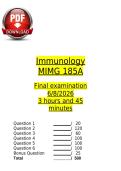
Immunology
MIMG 185A
Final examination
6/8/2026
3 hours and 45
minutes
Question 1 / 20
Question 2 / 120
Question 3 / 60
Question 4 / 100
Question 5 / 100
Question 6 / 100
Bonus Question / 25
Total / 500
,Question 1: (20 points)
Some autoimmune diseases are characterized by the production of
antibodies of IgG isotype that are specific for DNA. Knowing that B cells need
T cell help for proper activation and isotype class switching and that DNA
cannot be presented on MHCs to T cells, how would you explain this
phenomenon? (1-2 sentences)
Question 2 (120 points):
2A. Write down how each particular gene knock out (KO) affects mouse
immune responses to bacteria and parasitic worms. Use + for full response,
+/- for partial response and – for no response. (24 points total)
Response to
(extracellular) Response to
Type of mouse
bacteria parasitic
KO
worms
IgM IgG
Surrogate light
chain KO
RAG1/2 KO
β2 microglobulin
Iε KO
Pre-TCRα (gp33) KO
Igα/Igβ KO
AID KO
1
, CD28 KO
2
MIMG 185A
Final examination
6/8/2026
3 hours and 45
minutes
Question 1 / 20
Question 2 / 120
Question 3 / 60
Question 4 / 100
Question 5 / 100
Question 6 / 100
Bonus Question / 25
Total / 500
,Question 1: (20 points)
Some autoimmune diseases are characterized by the production of
antibodies of IgG isotype that are specific for DNA. Knowing that B cells need
T cell help for proper activation and isotype class switching and that DNA
cannot be presented on MHCs to T cells, how would you explain this
phenomenon? (1-2 sentences)
Question 2 (120 points):
2A. Write down how each particular gene knock out (KO) affects mouse
immune responses to bacteria and parasitic worms. Use + for full response,
+/- for partial response and – for no response. (24 points total)
Response to
(extracellular) Response to
Type of mouse
bacteria parasitic
KO
worms
IgM IgG
Surrogate light
chain KO
RAG1/2 KO
β2 microglobulin
Iε KO
Pre-TCRα (gp33) KO
Igα/Igβ KO
AID KO
1
, CD28 KO
2