

Written by students who passed Immediately available after payment Read online or as PDF Wrong document? Swap it for free 4.6 TrustPilot
logo-home
Document preview thumbnail
Preview 2 out of 14 pages
Exam (elaborations)

NURS 6023:Essential Guide to Advanced Respiratory Assessment Techniques-Arkansas State University, Main Campus 2026 Update with complete solutions.

Document preview thumbnail
Preview 2 out of 14 pages

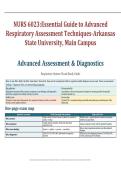
Respiratory System Visual Study Guide How to use this: Study the blue “must know” boxes first, then use the comparison tables to separate similar diagnoses on an exam. Focus on assessment findings + diagnostic clues, not memorizing paragraphs. Big picture Exam priority Respiratory assessment links anatomy, symptoms, exam findings, and diagnostics. Match the complaint to the likely structure involved. Auscultation is the most important technique for assessing airflow through the tracheobronchial tree. Safety cue Exam clue Cyanosis is a late sign of hypoxemia. New respiratory distress, stridor, or tracheal deviation needs urgent attention. One-page exam map Normal CXR + unexplained hypoxia should make pulmonary embolism part of the differential. Question on exam Think through this pathway What system? High-yield clue Upper airway vs lower airway vs pleura vs vascular vs cardiac overlap What symptom? Cough, sputum, dyspnea, chest pain, abnormal Pleuritic pain = parietal pleura irritation; lung tissue itself has no pain fibers. respiratory rate What exam finding? Inspect - palpate - percuss - auscultate Always compare severity with the patient’s baseline. Side-to-side comparison matters more than isolated findings. What diagnostic? CXR, CT/CTA, PFT, ABG, labs based on suspected disorder PFTs are key for obstructive disease; CTA/VQ for PE; CXR for pneumonia/PTX/effusion. Advanced Assessment Respiratory Visual Study Guide | Created from uploaded lecture transcript and PowerPoint 1. Anatomy & physiology: what to picture Respiration cycle Phase Upper respiratory tract: Nose and pharynx. Lower respiratory tract: Larynx, trachea, bronchi, bronchioles, and lungs. Right main bronchus: Shorter and more vertical, so aspiration commonly affects the right middle/lower lobes. Pleura: Visceral pleura covers lungs; parietal pleura lines rib cage and diaphragm. Fluid helps lung expansion. Costodiaphragmatic recess: Potential space below lung level. Fluid collection can compromise expansion, such as pleural effusion. What happens Inhalation/O2 delivery Why it matters O2 enters lungs - blood - heart - systemic circulation - cells. CO2 return/exhalation Supports cellular respiration and energy production. CO2 leaves cells - systemic circulation - heart - lungs - exhaled. Removes waste CO2 and supports acid-base balance. Advanced Assessment Respiratory Visual Study Guide | Created from uploaded lecture transcript and PowerPoint Advanced Assessment Respiratory Visual Study Guide | Created from uploaded lecture transcript and PowerPoint Start with baseline: Ask about chronic lung disease, home oxygen, usual SpO2, smoking history, occupational/environmental irritants, travel, vaccines, family history of asthma, and medication use. 2. History: respiratory HPI + review of systems Core HPI framework HPI piece Ask Exam/diagnostic meaning Onset Sudden, gradual, acute, chronic? Sudden dyspnea/chest pain raises concern for PE, pneumothorax, acute asthma, or cardiac causes. Duration Minutes, hours, days, weeks? Chronic cough has a different differential than acute cough with fever. Quality Wet/dry cough, sharp pain, pleuritic pain? Dry cough can be ACE inhibitor/allergies; pleuritic pain worsens with inspiration. Severity At rest or with activity? Compared with baseline? New dyspnea at rest in an active person is severe. Aggravating/alleviating Position, exercise, deep breath, meals, allergens? Orthopnea/PND can suggest CHF/pulmonary HTN; exercise/allergens may trigger asthma. Associated symptoms Fever, cough, sputum, chest pain, edema, DVT symptoms? Fever + cough favors infection; unilateral leg symptoms raise PE concern. Chief complaint pattern recognition Complaint Must ask Key clue Cough Acute/chronic? Pattern? Wet/dry? Pitch? Triggers? Medications? Brassy = possible compression/tumor; whoop = pertussis; dry = ACE inhibitor/allergies. Chest pain Sharp/stabbing? Worse with inspiration? Trauma/URI? Tender chest wall? Pleuritic pain usually comes from parietal pleura irritation. Tender chest wall can suggest costochondritis. Sputum Amount, color, odor, blood, true hemoptysis? Color is not fully specific. Confirm blood is from lungs, not nose/mouth/GI source. Dyspnea Sudden/gradual? At rest/activity? Orthopnea? PND? Baseline? Orthopnea = SOB supine. PND = sudden SOB after sleep, often CHF/pulmonary HTN. Abnormal RR Rate, rhythm, new/chronic, pain/trauma, fever? Tachypnea 25; bradypnea 12; hyperpnea = deeper and faster at rest. 3. Physical exam flow: inspect - palpate - percuss - auscultate Positioning: Posterior thorax is examined while the patient is sitting. Anterior thorax is examined with the patient supine. Compare symmetric areas side to-side. Inspection checklist Look at Expected/meaning Skin Color, pallor, cyanosis. Abnormal clue Face/mouth Cyanosis is late and dangerous hypoxemia. Work of breathing, breath odor, nasal flaring. Thorax shape Sternum flat; AP diameter less than transverse Pursed-lip breathing = increased effort; nasal flaring = air hunger; fruity breath can suggest DKA. Barrel chest may be chronic diameter, about 1:2. Symmetry Chest expansion should be symmetric. asthma/COPD/emphysema/CF. Asymmetry may occur with pneumothorax, rib fracture, or severe pneumonia. Retractions None expected at rest. Unilateral = possible foreign body; bilateral = Thoracic configurations quick view commonly asthma/airway obstruction. Configuration What it looks like Pectus excavatum Clinical association Lower sternum indented. Funnel chest. Barrel chest Increased AP diameter, horizontal ribs, kyphosis/prominent sternal angle. Pectus carinatum Sternum protrudes. Chronic asthma, COPD/emphysema, cystic fibrosis. Pigeon chest. Traumatic flail chest Paradoxical movement of thorax. Rib fractures/trauma. Scoliosis Abnormal curvature of spine. Can be severe enough to affect lungs. 4. Palpation + percussion: what changes and why Advanced Assessment Respiratory Visual Study Guide | Created from uploaded lecture transcript and PowerPoint Palpation findings Technique/finding How to assess Tenderness/crepitus Palpate thoracic muscles and rib cage. Interpretation Tenderness can occur with inflamed pleura/costochondritis. Crepitus feels like Rice Krispies and can occur with air in subcutaneous tissue. Tracheal position Palpate at suprasternal notch. Small right deviation may be normal. Significant deviation needs immediate evaluation. Thoracic expansion Thumbs at 10th ribs posteriorly; watch movement with inspiration. Tactile fremitus Patient says “99” or “mine”; compare sides with ulnar Problem is usually on the side with decreased expansion. hand/palmar fingers. Percussion notes visual Decreased: PTX, emphysema, bronchial obstruction. Increased: pulmonary fluid or copious nonobstructive secretions. Percussion note Means Resonance Examples to connect Normal air-filled lung. Hyperresonance Expected over healthy lung fields. Too much air in lung/pleural space. Dullness Emphysema, pneumothorax. Fluid or solid tissue. Flatness Pneumonia or pleural effusion. Very dense tissue/bone. Bony prominences. Tympany Air bubble/high air. Normal over stomach; concerning if heard over lungs such as PTX. Advanced Assessment Respiratory Visual Study Guide | Created from uploaded lecture transcript and PowerPoint Advanced Assessment Respiratory Visual Study Guide | Created from uploaded lecture transcript and PowerPoint Technique: Use the diaphragm. Ask the patient to take slow, deep breaths through an open mouth. Listen to one full breath at each site and compare in a ladder pattern. 5. Auscultation: normal sounds, adventitious sounds, vocal resonance Normal breath sounds Sound Description Where heard I:E pattern Vesicular Soft, low pitched. Most of both lungs. Inspiration expiration. Bronchial Louder, higher pitch. Large proximal airways. Expiration inspiration. Bronchovesicular Intermediate intensity and pitch. 1st and 2nd interspaces. Inspiration = expiration. Adventitious breath sounds: match sound to cause Sound What it sounds like Mechanism Think about Crackles/rales Fine/coarse, brief popping; high or low pitched. Air moving past fluid. Pneumonia, heart failure. Rhonchi Low-pitched, prolonged, snoring/gurgling; may clear with cough. Air over thick/solid secretions. Secretions in larger airways. Wheezes Continuous, high-pitched musical; inspiratory or expiratory. Air through constricted passageways. Asthma, COPD, bronchitis. Stridor High-pitched, louder over neck than chest. Upper airway obstruction. Urgent airway concern. Friction rub Dry, crackling/rubbing, low-pitched on inhale and exhale. Inflamed pleural/pericardial tissue rubbing. Ask patient to hold breath: pleural rub disappears. Mediastinal crunch Loud, wet crackling, end-expiration, synchronous with heartbeat. Mediastinal emphysema. Air in mediastinum. Succussion splash Loud, wet “splash.” Air + fluid in pleural cavity or lungs. Hydropneumothorax/air-fluid level. Vocal resonance tests Test Patient says Normal Positive finding Meaning Bronchophony “99” Muffled. Louder/more distinct. Lobar consolidation such as pneumonia. Egophony “E” Sounds like E. Sounds like A. Consolidation or superior edge of effusion. Whispered pectoriloquy Whisper “99” Faint/muffled. Loud/clear. Increased transmis

Content preview

Advanced Assessment & Diagnostics
Respiratory System Visual Study Guide
How to use this: Study the blue “must know” boxes first, then use the comparison tables to separate similar diagnoses on an exam. Focus on assessment
findings + diagnostic clues, not memorizing paragraphs.
Big picture Exam priority
Respiratory assessment links anatomy, symptoms, exam findings, and diagnostics. Auscultation is the most important technique for assessing airflow through the
Match the complaint to the likely structure involved. tracheobronchial tree.
Safety cue Exam clue
Cyanosis is a late sign of hypoxemia. New respiratory distress, stridor, or tracheal Normal CXR + unexplained hypoxia should make pulmonary embolism part of the
deviation needs urgent attention. differential.

One-page exam map
Question on exam Think through this pathway High-yield clue
Upper airway vs lower airway vs pleura vs vascular vs Pleuritic pain = parietal pleura irritation; lung tissue
What system? cardiac overlap itself has no pain fibers.
Cough, sputum, dyspnea, chest pain, abnormal
What symptom? respiratory rate Always compare severity with the patient’s baseline.
Side-to-side comparison matters more than isolated
What exam finding? Inspect -> palpate -> percuss -> auscultate findings.
CXR, CT/CTA, PFT, ABG, labs based on suspected PFTs are key for obstructive disease; CTA/VQ for PE;
What diagnostic? disorder CXR for pneumonia/PTX/effusion.


Advanced Assessment Respiratory Visual Study Guide | Created from uploaded lecture transcript and PowerPoint


, 1. Anatomy & physiology: what to picture

Upper respiratory tract: Nose and pharynx.
Lower respiratory tract: Larynx, trachea, bronchi, bronchioles, and lungs.
Right main bronchus: Shorter and more vertical, so aspiration commonly
affects the right middle/lower lobes.
Pleura: Visceral pleura covers lungs; parietal pleura lines rib cage and
diaphragm. Fluid helps lung expansion.
Costodiaphragmatic recess: Potential space below lung level. Fluid
collection can compromise expansion, such as pleural effusion.


Respiration cycle
Phase What happens Why it matters
O2 enters lungs -> blood -> heart -> systemic
Inhalation/O2 delivery Supports cellular respiration and energy production.
circulation -> cells.
CO2 leaves cells -> systemic circulation -> heart ->
CO2 return/exhalation Removes waste CO2 and supports acid-base balance.
lungs -> exhaled.


Advanced Assessment Respiratory Visual Study Guide | Created from uploaded lecture transcript and PowerPoint

Document information

Uploaded on
August 3, 2026
Number of pages
14
Written in
2026/2027
Type
Exam (elaborations)
Contains
Questions & answers
$13.99

Wrong document? Swap it for free Within 14 days of purchase and before downloading, you can choose a different document. You can simply spend the amount again.
Written by students who passed
Immediately available after payment
Read online or as PDF

Seller avatar
Reputation scores are based on the amount of documents a seller has sold for a fee and the reviews they have received for those documents. There are three levels: Bronze, Silver and Gold. The better the reputation, the more your can rely on the quality of the sellers work.
Brainarium
3.8
(333)
Sold
1987
Followers
1046
Items
23954
Last sold
19 hours ago


Why students choose Stuvia

Created by fellow students, verified by reviews

Quality you can trust: written by students who passed their tests and reviewed by others who've used these notes.

Didn't get what you expected? Choose another document

No worries! You can instantly pick a different document that better fits what you're looking for.

Pay as you like, start learning right away

No subscription, no commitments. Pay the way you're used to via credit card and download your PDF document instantly.

Student with book image

“Bought, downloaded, and aced it. It really can be that simple.”

Alisha Student

Working on your references?

Create accurate citations in APA, MLA and Harvard with our free citation generator.

Working on your references?

Frequently asked questions