

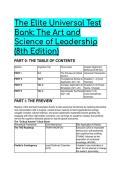
The Elite Universal Test
Bank: The Art and
Science of Leadership
(8th Edition)
PART 0: THE TABLE OF CONTENTS
Section Cognitive Tier Focus Area Chapter Alignment
(Nahavandi 8th Ed.)
PART I N/A The Preview & Critical Universal Frameworks
Axioms
PART II Tier 1 Foundational Syntax & Chapters 1–4 (Core
Application (Q1–10) Theories)
PART II Tier 2 Complex Application & Chapters 5–9 (Power,
Simulation (Q11–20) Teams, Change)
PART II Tier 3 Grandmaster Synthesis Chapter 10 &
(Q21–30) Cross-Disciplinary
Synthesis
PART I: THE PREVIEW
Mastery of this test bank translates directly to elite executive functioning by replacing theoretical
rote memorization with a surgical, context-driven capacity to lead organizational change,
navigate complex cultural matrices, and avert catastrophic leadership failures globally. By
engaging with these high-stakes scenarios, you will forge an academic mastery that perfectly
mirrors the cognitive demands placed on top-tier global executives.
The "Critical Axioms" Cheat Sheet
Theoretical Framework Core Mechanism Elite Application & Reality
The TKD Roadmap THINK-KNOW-DO Execution (DO) is impossible
without prior self-awareness
and cognitive bias auditing
(THINK), followed by the
acquisition of contextual
knowledge (KNOW).
Fiedler's Contingency Least Preferred Coworker A leader's core motivation is
(LPC) fixed. Do not attempt to change
the leader's personality;
,Theoretical Framework Core Mechanism Elite Application & Reality
engineer the situational control
(Task, Power, Relations) to
match their style.
Cognitive Resource Theory Stress as a Moderator Under low stress, fluid
intelligence drives performance.
Under high stress, cognitive
bandwidth collapses, and the
leader must rely on rote
experience.
The Augmentation Effect Transformational + Transformational Leadership
Transactional does not replace Transactional
Leadership; it multiplies
performance only when built
upon a stable baseline of
Contingent Reward.
GLOBE Cultural Matrix Culturally Endorsed Theory While Charismatic/Value-Based
(CLT) leadership is universally
endorsed, Self-Protective
behaviors generate radically
divergent outcomes depending
on native power distance
norms.
PART II: THE ELITE TEST BANK
Tier 1: Foundational Syntax & Application
Q1: An organization transitions from a stable domestic market into a highly volatile, globally
competitive arena. The Chief Executive Officer (CEO) relies entirely on formal hierarchical
authority to force compliance to legacy protocols, punishing experimentation. Based on the
principles of the Art and Science of Leadership framework in a turbulent world, which conclusion
regarding the CEO's approach is the MOST ACCURATE? A) It is the optimal strategy because
turbulent environments require centralized, autocratic decision-making to maintain strict
operational control. B) It demonstrates a failure to understand that modern leadership involves
guiding and influencing others amidst constant change, rather than merely forcing compliance.
C) It correctly applies the DO phase of the TKD roadmap by prioritizing immediate action over
collaborative strategic planning. D) It aligns with the principles of Management by Exception
(Active), which is universally recognized as the most effective style for crisis management.
● Answer: B (It demonstrates a failure to understand that modern leadership involves
guiding and influencing others amidst constant change, rather than merely forcing
compliance.)
● Distractor Analysis:
○ A is incorrect: Turbulent (VUCA) environments require adaptation, innovation, and
influence, not rigid reliance on legacy formal authority or the punishment of
necessary experimentation.
○ C is incorrect: The DO phase involves implementing knowledge and developing
skills, not blindly forcing compliance without the requisite THINK (self-awareness)
, and KNOW (contextual data) phases.
○ D is incorrect: Management by Exception (Active) focuses on monitoring for errors,
but it is a transactional baseline, not the optimal style for navigating massive
organizational change and volatility.
The Mentor's Analysis: Leadership in the modern era is fundamentally about interpersonal
influence and guiding adaptation in turbulent environments. When facing rapid environmental
shifts, the immediate priority is fostering agility, not enforcing rigid compliance. By utilizing
Influence, you bypass the common trap of relying solely on positional authority.
Professional/Academic Intuition: True leadership is measured by the ability to influence
adaptation, whereas pure management relies on enforcing compliance.
Q2: A senior manager is undergoing an executive development program. The curriculum
focuses heavily on identifying personal biases, understanding one's own cultural background,
and reflecting on inherent cognitive strengths and weaknesses. According to Nahavandi's
framework, which specific phase of the roadmap is being executed? A) The KNOW phase B)
The DO phase C) The THINK phase D) The REFLECT phase
● Answer: C (The THINK phase)
● Distractor Analysis:
○ A is incorrect: The KNOW phase focuses on acquiring external information,
understanding the environment, and developing technical knowledge about leading
others.
○ B is incorrect: The DO phase represents the behavioral application, practice, and
implementation of acquired skills in real-world scenarios.
○ D is incorrect: While introspection is involved, REFLECT is not the formal
terminology used in Nahavandi's structured THINK-KNOW-DO (TKD) roadmap.
The Mentor's Analysis: Before a leader can acquire contextual knowledge or execute a
strategy, they must undergo rigorous internal auditing. When facing leadership development, the
immediate priority is mastering the THINK phase. By utilizing Self-Awareness, you bypass the
common trap of projecting unexamined biases onto followers. Professional/Academic
Intuition: Elite execution (DO) is impossible without objective self-auditing (THINK).
Q3: A project manager completes Fiedler's Least Preferred Coworker (LPC) scale and scores
very low. Based on Fiedler's Contingency Model, which motivation fundamentally drives this
leader? A) The leader is primarily motivated by establishing good interpersonal relationships
with subordinates and fostering harmony. B) The leader is primarily motivated by task
accomplishment and evaluates employees based on their competence and performance. C)
The leader is socio-independent and generally unconcerned with others' opinions or immediate
task completion. D) The leader is highly adaptable and can seamlessly switch between
relationship-building and task-execution based on the environment.
● Answer: B (The leader is primarily motivated by task accomplishment and evaluates
employees based on their competence and performance.)
● Distractor Analysis:
○ A is incorrect: This describes a High-LPC leader, who is relationship-motivated and
describes their least preferred coworker in relatively positive terms.
○ C is incorrect: This describes a Middle-LPC leader, who operates with
socio-independence.
○ D is incorrect: Fiedler explicitly argues that a leader's underlying LPC style is a
stable personality trait that is highly resistant to change; they cannot seamlessly
switch.
The Mentor's Analysis: Fiedler's construct operates on the premise of fixed motivational
Bank: The Art and
Science of Leadership
(8th Edition)
PART 0: THE TABLE OF CONTENTS
Section Cognitive Tier Focus Area Chapter Alignment
(Nahavandi 8th Ed.)
PART I N/A The Preview & Critical Universal Frameworks
Axioms
PART II Tier 1 Foundational Syntax & Chapters 1–4 (Core
Application (Q1–10) Theories)
PART II Tier 2 Complex Application & Chapters 5–9 (Power,
Simulation (Q11–20) Teams, Change)
PART II Tier 3 Grandmaster Synthesis Chapter 10 &
(Q21–30) Cross-Disciplinary
Synthesis
PART I: THE PREVIEW
Mastery of this test bank translates directly to elite executive functioning by replacing theoretical
rote memorization with a surgical, context-driven capacity to lead organizational change,
navigate complex cultural matrices, and avert catastrophic leadership failures globally. By
engaging with these high-stakes scenarios, you will forge an academic mastery that perfectly
mirrors the cognitive demands placed on top-tier global executives.
The "Critical Axioms" Cheat Sheet
Theoretical Framework Core Mechanism Elite Application & Reality
The TKD Roadmap THINK-KNOW-DO Execution (DO) is impossible
without prior self-awareness
and cognitive bias auditing
(THINK), followed by the
acquisition of contextual
knowledge (KNOW).
Fiedler's Contingency Least Preferred Coworker A leader's core motivation is
(LPC) fixed. Do not attempt to change
the leader's personality;
,Theoretical Framework Core Mechanism Elite Application & Reality
engineer the situational control
(Task, Power, Relations) to
match their style.
Cognitive Resource Theory Stress as a Moderator Under low stress, fluid
intelligence drives performance.
Under high stress, cognitive
bandwidth collapses, and the
leader must rely on rote
experience.
The Augmentation Effect Transformational + Transformational Leadership
Transactional does not replace Transactional
Leadership; it multiplies
performance only when built
upon a stable baseline of
Contingent Reward.
GLOBE Cultural Matrix Culturally Endorsed Theory While Charismatic/Value-Based
(CLT) leadership is universally
endorsed, Self-Protective
behaviors generate radically
divergent outcomes depending
on native power distance
norms.
PART II: THE ELITE TEST BANK
Tier 1: Foundational Syntax & Application
Q1: An organization transitions from a stable domestic market into a highly volatile, globally
competitive arena. The Chief Executive Officer (CEO) relies entirely on formal hierarchical
authority to force compliance to legacy protocols, punishing experimentation. Based on the
principles of the Art and Science of Leadership framework in a turbulent world, which conclusion
regarding the CEO's approach is the MOST ACCURATE? A) It is the optimal strategy because
turbulent environments require centralized, autocratic decision-making to maintain strict
operational control. B) It demonstrates a failure to understand that modern leadership involves
guiding and influencing others amidst constant change, rather than merely forcing compliance.
C) It correctly applies the DO phase of the TKD roadmap by prioritizing immediate action over
collaborative strategic planning. D) It aligns with the principles of Management by Exception
(Active), which is universally recognized as the most effective style for crisis management.
● Answer: B (It demonstrates a failure to understand that modern leadership involves
guiding and influencing others amidst constant change, rather than merely forcing
compliance.)
● Distractor Analysis:
○ A is incorrect: Turbulent (VUCA) environments require adaptation, innovation, and
influence, not rigid reliance on legacy formal authority or the punishment of
necessary experimentation.
○ C is incorrect: The DO phase involves implementing knowledge and developing
skills, not blindly forcing compliance without the requisite THINK (self-awareness)
, and KNOW (contextual data) phases.
○ D is incorrect: Management by Exception (Active) focuses on monitoring for errors,
but it is a transactional baseline, not the optimal style for navigating massive
organizational change and volatility.
The Mentor's Analysis: Leadership in the modern era is fundamentally about interpersonal
influence and guiding adaptation in turbulent environments. When facing rapid environmental
shifts, the immediate priority is fostering agility, not enforcing rigid compliance. By utilizing
Influence, you bypass the common trap of relying solely on positional authority.
Professional/Academic Intuition: True leadership is measured by the ability to influence
adaptation, whereas pure management relies on enforcing compliance.
Q2: A senior manager is undergoing an executive development program. The curriculum
focuses heavily on identifying personal biases, understanding one's own cultural background,
and reflecting on inherent cognitive strengths and weaknesses. According to Nahavandi's
framework, which specific phase of the roadmap is being executed? A) The KNOW phase B)
The DO phase C) The THINK phase D) The REFLECT phase
● Answer: C (The THINK phase)
● Distractor Analysis:
○ A is incorrect: The KNOW phase focuses on acquiring external information,
understanding the environment, and developing technical knowledge about leading
others.
○ B is incorrect: The DO phase represents the behavioral application, practice, and
implementation of acquired skills in real-world scenarios.
○ D is incorrect: While introspection is involved, REFLECT is not the formal
terminology used in Nahavandi's structured THINK-KNOW-DO (TKD) roadmap.
The Mentor's Analysis: Before a leader can acquire contextual knowledge or execute a
strategy, they must undergo rigorous internal auditing. When facing leadership development, the
immediate priority is mastering the THINK phase. By utilizing Self-Awareness, you bypass the
common trap of projecting unexamined biases onto followers. Professional/Academic
Intuition: Elite execution (DO) is impossible without objective self-auditing (THINK).
Q3: A project manager completes Fiedler's Least Preferred Coworker (LPC) scale and scores
very low. Based on Fiedler's Contingency Model, which motivation fundamentally drives this
leader? A) The leader is primarily motivated by establishing good interpersonal relationships
with subordinates and fostering harmony. B) The leader is primarily motivated by task
accomplishment and evaluates employees based on their competence and performance. C)
The leader is socio-independent and generally unconcerned with others' opinions or immediate
task completion. D) The leader is highly adaptable and can seamlessly switch between
relationship-building and task-execution based on the environment.
● Answer: B (The leader is primarily motivated by task accomplishment and evaluates
employees based on their competence and performance.)
● Distractor Analysis:
○ A is incorrect: This describes a High-LPC leader, who is relationship-motivated and
describes their least preferred coworker in relatively positive terms.
○ C is incorrect: This describes a Middle-LPC leader, who operates with
socio-independence.
○ D is incorrect: Fiedler explicitly argues that a leader's underlying LPC style is a
stable personality trait that is highly resistant to change; they cannot seamlessly
switch.
The Mentor's Analysis: Fiedler's construct operates on the premise of fixed motivational


