

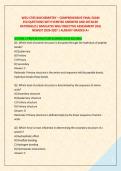
WGU C785 BIOCHEMISTRY – COMPREHENSIVE FINAL EXAM
250 QUESTIONS WITH VERIFIED ANSWERS AND DETAILED
RATIONALES| SIMULATES WGU OBJECTIVE ASSESSMENT (OA)
NEWEST 2026-2027 | ALREADY GRADED A+
SECTION 1: PROTEIN STRUCTURE & AMINO ACIDS (Q1–Q45)
Q1: Which level of protein structure is disrupted through the hydrolysis of peptide
bonds?
A) Quaternary
B) Tertiary
C) Primary
D) Secondary
Answer: C
Rationale: Primary structure is the amino acid sequence held by peptide bonds;
hydrolysis breaks these bonds.
Q2: Which level of protein structure is determined by the sequence of amino
acids?
A) Secondary structure
B) Quaternary structure
C) Tertiary structure
D) Primary structure
Answer: D
Rationale: Primary structure is defined solely by the linear sequence of amino
acids.
Q3: Which force is most influential in determining the secondary structure of a
protein?
A) Hydrophobic effect
B) Disulfide bonding
C) Hydrogen bonding
D) Electrostatic interactions
Answer: C
1
,Rationale: Secondary structures (α-helices, β-sheets) are stabilized by hydrogen
bonds between backbone groups.
Q4: Which amino acid contains a sulfur atom and can form disulfide bonds?
A) Methionine
B) Cysteine
C) Serine
D) Threonine
Answer: B
Rationale: Cysteine has a thiol (-SH) group that can oxidize to form disulfide
bonds; methionine also has sulfur but does not form disulfides.
Q5: Which of the following amino acids is classified as basic (positively charged at
physiological pH)?
A) Glutamic acid
B) Asparagine
C) Lysine
D) Alanine
Answer: C
Rationale: Lysine, arginine, and histidine are basic amino acids; lysine has a
positively charged side chain at pH 7.4.
Q6: The α-helix is stabilized by hydrogen bonds between which atoms?
A) Side chain R-groups
B) The carbonyl oxygen of one residue and the amide hydrogen of a residue four
residues away
C) The amino terminus and carboxyl terminus
D) Adjacent peptide bonds
Answer: B
Rationale: In an α-helix, each carbonyl oxygen forms a hydrogen bond with the
amide hydrogen of the i+4 residue.
2
,Q7: A mutation that changes a valine to a glutamic acid in a protein's core would
most likely affect which level of structure?
A) Primary
B) Secondary
C) Tertiary
D) Quaternary
Answer: C
Rationale: Changing a hydrophobic residue to a charged residue in the core
disrupts tertiary folding and stability.
Q8: Which of the following is NOT a non-covalent interaction that stabilizes
protein tertiary structure?
A) Hydrogen bonds
B) Ionic bonds
C) Disulfide bonds
D) Hydrophobic interactions
Answer: C
Rationale: Disulfide bonds are covalent, not non-covalent.
Q9: What is the primary function of chaperone proteins?
A) Catalyze peptide bond formation
B) Assist in proper protein folding and prevent aggregation
C) Degrade misfolded proteins
D) Transport proteins across membranes
Answer: B
Rationale: Chaperones help proteins fold correctly and prevent
misfolding/aggregation.
Q10: The pKa of a side chain determines its protonation state. At pH 7.4, which
amino acid side chain is mostly deprotonated?
A) Histidine (pKa ≈ 6.0)
B) Lysine (pKa ≈ 10.5)
C) Aspartic acid (pKa ≈ 3.9)
3
, D) Tyrosine (pKa ≈ 10.1)
Answer: C
Rationale: At pH 7.4, aspartic acid (pKa 3.9) is above its pKa, so it is deprotonated
(negatively charged).
Q11: Which amino acid has a side chain that can form a Schiff base with carbonyl
compounds?
A) Serine
B) Cysteine
C) Lysine
D) Proline
Answer: C
Rationale: Lysine's ε-amino group can react with aldehydes/ketones to form Schiff
bases (imines).
Q12: The peptide bond has partial double-bond character due to resonance. This
restricts rotation around which bond?
A) N-Cα
B) Cα-C
C) C-N (peptide bond)
D) Cα-N
Answer: C
Rationale: The peptide bond (C-N) has partial double-bond character, making it
planar and restricting rotation.
Q13: Which of the following best describes the quaternary structure of a protein?
A) The linear sequence of amino acids
B) The local folding pattern (α-helix, β-sheet)
C) The three-dimensional arrangement of a single polypeptide chain
D) The association of multiple polypeptide subunits
Answer: D
Rationale: Quaternary structure refers to the assembly of two or more protein
subunits.
4
250 QUESTIONS WITH VERIFIED ANSWERS AND DETAILED
RATIONALES| SIMULATES WGU OBJECTIVE ASSESSMENT (OA)
NEWEST 2026-2027 | ALREADY GRADED A+
SECTION 1: PROTEIN STRUCTURE & AMINO ACIDS (Q1–Q45)
Q1: Which level of protein structure is disrupted through the hydrolysis of peptide
bonds?
A) Quaternary
B) Tertiary
C) Primary
D) Secondary
Answer: C
Rationale: Primary structure is the amino acid sequence held by peptide bonds;
hydrolysis breaks these bonds.
Q2: Which level of protein structure is determined by the sequence of amino
acids?
A) Secondary structure
B) Quaternary structure
C) Tertiary structure
D) Primary structure
Answer: D
Rationale: Primary structure is defined solely by the linear sequence of amino
acids.
Q3: Which force is most influential in determining the secondary structure of a
protein?
A) Hydrophobic effect
B) Disulfide bonding
C) Hydrogen bonding
D) Electrostatic interactions
Answer: C
1
,Rationale: Secondary structures (α-helices, β-sheets) are stabilized by hydrogen
bonds between backbone groups.
Q4: Which amino acid contains a sulfur atom and can form disulfide bonds?
A) Methionine
B) Cysteine
C) Serine
D) Threonine
Answer: B
Rationale: Cysteine has a thiol (-SH) group that can oxidize to form disulfide
bonds; methionine also has sulfur but does not form disulfides.
Q5: Which of the following amino acids is classified as basic (positively charged at
physiological pH)?
A) Glutamic acid
B) Asparagine
C) Lysine
D) Alanine
Answer: C
Rationale: Lysine, arginine, and histidine are basic amino acids; lysine has a
positively charged side chain at pH 7.4.
Q6: The α-helix is stabilized by hydrogen bonds between which atoms?
A) Side chain R-groups
B) The carbonyl oxygen of one residue and the amide hydrogen of a residue four
residues away
C) The amino terminus and carboxyl terminus
D) Adjacent peptide bonds
Answer: B
Rationale: In an α-helix, each carbonyl oxygen forms a hydrogen bond with the
amide hydrogen of the i+4 residue.
2
,Q7: A mutation that changes a valine to a glutamic acid in a protein's core would
most likely affect which level of structure?
A) Primary
B) Secondary
C) Tertiary
D) Quaternary
Answer: C
Rationale: Changing a hydrophobic residue to a charged residue in the core
disrupts tertiary folding and stability.
Q8: Which of the following is NOT a non-covalent interaction that stabilizes
protein tertiary structure?
A) Hydrogen bonds
B) Ionic bonds
C) Disulfide bonds
D) Hydrophobic interactions
Answer: C
Rationale: Disulfide bonds are covalent, not non-covalent.
Q9: What is the primary function of chaperone proteins?
A) Catalyze peptide bond formation
B) Assist in proper protein folding and prevent aggregation
C) Degrade misfolded proteins
D) Transport proteins across membranes
Answer: B
Rationale: Chaperones help proteins fold correctly and prevent
misfolding/aggregation.
Q10: The pKa of a side chain determines its protonation state. At pH 7.4, which
amino acid side chain is mostly deprotonated?
A) Histidine (pKa ≈ 6.0)
B) Lysine (pKa ≈ 10.5)
C) Aspartic acid (pKa ≈ 3.9)
3
, D) Tyrosine (pKa ≈ 10.1)
Answer: C
Rationale: At pH 7.4, aspartic acid (pKa 3.9) is above its pKa, so it is deprotonated
(negatively charged).
Q11: Which amino acid has a side chain that can form a Schiff base with carbonyl
compounds?
A) Serine
B) Cysteine
C) Lysine
D) Proline
Answer: C
Rationale: Lysine's ε-amino group can react with aldehydes/ketones to form Schiff
bases (imines).
Q12: The peptide bond has partial double-bond character due to resonance. This
restricts rotation around which bond?
A) N-Cα
B) Cα-C
C) C-N (peptide bond)
D) Cα-N
Answer: C
Rationale: The peptide bond (C-N) has partial double-bond character, making it
planar and restricting rotation.
Q13: Which of the following best describes the quaternary structure of a protein?
A) The linear sequence of amino acids
B) The local folding pattern (α-helix, β-sheet)
C) The three-dimensional arrangement of a single polypeptide chain
D) The association of multiple polypeptide subunits
Answer: D
Rationale: Quaternary structure refers to the assembly of two or more protein
subunits.
4


