
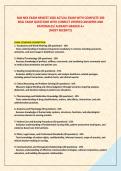
NLN NEX EXAM NEWEST 2026 ACTUAL EXAM WITH COMPLETE 300
REAL EXAM QUESTIONS WITH CORRECT VERIFIED ANSWERS AND
RATIONALES/ ALREADY GRADED A+
(MOST RECENT!!)
EXAM COVERAGE DESCRIPTION
1. Vocabulary and Word Meaning (30 questions) - 10%
Tests understanding of medical and general vocabulary in context, including synonyms,
antonyms, and word usage in healthcare scenarios.
2. Medical Terminology (30 questions) - 10%
Assesses knowledge of prefixes, suffixes, root words, and combining forms commonly used
in medical documentation and patient care.
3. Reading Comprehension (45 questions) - 15%
Evaluates ability to understand, interpret, and analyze healthcare-related passages,
including patient instructions, medical charts, and clinical reports.
4. Critical Reasoning and Problem Solving (30 questions) - 10%
Measures logical thinking and clinical judgment through scenarios requiring analysis,
deduction, and decision-making in patient care situations.
5. Pharmacology and Medication Knowledge (30 questions) - 10%
Tests understanding of drug classifications, actions, side effects, interactions, and safe
administration practices.
6. Anatomy and Physiology (30 questions) - 10%
Assesses knowledge of human body systems, structures, functions, and physiological
processes relevant to nursing practice.
7. Patient Care and Nursing Procedures (30 questions) - 10%
Evaluates understanding of fundamental nursing skills, patient assessment techniques, and
evidence-based care interventions.
8. Ethics, Legal Issues, and Professional Standards (30 questions) - 10%
Tests knowledge of patient rights, confidentiality, informed consent, scope of practice, and
ethical decision-making in nursing.
9. Communication and Therapeutic Relationships (30 questions) - 10%
Assesses understanding of effective communication strategies, cultural competence, patient
education, and building therapeutic relationships.
1
,10. Math and Dosage Calculations (15 questions) - 5%
Evaluates ability to perform basic mathematical operations and calculate medication
dosages, IV rates, and conversions accurately.
SECTION 1: VOCABULARY AND WORD MEANING (Questions 1-30)
1. Which of the following is the best definition of the word "adverse" as used in
the context of a medication's side effects?
A) Favorable
B) Unfavorable
C) Predictable
D) Temporary
Correct Answer: B) Unfavorable
Rationale: "Adverse" means harmful or unfavorable. In medicine, an adverse
effect is a negative or harmful reaction to a drug. "Favorable" is the opposite,
"predictable" means expected, and "temporary" means lasting for a limited time.
2. A patient's chart indicates he is "ambivalent" about his upcoming surgery. This
means he:
A) Is very excited.
B) Has conflicting feelings.
C) Is completely indifferent.
D) Has no understanding of the procedure.
Correct Answer: B) Has conflicting feelings.
Rationale: Ambivalence is the state of having mixed feelings or contradictory
ideas about something. It is not excitement (A), indifference (C), or a lack of
understanding (D).
3. Which of the following is a synonym for "mitigate"?
A) Worsen
B) Lessen
C) Ignore
D) Cause
2
, Correct Answer: B) Lessen
Rationale: To "mitigate" means to make something less severe, serious, or
painful. "Lessen" is the most accurate synonym. "Worsen," "ignore," and "cause"
all have opposite or unrelated meanings.
4. The term "acute" in a medical context most closely means:
A) Chronic
B) Sudden and severe
C) Mild
D) Long-lasting
Correct Answer: B) Sudden and severe
Rationale: Acute refers to a condition that has a rapid onset and is often severe
in nature. This is in contrast to "chronic," which means long-lasting or persistent.
5. If a patient is described as "lethargic," they are most likely:
A) Energetic
B) Drowsy and sluggish
C) Anxious
D) Pain-free
Correct Answer: B) Drowsy and sluggish
Rationale: Lethargy refers to a state of drowsiness, sluggishness, and lack of
energy. It is the opposite of energetic (A), not related to anxiety (C), and does not
indicate freedom from pain (D).
6. The word "contraindication" refers to:
A) A reason to use a treatment
B) A reason to avoid a treatment
C) A medication side effect
D) A patient's preference
Correct Answer: B) A reason to avoid a treatment
Rationale: A contraindication is a specific situation or condition where a
particular treatment, medication, or procedure should not be used because it
may be harmful.
3
, 7. Which of the following is the best synonym for "prudent"?
A) Careless
B) Wise and cautious
C) Hasty
D) Reckless
Correct Answer: B) Wise and cautious
Rationale: Prudent means acting with or showing care and thought for the
future. It is synonymous with being wise and cautious, and the opposite of
careless, hasty, or reckless.
8. The term "iatrogenic" means:
A) Related to genetics
B) Caused by medical treatment
C) Related to infection
D) Caused by lifestyle choices
Correct Answer: B) Caused by medical treatment
Rationale: Iatrogenic refers to an illness or condition that is caused by medical
examination or treatment. It derives from the Greek words "iatros" (physician)
and "genic" (produced by).
9. If a patient's condition is "deteriorating," it is:
A) Improving
B) Remaining stable
C) Getting worse
D) Unchanged
Correct Answer: C) Getting worse
Rationale: Deteriorating means becoming progressively worse or declining in
quality, condition, or health. It is the opposite of improving or remaining stable.
10. The word "efficacy" refers to:
A) The safety of a treatment
B) The effectiveness of a treatment
4
REAL EXAM QUESTIONS WITH CORRECT VERIFIED ANSWERS AND
RATIONALES/ ALREADY GRADED A+
(MOST RECENT!!)
EXAM COVERAGE DESCRIPTION
1. Vocabulary and Word Meaning (30 questions) - 10%
Tests understanding of medical and general vocabulary in context, including synonyms,
antonyms, and word usage in healthcare scenarios.
2. Medical Terminology (30 questions) - 10%
Assesses knowledge of prefixes, suffixes, root words, and combining forms commonly used
in medical documentation and patient care.
3. Reading Comprehension (45 questions) - 15%
Evaluates ability to understand, interpret, and analyze healthcare-related passages,
including patient instructions, medical charts, and clinical reports.
4. Critical Reasoning and Problem Solving (30 questions) - 10%
Measures logical thinking and clinical judgment through scenarios requiring analysis,
deduction, and decision-making in patient care situations.
5. Pharmacology and Medication Knowledge (30 questions) - 10%
Tests understanding of drug classifications, actions, side effects, interactions, and safe
administration practices.
6. Anatomy and Physiology (30 questions) - 10%
Assesses knowledge of human body systems, structures, functions, and physiological
processes relevant to nursing practice.
7. Patient Care and Nursing Procedures (30 questions) - 10%
Evaluates understanding of fundamental nursing skills, patient assessment techniques, and
evidence-based care interventions.
8. Ethics, Legal Issues, and Professional Standards (30 questions) - 10%
Tests knowledge of patient rights, confidentiality, informed consent, scope of practice, and
ethical decision-making in nursing.
9. Communication and Therapeutic Relationships (30 questions) - 10%
Assesses understanding of effective communication strategies, cultural competence, patient
education, and building therapeutic relationships.
1
,10. Math and Dosage Calculations (15 questions) - 5%
Evaluates ability to perform basic mathematical operations and calculate medication
dosages, IV rates, and conversions accurately.
SECTION 1: VOCABULARY AND WORD MEANING (Questions 1-30)
1. Which of the following is the best definition of the word "adverse" as used in
the context of a medication's side effects?
A) Favorable
B) Unfavorable
C) Predictable
D) Temporary
Correct Answer: B) Unfavorable
Rationale: "Adverse" means harmful or unfavorable. In medicine, an adverse
effect is a negative or harmful reaction to a drug. "Favorable" is the opposite,
"predictable" means expected, and "temporary" means lasting for a limited time.
2. A patient's chart indicates he is "ambivalent" about his upcoming surgery. This
means he:
A) Is very excited.
B) Has conflicting feelings.
C) Is completely indifferent.
D) Has no understanding of the procedure.
Correct Answer: B) Has conflicting feelings.
Rationale: Ambivalence is the state of having mixed feelings or contradictory
ideas about something. It is not excitement (A), indifference (C), or a lack of
understanding (D).
3. Which of the following is a synonym for "mitigate"?
A) Worsen
B) Lessen
C) Ignore
D) Cause
2
, Correct Answer: B) Lessen
Rationale: To "mitigate" means to make something less severe, serious, or
painful. "Lessen" is the most accurate synonym. "Worsen," "ignore," and "cause"
all have opposite or unrelated meanings.
4. The term "acute" in a medical context most closely means:
A) Chronic
B) Sudden and severe
C) Mild
D) Long-lasting
Correct Answer: B) Sudden and severe
Rationale: Acute refers to a condition that has a rapid onset and is often severe
in nature. This is in contrast to "chronic," which means long-lasting or persistent.
5. If a patient is described as "lethargic," they are most likely:
A) Energetic
B) Drowsy and sluggish
C) Anxious
D) Pain-free
Correct Answer: B) Drowsy and sluggish
Rationale: Lethargy refers to a state of drowsiness, sluggishness, and lack of
energy. It is the opposite of energetic (A), not related to anxiety (C), and does not
indicate freedom from pain (D).
6. The word "contraindication" refers to:
A) A reason to use a treatment
B) A reason to avoid a treatment
C) A medication side effect
D) A patient's preference
Correct Answer: B) A reason to avoid a treatment
Rationale: A contraindication is a specific situation or condition where a
particular treatment, medication, or procedure should not be used because it
may be harmful.
3
, 7. Which of the following is the best synonym for "prudent"?
A) Careless
B) Wise and cautious
C) Hasty
D) Reckless
Correct Answer: B) Wise and cautious
Rationale: Prudent means acting with or showing care and thought for the
future. It is synonymous with being wise and cautious, and the opposite of
careless, hasty, or reckless.
8. The term "iatrogenic" means:
A) Related to genetics
B) Caused by medical treatment
C) Related to infection
D) Caused by lifestyle choices
Correct Answer: B) Caused by medical treatment
Rationale: Iatrogenic refers to an illness or condition that is caused by medical
examination or treatment. It derives from the Greek words "iatros" (physician)
and "genic" (produced by).
9. If a patient's condition is "deteriorating," it is:
A) Improving
B) Remaining stable
C) Getting worse
D) Unchanged
Correct Answer: C) Getting worse
Rationale: Deteriorating means becoming progressively worse or declining in
quality, condition, or health. It is the opposite of improving or remaining stable.
10. The word "efficacy" refers to:
A) The safety of a treatment
B) The effectiveness of a treatment
4


