BIOL 252 - Human Anatomy &
Physiology II: The Respiratory System
Exam Review Questions with Answers and Rationale
Section 1: Respiratory Anatomy (Questions 1-20)
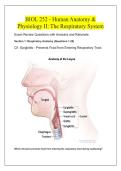
Q1: Epiglottis - Prevents Food from Entering Respiratory Tract
Which structure prevents food from entering the respiratory tract during swallowing?
,Answer: B) Epiglottis
Rationale: The epiglottis is a flap of elastic cartilage that closes over the glottis during
swallowing, preventing food and liquid from entering the trachea. It is attached to the thyroid
cartilage and is controlled by the vagus nerve (CN X) during the swallowing reflex.
Q2: Nasal Conchae - Warm, Humidify, and Filter Air
The primary function of the nasal conchae is to:
Answer: B) Warm, humidify, and filter incoming air
Rationale: The nasal conchae (superior, middle, inferior) are bony projections that increase the
surface area of the nasal cavity. They create turbulent airflow, which enhances the warming,
,humidification, and filtration of incoming air. This conditioning process is essential for protecting
the delicate respiratory epithelium.
Q3: Air Flow Pathway Through the Respiratory System
Which sequence correctly represents the flow of air through the respiratory system?
Answer: A) Nasal cavity - Pharynx - Larynx - Trachea - Bronchioles - Alveoli
Rationale: Air follows the conducting zone pathway: nasal cavity (or oral cavity) - pharynx -
larynx - trachea - primary bronchi - secondary bronchi - tertiary bronchi - bronchioles - terminal
bronchioles - respiratory bronchioles - alveolar ducts - alveolar sacs - alveoli, where gas
exchange occurs.
Q4: Trachea - Ciliated Pseudostratified Epithelium
, The trachea is lined with ciliated pseudostratified epithelium because:
Answer: A) It moves mucus and trapped debris toward the pharynx
Rationale: The coordinated beating of cilia moves mucus and trapped debris upward toward the
pharynx (mucociliary escalator), where it can be swallowed or expectorated. This mechanism is
a crucial part of the respiratory defense system.
Q5: Alveoli - Dense Capillary Networks for Gas Exchange
Physiology II: The Respiratory System
Exam Review Questions with Answers and Rationale
Section 1: Respiratory Anatomy (Questions 1-20)
Q1: Epiglottis - Prevents Food from Entering Respiratory Tract
Which structure prevents food from entering the respiratory tract during swallowing?
,Answer: B) Epiglottis
Rationale: The epiglottis is a flap of elastic cartilage that closes over the glottis during
swallowing, preventing food and liquid from entering the trachea. It is attached to the thyroid
cartilage and is controlled by the vagus nerve (CN X) during the swallowing reflex.
Q2: Nasal Conchae - Warm, Humidify, and Filter Air
The primary function of the nasal conchae is to:
Answer: B) Warm, humidify, and filter incoming air
Rationale: The nasal conchae (superior, middle, inferior) are bony projections that increase the
surface area of the nasal cavity. They create turbulent airflow, which enhances the warming,
,humidification, and filtration of incoming air. This conditioning process is essential for protecting
the delicate respiratory epithelium.
Q3: Air Flow Pathway Through the Respiratory System
Which sequence correctly represents the flow of air through the respiratory system?
Answer: A) Nasal cavity - Pharynx - Larynx - Trachea - Bronchioles - Alveoli
Rationale: Air follows the conducting zone pathway: nasal cavity (or oral cavity) - pharynx -
larynx - trachea - primary bronchi - secondary bronchi - tertiary bronchi - bronchioles - terminal
bronchioles - respiratory bronchioles - alveolar ducts - alveolar sacs - alveoli, where gas
exchange occurs.
Q4: Trachea - Ciliated Pseudostratified Epithelium
, The trachea is lined with ciliated pseudostratified epithelium because:
Answer: A) It moves mucus and trapped debris toward the pharynx
Rationale: The coordinated beating of cilia moves mucus and trapped debris upward toward the
pharynx (mucociliary escalator), where it can be swallowed or expectorated. This mechanism is
a crucial part of the respiratory defense system.
Q5: Alveoli - Dense Capillary Networks for Gas Exchange