

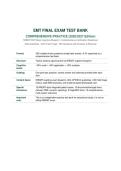
EMT FINAL EXAM TEST BANK
COMPREHENSIVE PRACTICE (2026/2027 Edition)
NREMT EMT-Basic Cognitive Blueprint • Comprehensive Certification Readiness
AHA Guidelines • CDC Field Triage • 320 Questions with Answers & Rationale
Format: 320 multiple-choice questions (single best answer, A–D) organized as a
comprehensive test bank.
Structure: Twelve sections spanning the full NREMT cognitive blueprint.
Cognitive ~30% recall • ~50% application • ~20% analysis.
levels:
Grading: One point per question; correct answer and rationale provided after each
item.
Content basis: NREMT cognitive exam blueprint, AHA CPR/ECC guidelines, CDC field triage
criteria, state EMS protocols, and evidence-based prehospital care.
Special 15 NREMT-style integrated patient cases; 10 documentation/legal items
inclusions: (refusal, DNR, consent, reporting); 5 triage/MCI items; 10 comprehensive
multi-system scenarios.
Important This is an independent practice test bank for educational study; it is not an
note: official NREMT exam.
, Section 1: EMS Systems, Safety, Wellness, & Legal/Ethical Issues (25 questions)
Q1: Which of the following is the MOST important reason the EMT maintains the ambulance and
equipment?
A. To ensure readiness to respond and provide safe care [CORRECT]
B. To impress supervisors
C. To reduce paperwork
D. To avoid dispatch
Correct Answer: A
Rationale: A is correct: readiness ensures safe, effective care. B, C, and D are incorrect.
Q2: Which is an example of evidence-based practice in EMS?
A. Using only personal experience
B. Applying current research and guidelines to patient care [CORRECT]
C. Ignoring protocols
D. Avoiding new information
Correct Answer: B
Rationale: A is correct: evidence-based practice uses research and guidelines. B, C, and D are incorrect.
Q3: Which is a component of personal wellness for an EMT?
A. Skipping meals
B. Ignoring fatigue
C. Adequate sleep, nutrition, and exercise [CORRECT]
D. Avoiding exercise
Correct Answer: C
Rationale: A is correct: sleep, nutrition, and exercise support wellness. B, C, and D are incorrect.
Q4: Which best describes the EMT's duty to act?
A. No obligation
B. Optional care
C. Care only when paid
D. The obligation to provide care once the role is assumed [CORRECT]
Correct Answer: D
Rationale: A is correct: once on duty/responding, the EMT has a duty to act. B, C, and D are incorrect.
Q5: Which is appropriate when a patient is unresponsive and needs immediate care?
A. Implied consent is assumed [CORRECT]
B. No consent is needed because the patient is a minor
C. Obtain written consent first
D. Refuse care
Correct Answer: A
Rationale: A is correct: implied consent is assumed for an unresponsive patient in an emergency. B, C, and D
are incorrect.
Q6: Which best describes involuntary consent?
A. Verbal consent
B. Care given under a court order or legal authority without the patient's choice [CORRECT]
C. Written consent
D. Implied consent
Correct Answer: B
Rationale: A is correct: involuntary consent is ordered by legal authority. B, C, and D are not.
EMT Final Exam Test Bank – Comprehensive Practice (2026/2027) Page 2
, Q7: Which is a key element of a legally valid refusal?
A. The patient is coerced
B. No documentation
C. The patient is competent and informed of consequences [CORRECT]
D. The family decides
Correct Answer: C
Rationale: A is correct: competency and informed understanding are required. B, C, and D invalidate the
refusal.
Q8: Under HIPAA, the EMT must:
A. Share information freely
B. Post patient details
C. Discuss cases in public
D. Protect the confidentiality of patient health information [CORRECT]
Correct Answer: D
Rationale: A is correct: HIPAA protects patient confidentiality. B, C, and D violate HIPAA.
Q9: Which is a mandatory reporting duty?
A. Reporting suspected abuse or neglect [CORRECT]
B. Keeping abuse secret
C. Reporting only if asked
D. Never reporting
Correct Answer: A
Rationale: A is correct: EMTs are mandated reporters of suspected abuse/neglect. B, C, and D fail that duty.
Q10: Which best describes the Good Samaritan law?
A. It allows reckless care
B. It protects those who provide care in good faith from liability (with limits) [CORRECT]
C. It removes all liability
D. It requires payment
Correct Answer: B
Rationale: A is correct: Good Samaritan laws protect good-faith responders. B, C, and D are incorrect.
Q11: Which is appropriate when a patient is a minor without a parent present in an emergency?
A. Wait for the parent
B. Refuse care
C. Provide emergency care under implied consent [CORRECT]
D. Require written consent
Correct Answer: C
Rationale: A is correct: emergency care may be provided under implied consent for a minor. B, C, and D are
incorrect.
Q12: Which best describes negligence?
A. Providing excellent care
B. Following protocol
C. Documenting accurately
D. Failure to meet the standard of care causing harm [CORRECT]
Correct Answer: D
Rationale: A is correct: negligence is a breach of the standard of care causing harm. B, C, and D are not.
EMT Final Exam Test Bank – Comprehensive Practice (2026/2027) Page 3
, Q13: Which is appropriate when a valid DNR is present?
A. Honor it and provide comfort care [CORRECT]
B. Begin resuscitation regardless
C. Ignore it
D. Destroy it
Correct Answer: A
Rationale: A is correct: honor a valid DNR. B, C, and D are incorrect.
Q14: Which is appropriate for lifting a heavy patient?
A. Lift with the back
B. Use a lift team or mechanical device and proper body mechanics [CORRECT]
C. Twist while lifting
D. Lift alone
Correct Answer: B
Rationale: A is correct: use proper equipment and body mechanics. B, C, and D are unsafe.
Q15: Which is appropriate when entering a potentially dangerous scene?
A. Enter immediately
B. Ignore the danger
C. Wait for law enforcement if the scene is unsafe [CORRECT]
D. Run in
Correct Answer: C
Rationale: A is correct: ensure scene safety. B, C, and D are unsafe.
Q16: Which is a standard precaution for bloodborne pathogens?
A. Recapping needles
B. Reusing gloves
C. Skipping hand hygiene
D. Wearing gloves and proper handling of sharps [CORRECT]
Correct Answer: D
Rationale: A is correct: gloves and safe sharps handling prevent exposure. B, C, and D increase risk.
Q17: Which is appropriate when a patient has an emotional response to bad news?
A. Provide support and a calm presence [CORRECT]
B. Ignore the emotion
C. Tell the patient to stop
D. Leave the patient
Correct Answer: A
Rationale: A is correct: provide support. B, C, and D are inappropriate.
Q18: Which is appropriate regarding the confidentiality of a patient's condition?
A. Discuss publicly
B. Share only with those involved in care [CORRECT]
C. Post details
D. Share with media
Correct Answer: B
Rationale: A is correct: share only with the care team. B, C, and D violate confidentiality.
EMT Final Exam Test Bank – Comprehensive Practice (2026/2027) Page 4
COMPREHENSIVE PRACTICE (2026/2027 Edition)
NREMT EMT-Basic Cognitive Blueprint • Comprehensive Certification Readiness
AHA Guidelines • CDC Field Triage • 320 Questions with Answers & Rationale
Format: 320 multiple-choice questions (single best answer, A–D) organized as a
comprehensive test bank.
Structure: Twelve sections spanning the full NREMT cognitive blueprint.
Cognitive ~30% recall • ~50% application • ~20% analysis.
levels:
Grading: One point per question; correct answer and rationale provided after each
item.
Content basis: NREMT cognitive exam blueprint, AHA CPR/ECC guidelines, CDC field triage
criteria, state EMS protocols, and evidence-based prehospital care.
Special 15 NREMT-style integrated patient cases; 10 documentation/legal items
inclusions: (refusal, DNR, consent, reporting); 5 triage/MCI items; 10 comprehensive
multi-system scenarios.
Important This is an independent practice test bank for educational study; it is not an
note: official NREMT exam.
, Section 1: EMS Systems, Safety, Wellness, & Legal/Ethical Issues (25 questions)
Q1: Which of the following is the MOST important reason the EMT maintains the ambulance and
equipment?
A. To ensure readiness to respond and provide safe care [CORRECT]
B. To impress supervisors
C. To reduce paperwork
D. To avoid dispatch
Correct Answer: A
Rationale: A is correct: readiness ensures safe, effective care. B, C, and D are incorrect.
Q2: Which is an example of evidence-based practice in EMS?
A. Using only personal experience
B. Applying current research and guidelines to patient care [CORRECT]
C. Ignoring protocols
D. Avoiding new information
Correct Answer: B
Rationale: A is correct: evidence-based practice uses research and guidelines. B, C, and D are incorrect.
Q3: Which is a component of personal wellness for an EMT?
A. Skipping meals
B. Ignoring fatigue
C. Adequate sleep, nutrition, and exercise [CORRECT]
D. Avoiding exercise
Correct Answer: C
Rationale: A is correct: sleep, nutrition, and exercise support wellness. B, C, and D are incorrect.
Q4: Which best describes the EMT's duty to act?
A. No obligation
B. Optional care
C. Care only when paid
D. The obligation to provide care once the role is assumed [CORRECT]
Correct Answer: D
Rationale: A is correct: once on duty/responding, the EMT has a duty to act. B, C, and D are incorrect.
Q5: Which is appropriate when a patient is unresponsive and needs immediate care?
A. Implied consent is assumed [CORRECT]
B. No consent is needed because the patient is a minor
C. Obtain written consent first
D. Refuse care
Correct Answer: A
Rationale: A is correct: implied consent is assumed for an unresponsive patient in an emergency. B, C, and D
are incorrect.
Q6: Which best describes involuntary consent?
A. Verbal consent
B. Care given under a court order or legal authority without the patient's choice [CORRECT]
C. Written consent
D. Implied consent
Correct Answer: B
Rationale: A is correct: involuntary consent is ordered by legal authority. B, C, and D are not.
EMT Final Exam Test Bank – Comprehensive Practice (2026/2027) Page 2
, Q7: Which is a key element of a legally valid refusal?
A. The patient is coerced
B. No documentation
C. The patient is competent and informed of consequences [CORRECT]
D. The family decides
Correct Answer: C
Rationale: A is correct: competency and informed understanding are required. B, C, and D invalidate the
refusal.
Q8: Under HIPAA, the EMT must:
A. Share information freely
B. Post patient details
C. Discuss cases in public
D. Protect the confidentiality of patient health information [CORRECT]
Correct Answer: D
Rationale: A is correct: HIPAA protects patient confidentiality. B, C, and D violate HIPAA.
Q9: Which is a mandatory reporting duty?
A. Reporting suspected abuse or neglect [CORRECT]
B. Keeping abuse secret
C. Reporting only if asked
D. Never reporting
Correct Answer: A
Rationale: A is correct: EMTs are mandated reporters of suspected abuse/neglect. B, C, and D fail that duty.
Q10: Which best describes the Good Samaritan law?
A. It allows reckless care
B. It protects those who provide care in good faith from liability (with limits) [CORRECT]
C. It removes all liability
D. It requires payment
Correct Answer: B
Rationale: A is correct: Good Samaritan laws protect good-faith responders. B, C, and D are incorrect.
Q11: Which is appropriate when a patient is a minor without a parent present in an emergency?
A. Wait for the parent
B. Refuse care
C. Provide emergency care under implied consent [CORRECT]
D. Require written consent
Correct Answer: C
Rationale: A is correct: emergency care may be provided under implied consent for a minor. B, C, and D are
incorrect.
Q12: Which best describes negligence?
A. Providing excellent care
B. Following protocol
C. Documenting accurately
D. Failure to meet the standard of care causing harm [CORRECT]
Correct Answer: D
Rationale: A is correct: negligence is a breach of the standard of care causing harm. B, C, and D are not.
EMT Final Exam Test Bank – Comprehensive Practice (2026/2027) Page 3
, Q13: Which is appropriate when a valid DNR is present?
A. Honor it and provide comfort care [CORRECT]
B. Begin resuscitation regardless
C. Ignore it
D. Destroy it
Correct Answer: A
Rationale: A is correct: honor a valid DNR. B, C, and D are incorrect.
Q14: Which is appropriate for lifting a heavy patient?
A. Lift with the back
B. Use a lift team or mechanical device and proper body mechanics [CORRECT]
C. Twist while lifting
D. Lift alone
Correct Answer: B
Rationale: A is correct: use proper equipment and body mechanics. B, C, and D are unsafe.
Q15: Which is appropriate when entering a potentially dangerous scene?
A. Enter immediately
B. Ignore the danger
C. Wait for law enforcement if the scene is unsafe [CORRECT]
D. Run in
Correct Answer: C
Rationale: A is correct: ensure scene safety. B, C, and D are unsafe.
Q16: Which is a standard precaution for bloodborne pathogens?
A. Recapping needles
B. Reusing gloves
C. Skipping hand hygiene
D. Wearing gloves and proper handling of sharps [CORRECT]
Correct Answer: D
Rationale: A is correct: gloves and safe sharps handling prevent exposure. B, C, and D increase risk.
Q17: Which is appropriate when a patient has an emotional response to bad news?
A. Provide support and a calm presence [CORRECT]
B. Ignore the emotion
C. Tell the patient to stop
D. Leave the patient
Correct Answer: A
Rationale: A is correct: provide support. B, C, and D are inappropriate.
Q18: Which is appropriate regarding the confidentiality of a patient's condition?
A. Discuss publicly
B. Share only with those involved in care [CORRECT]
C. Post details
D. Share with media
Correct Answer: B
Rationale: A is correct: share only with the care team. B, C, and D violate confidentiality.
EMT Final Exam Test Bank – Comprehensive Practice (2026/2027) Page 4


