

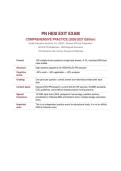
PN HESI EXIT EXAM
COMPREHENSIVE PRACTICE (2026/2027 Edition)
Health Education Systems, Inc. (HESI) • Elsevier PN Exit Preparation
NCLEX-PN Readiness • NGN-Aligned Scenarios
150 Questions with Correct Answers & Rationale
Format: 150 multiple-choice questions (single best answer, A–D), including NGN-style
case studies.
Structure: Eight sections aligned to the HESI/NCLEX-PN test plan.
Cognitive ~30% recall • ~50% application • ~20% analysis.
levels:
Grading: One point per question; correct answer and rationale provided after each
item.
Content basis: Elsevier/HESI PN blueprint, current NCLEX-PN test plan, NCSBN standards,
CDC guidelines, and evidence-based practical nursing practice.
Special 10 NGN-style items (DKA, postpartum hemorrhage, pediatric asthma,
inclusions: prioritization); 5 Maslow/ABC prioritization items; multiple dosage-calculation
items.
Important This is an independent practice exam for educational study; it is not an official
note: HESI or Elsevier exam.
, Section 1: Management of Care – Safety, Delegation, Legal/Ethical, Case
Management (20 questions)
Q1: A PN is caring for four clients. Which client should the PN assess first?
A. A client with a rapidly dropping oxygen saturation [CORRECT]
B. A client requesting a warm blanket
C. A client ready for discharge teaching
D. A client needing a routine bath
Correct Answer: A
Rationale: A is correct: hypoxemia is a priority ABC concern. B, C, and D are lower priority.
Q2: Which task is appropriate to delegate to assistive personnel (AP)?
A. Administering IV medication
B. Giving a bed bath to a stable client [CORRECT]
C. Assessing a new admission
D. Providing discharge teaching
Correct Answer: B
Rationale: A is correct: a bed bath is within the AP's scope. B, C, and D require nursing judgment or RN
scope.
Q3: Which task should the PN NOT delegate to unlicensed assistive personnel (UAP)?
A. Measuring routine vital signs
B. Assisting the client to the bathroom
C. Evaluating the client's response to a pain medication [CORRECT]
D. Recording intake and output
Correct Answer: C
Rationale: A is correct: evaluating medication response requires nursing judgment. B, C, and D are routine
UAP tasks.
Q4: A PN realizes a wrong medication was administered. Which is the first action?
A. Document it and say nothing
B. Hide the error
C. Give the correct drug silently
D. Assess the client for harm and notify the provider [CORRECT]
Correct Answer: D
Rationale: A is correct: assess for harm and notify the provider first. B, C, and D are unsafe and unethical.
Q5: A confused client is at risk for pulling out a feeding tube. Which is the least-restrictive
intervention to try first?
A. Reorientation, supervision, and diversion [CORRECT]
B. Immediate four-point restraints
C. Tying the tube to the bed
D. Sedating without an order
Correct Answer: A
Rationale: A is correct: least-restrictive measures (reorientation, supervision) are tried before restraints. B, C,
and D are more restrictive or unsafe.
PN HESI Exit Exam – Comprehensive Practice (2026/2027) Page 2
, Q6: Which precaution is required for a client with a draining wound infected with MRSA?
A. Airborne precautions
B. Contact precautions (gloves and gown) [CORRECT]
C. Droplet precautions
D. No precautions
Correct Answer: B
Rationale: A is correct: MRSA wound drainage requires contact precautions. B and C are for other
transmission; D is incorrect.
Q7: A client on droplet precautions needs which protection?
A. An N95 respirator
B. A negative-pressure room
C. A surgical mask when within 3 feet [CORRECT]
D. Only gloves
Correct Answer: C
Rationale: A is correct: droplet precautions require a surgical mask at close range. B and C are for airborne;
D is insufficient.
Q8: Which client is at greatest risk for falls?
A. A fully independent young adult
B. A client with stable vital signs
C. A client who is alert and oriented
D. An older adult taking a sedative and walking to the bathroom at night [CORRECT]
Correct Answer: D
Rationale: A is correct: age, sedatives, and nighttime ambulation increase fall risk. B, C, and D are lower risk.
Q9: Which is an appropriate fall-prevention action for an at-risk older adult?
A. Keep the call light within reach and provide non-slip footwear [CORRECT]
B. Keep the bed in the highest position
C. Leave the room dark
D. Encourage independent walking without assistance
Correct Answer: A
Rationale: A is correct: call light access and non-slip footwear reduce fall risk. B, C, and D increase risk.
Q10: A PN suspects a coworker is stealing controlled substances. The PN should:
A. Ignore it
B. Report the concern to the charge nurse or appropriate authority [CORRECT]
C. Confront and do nothing further
D. Ask to share the medication
Correct Answer: B
Rationale: A is correct: suspected diversion must be reported. B, C, and D are improper.
Q11: Which action reflects the PN's duty as a mandated reporter of suspected child abuse?
A. Keep it confidential
B. Confront the family only
C. Notify the appropriate authorities [CORRECT]
D. Wait for the child to disclose more
Correct Answer: C
Rationale: A is correct: mandated reporters must notify authorities. B, C, and D fail the duty.
PN HESI Exit Exam – Comprehensive Practice (2026/2027) Page 3
COMPREHENSIVE PRACTICE (2026/2027 Edition)
Health Education Systems, Inc. (HESI) • Elsevier PN Exit Preparation
NCLEX-PN Readiness • NGN-Aligned Scenarios
150 Questions with Correct Answers & Rationale
Format: 150 multiple-choice questions (single best answer, A–D), including NGN-style
case studies.
Structure: Eight sections aligned to the HESI/NCLEX-PN test plan.
Cognitive ~30% recall • ~50% application • ~20% analysis.
levels:
Grading: One point per question; correct answer and rationale provided after each
item.
Content basis: Elsevier/HESI PN blueprint, current NCLEX-PN test plan, NCSBN standards,
CDC guidelines, and evidence-based practical nursing practice.
Special 10 NGN-style items (DKA, postpartum hemorrhage, pediatric asthma,
inclusions: prioritization); 5 Maslow/ABC prioritization items; multiple dosage-calculation
items.
Important This is an independent practice exam for educational study; it is not an official
note: HESI or Elsevier exam.
, Section 1: Management of Care – Safety, Delegation, Legal/Ethical, Case
Management (20 questions)
Q1: A PN is caring for four clients. Which client should the PN assess first?
A. A client with a rapidly dropping oxygen saturation [CORRECT]
B. A client requesting a warm blanket
C. A client ready for discharge teaching
D. A client needing a routine bath
Correct Answer: A
Rationale: A is correct: hypoxemia is a priority ABC concern. B, C, and D are lower priority.
Q2: Which task is appropriate to delegate to assistive personnel (AP)?
A. Administering IV medication
B. Giving a bed bath to a stable client [CORRECT]
C. Assessing a new admission
D. Providing discharge teaching
Correct Answer: B
Rationale: A is correct: a bed bath is within the AP's scope. B, C, and D require nursing judgment or RN
scope.
Q3: Which task should the PN NOT delegate to unlicensed assistive personnel (UAP)?
A. Measuring routine vital signs
B. Assisting the client to the bathroom
C. Evaluating the client's response to a pain medication [CORRECT]
D. Recording intake and output
Correct Answer: C
Rationale: A is correct: evaluating medication response requires nursing judgment. B, C, and D are routine
UAP tasks.
Q4: A PN realizes a wrong medication was administered. Which is the first action?
A. Document it and say nothing
B. Hide the error
C. Give the correct drug silently
D. Assess the client for harm and notify the provider [CORRECT]
Correct Answer: D
Rationale: A is correct: assess for harm and notify the provider first. B, C, and D are unsafe and unethical.
Q5: A confused client is at risk for pulling out a feeding tube. Which is the least-restrictive
intervention to try first?
A. Reorientation, supervision, and diversion [CORRECT]
B. Immediate four-point restraints
C. Tying the tube to the bed
D. Sedating without an order
Correct Answer: A
Rationale: A is correct: least-restrictive measures (reorientation, supervision) are tried before restraints. B, C,
and D are more restrictive or unsafe.
PN HESI Exit Exam – Comprehensive Practice (2026/2027) Page 2
, Q6: Which precaution is required for a client with a draining wound infected with MRSA?
A. Airborne precautions
B. Contact precautions (gloves and gown) [CORRECT]
C. Droplet precautions
D. No precautions
Correct Answer: B
Rationale: A is correct: MRSA wound drainage requires contact precautions. B and C are for other
transmission; D is incorrect.
Q7: A client on droplet precautions needs which protection?
A. An N95 respirator
B. A negative-pressure room
C. A surgical mask when within 3 feet [CORRECT]
D. Only gloves
Correct Answer: C
Rationale: A is correct: droplet precautions require a surgical mask at close range. B and C are for airborne;
D is insufficient.
Q8: Which client is at greatest risk for falls?
A. A fully independent young adult
B. A client with stable vital signs
C. A client who is alert and oriented
D. An older adult taking a sedative and walking to the bathroom at night [CORRECT]
Correct Answer: D
Rationale: A is correct: age, sedatives, and nighttime ambulation increase fall risk. B, C, and D are lower risk.
Q9: Which is an appropriate fall-prevention action for an at-risk older adult?
A. Keep the call light within reach and provide non-slip footwear [CORRECT]
B. Keep the bed in the highest position
C. Leave the room dark
D. Encourage independent walking without assistance
Correct Answer: A
Rationale: A is correct: call light access and non-slip footwear reduce fall risk. B, C, and D increase risk.
Q10: A PN suspects a coworker is stealing controlled substances. The PN should:
A. Ignore it
B. Report the concern to the charge nurse or appropriate authority [CORRECT]
C. Confront and do nothing further
D. Ask to share the medication
Correct Answer: B
Rationale: A is correct: suspected diversion must be reported. B, C, and D are improper.
Q11: Which action reflects the PN's duty as a mandated reporter of suspected child abuse?
A. Keep it confidential
B. Confront the family only
C. Notify the appropriate authorities [CORRECT]
D. Wait for the child to disclose more
Correct Answer: C
Rationale: A is correct: mandated reporters must notify authorities. B, C, and D fail the duty.
PN HESI Exit Exam – Comprehensive Practice (2026/2027) Page 3


