

HESI FUNDAMENTALS VERSION 2 EXAM QUESTIONS & ANSWERS 2026-2027 (RAT… EXAM
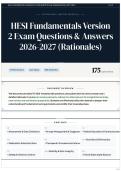
P R O F E S S I O N A L P R A C T I C E M AT E R I A L S
HESI Fundamentals Version
2 Exam Questions & Answers
2026-2027 (Rationales)
Verified Answers Exam Ready With Rationales
175 QUESTIONS
DOCUMENT OVERVIEW
This document provides 175 HESI Fundamentals questions, each paired with its correct answer and a
detailed rationale. It covers core nursing concepts, making it an ideal resource for comprehensive study,
exam review, and certification preparation. Students can effectively utilize this material to deepen their
understanding of fundamental nursing principles and solidify their knowledge base.
CONTENTS
01 02 03
• Assessment & Data Collection • Airway Management & Oxygenation• Patient Education & Communication
04 05 • Nutrition & Elimination
06
• Medication Administration • Therapeutic Procedures & Interventions
07 08 • Mobility & Skin Integrity 09
• Safety & Infection Control • Fluid & Electrolyte Balance
Page 1
, E XA M Q U EST I O N S
Q1 QUESTION 1 OF 175
The nurse observes a newly admitted older adult female take short steps and walk very slowly while pushing a
walker in front of her. What action should the nurse take in response to these observations?
A) Complete a full fall risk assessment of the client.
B) Teach the client to take longer steps at faster pace.
C) Suggest that the the client use a wheelchair instead of a walker.
D) Place client on bedrest until the healthcare provider is notified.
CORRECT ANSWER
A) Complete a full fall risk assessment of the client.
RATIONALE
Gait abnormalities such as slow, short-stepped ambulation with a walker are significant indicators of increased fall risk,
necessitating a comprehensive assessment to identify contributing factors and implement preventative interventions.
This assessment directly addresses the underlying concern of patient safety and potential injury.
Q2 QUESTION 2 OF 175
When assessing a client who starts to wheeze related data should obtain?
A) Presence of radiation.
B) Heart sounds.
C) Body temperature.
D) Precipitating factors.
CORRECT ANSWER
D) Precipitating factors.
RATIONALE
Identifying precipitating factors is key to managing bronchoconstriction, as the underlying cause often dictates the
appropriate intervention for wheezing. Assessing heart sounds, radiation, or body temperature is less directly related to
the immediate etiology of wheezing.
Q3 QUESTION 3 OF 175
Page 2
,To assess the quality of an adult client's pain, what approach should the nurse use?
A) Observe body language and movement.
B) Provide a numeric pain scale.
C) Ask the client to describe the pain.
D) Identify effective pain relief measures.
CORRECT ANSWER
C) Ask the client to describe the pain.
RATIONALE
The client's subjective experience is the most accurate indicator of pain quality, making direct inquiry through open-
ended questions the priority for assessment. This approach directly elicits the patient's unique perception and
characteristics of their pain.
Q4 QUESTION 4 OF 175
When performing blood pressure measurement to assess for orthostatic hypotension, which action should the
nurse implement first?
A) Apply the blood pressure cuff securely.
B) Record the client's pulse rate and rhythm.
C) Position the client supine for a few minutes.
D) Assist the client to stand at bedside.
CORRECT ANSWER
C) Position the client supine for a few minutes.
RATIONALE
Establishing a baseline blood pressure and heart rate while the client is at rest in a supine position is critical before
assessing for postural changes. This initial measurement provides a reference point against which subsequent supine,
sitting, and standing readings will be compared to identify significant hemodynamic shifts.
Q5 QUESTION 5 OF 175
When assessing a male client, the nurse finds that he is fatigue, and is experiencing muscle weakness, leg
cramps, and cardiac dysrhythmias. Based on these findings, the nurse plans to check the client's laboratory
values to validate the existence of which?
A) Hyperphosphatemia.
B) Hypocalcemia.
Page 3
, C) Hypermagnesemia.
D) Hypokalemia.
CORRECT ANSWER
D) Hypokalemia.
RATIONALE
Fatigue, muscle weakness, leg cramps, and cardiac dysrhythmias are classic signs and symptoms of hypokalemia,
reflecting potassium's critical role in maintaining cardiac and neuromuscular function. The nurse should check
laboratory values to confirm low serum potassium levels.
Q6 QUESTION 6 OF 175
When measuring vital signs, the nurse observes that a client is using accessory neck muscles during respiration.
What follow-up action should the nurses take first?
A) Determine pulse pressure.
B) Auscultate heart sounds.
C) Measure oxygen saturation.
D) Check for neck vein distention.
CORRECT ANSWER
D) Check for neck vein distention.
RATIONALE
Accessory muscle use during respiration signifies increased work of breathing, potentially indicating a cardiopulmonary
compromise such as right-sided heart failure or fluid overload. Checking for neck vein distention directly assesses for
jugular venous distention (JVD), a classic sign of elevated central venous pressure often associated with these
conditions.
Q7 QUESTION 7 OF 175
A client is admitted with a fever of unknown origin. To assess fever patterns, which intervention should the nurse
implement?
A) Document the client's circadian rhythms.
B) Assess for flushed, warm skin regularly.
Page 4
P R O F E S S I O N A L P R A C T I C E M AT E R I A L S
HESI Fundamentals Version
2 Exam Questions & Answers
2026-2027 (Rationales)
Verified Answers Exam Ready With Rationales
175 QUESTIONS
DOCUMENT OVERVIEW
This document provides 175 HESI Fundamentals questions, each paired with its correct answer and a
detailed rationale. It covers core nursing concepts, making it an ideal resource for comprehensive study,
exam review, and certification preparation. Students can effectively utilize this material to deepen their
understanding of fundamental nursing principles and solidify their knowledge base.
CONTENTS
01 02 03
• Assessment & Data Collection • Airway Management & Oxygenation• Patient Education & Communication
04 05 • Nutrition & Elimination
06
• Medication Administration • Therapeutic Procedures & Interventions
07 08 • Mobility & Skin Integrity 09
• Safety & Infection Control • Fluid & Electrolyte Balance
Page 1
, E XA M Q U EST I O N S
Q1 QUESTION 1 OF 175
The nurse observes a newly admitted older adult female take short steps and walk very slowly while pushing a
walker in front of her. What action should the nurse take in response to these observations?
A) Complete a full fall risk assessment of the client.
B) Teach the client to take longer steps at faster pace.
C) Suggest that the the client use a wheelchair instead of a walker.
D) Place client on bedrest until the healthcare provider is notified.
CORRECT ANSWER
A) Complete a full fall risk assessment of the client.
RATIONALE
Gait abnormalities such as slow, short-stepped ambulation with a walker are significant indicators of increased fall risk,
necessitating a comprehensive assessment to identify contributing factors and implement preventative interventions.
This assessment directly addresses the underlying concern of patient safety and potential injury.
Q2 QUESTION 2 OF 175
When assessing a client who starts to wheeze related data should obtain?
A) Presence of radiation.
B) Heart sounds.
C) Body temperature.
D) Precipitating factors.
CORRECT ANSWER
D) Precipitating factors.
RATIONALE
Identifying precipitating factors is key to managing bronchoconstriction, as the underlying cause often dictates the
appropriate intervention for wheezing. Assessing heart sounds, radiation, or body temperature is less directly related to
the immediate etiology of wheezing.
Q3 QUESTION 3 OF 175
Page 2
,To assess the quality of an adult client's pain, what approach should the nurse use?
A) Observe body language and movement.
B) Provide a numeric pain scale.
C) Ask the client to describe the pain.
D) Identify effective pain relief measures.
CORRECT ANSWER
C) Ask the client to describe the pain.
RATIONALE
The client's subjective experience is the most accurate indicator of pain quality, making direct inquiry through open-
ended questions the priority for assessment. This approach directly elicits the patient's unique perception and
characteristics of their pain.
Q4 QUESTION 4 OF 175
When performing blood pressure measurement to assess for orthostatic hypotension, which action should the
nurse implement first?
A) Apply the blood pressure cuff securely.
B) Record the client's pulse rate and rhythm.
C) Position the client supine for a few minutes.
D) Assist the client to stand at bedside.
CORRECT ANSWER
C) Position the client supine for a few minutes.
RATIONALE
Establishing a baseline blood pressure and heart rate while the client is at rest in a supine position is critical before
assessing for postural changes. This initial measurement provides a reference point against which subsequent supine,
sitting, and standing readings will be compared to identify significant hemodynamic shifts.
Q5 QUESTION 5 OF 175
When assessing a male client, the nurse finds that he is fatigue, and is experiencing muscle weakness, leg
cramps, and cardiac dysrhythmias. Based on these findings, the nurse plans to check the client's laboratory
values to validate the existence of which?
A) Hyperphosphatemia.
B) Hypocalcemia.
Page 3
, C) Hypermagnesemia.
D) Hypokalemia.
CORRECT ANSWER
D) Hypokalemia.
RATIONALE
Fatigue, muscle weakness, leg cramps, and cardiac dysrhythmias are classic signs and symptoms of hypokalemia,
reflecting potassium's critical role in maintaining cardiac and neuromuscular function. The nurse should check
laboratory values to confirm low serum potassium levels.
Q6 QUESTION 6 OF 175
When measuring vital signs, the nurse observes that a client is using accessory neck muscles during respiration.
What follow-up action should the nurses take first?
A) Determine pulse pressure.
B) Auscultate heart sounds.
C) Measure oxygen saturation.
D) Check for neck vein distention.
CORRECT ANSWER
D) Check for neck vein distention.
RATIONALE
Accessory muscle use during respiration signifies increased work of breathing, potentially indicating a cardiopulmonary
compromise such as right-sided heart failure or fluid overload. Checking for neck vein distention directly assesses for
jugular venous distention (JVD), a classic sign of elevated central venous pressure often associated with these
conditions.
Q7 QUESTION 7 OF 175
A client is admitted with a fever of unknown origin. To assess fever patterns, which intervention should the nurse
implement?
A) Document the client's circadian rhythms.
B) Assess for flushed, warm skin regularly.
Page 4


