

Page 1 of 249
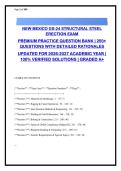
# TABLE OF CONTENTS
| **Section** | **Topic Area** | **Question Numbers** | **Page** |
|-------------|----------------|---------------------|----------|
| **Section 1** | Materials & Metallurgy | 1 – 55 | 3 |
| **Section 2** | Rigging & Crane Operations | 56 – 110 | 12 |
| **Section 3** | Steel Erection Methods & Sequencing | 111 – 165 | 22 |
| **Section 4** | Welding & Field Fabrication | 166 – 210 | 32 |
| **Section 5** | Bolting & Connections | 211 – 240 | 40 |
| **Section 6** | Safety & OSHA Compliance (Subpart R) | 241 – 270 | 46 |
| **Section 7** | Blueprint Reading & Estimating | 271 – 290 | 52 |
| **Section 8** | Seismic Requirements & Special Topics | 291 – 310 | 56 |
---
,Page 2 of 249
# SECTION 1: MATERIALS & METALLURGY
## (55 Questions)
### Question 1
What is the minimum specified yield strength of ASTM A992 structural steel, the most
commonly used grade for wide-flange shapes?
A) 36 ksi
B) 42 ksi
C) 50 ksi
D) 65 ksi
**Correct Answer: C) 50 ksi**
**Rationale:** ASTM A992 is the predominant specification for wide-flange structural steel
shapes used in building construction. It has a minimum yield strength of 50 ksi (345 MPa) and a
minimum tensile strength of 65 ksi. This grade replaced A36 for most wide-flange applications
due to its superior strength-to-weight ratio and improved weldability. A992 also provides
enhanced toughness and tighter chemical composition controls compared to older specifications.
**Distractor Analysis:**
- **A) 36 ksi:** This is the yield strength of ASTM A36 steel, which was historically used for
structural shapes but has been largely superseded by A992 for wide-flange members.
- **B) 42 ksi:** This is not a standard yield strength for structural steel shapes; it may be
confused with intermediate strength grades.
- **D) 65 ksi:** This is the minimum tensile strength of A992, not the yield strength. Tensile
strength represents the maximum stress the material can withstand before fracture.
---
,Page 3 of 249
### Question 2
Which of the following best describes the primary difference between ASTM A36 and ASTM
A992 structural steel?
A) A36 has higher carbon content than A992
B) A992 has a higher minimum yield strength and tighter chemical composition controls
C) A36 is only used for plates while A992 is used for shapes
D) A992 is more expensive but has lower weldability
**Correct Answer: B) A992 has a higher minimum yield strength and tighter chemical
composition controls**
**Rationale:** ASTM A992 was developed specifically for wide-flange shapes and offers a
minimum yield strength of 50 ksi compared to A36's 36 ksi. Additionally, A992 has more
stringent requirements for carbon equivalent, manganese, and other alloying elements, resulting
in better weldability and toughness. The specification also includes requirements for maximum
yield-to-tensile ratio, which is important for seismic performance.
**Distractor Analysis:**
- **A) A36 has higher carbon content than A992:** Incorrect. A992 actually has tighter carbon
equivalent limits to improve weldability.
- **C) A36 is only used for plates while A992 is used for shapes:** Incorrect. A36 can be used
for both plates and shapes, though A992 is preferred for wide-flange shapes.
- **D) A992 is more expensive but has lower weldability:** Incorrect. A992 has superior
weldability due to tighter chemical controls.
---
### Question 3
What is the significance of the "yield-to-tensile ratio" in structural steel specifications?
, Page 4 of 249
A) It indicates the steel's resistance to corrosion
B) It measures the steel's ability to be welded
C) It provides an indication of the steel's ductility and performance under overload conditions
D) It determines the steel's modulus of elasticity
**Correct Answer: C) It provides an indication of the steel's ductility and performance under
overload conditions**
**Rationale:** The yield-to-tensile ratio (yield strength divided by tensile strength) is a critical
parameter that indicates how much ductility the steel possesses before reaching its ultimate
strength. A lower ratio (typically below 0.85 for seismic applications) indicates greater ductility
and strain-hardening capacity, which is essential for structures to absorb energy during seismic
events or other overload conditions. This parameter is particularly important in seismic design
categories where inelastic behavior is expected.
**Distractor Analysis:**
- **A) It indicates the steel's resistance to corrosion:** Incorrect. Corrosion resistance is related
to chemical composition and protective coatings, not the yield-to-tensile ratio.
- **B) It measures the steel's ability to be welded:** Incorrect. Weldability is related to carbon
equivalent and other chemical factors.
- **D) It determines the steel's modulus of elasticity:** Incorrect. The modulus of elasticity
(approximately 29,000 ksi) is essentially constant for all structural steels regardless of strength
grade.
---
### Question 4
What is the minimum tensile strength requirement for ASTM A992 structural steel?
# TABLE OF CONTENTS
| **Section** | **Topic Area** | **Question Numbers** | **Page** |
|-------------|----------------|---------------------|----------|
| **Section 1** | Materials & Metallurgy | 1 – 55 | 3 |
| **Section 2** | Rigging & Crane Operations | 56 – 110 | 12 |
| **Section 3** | Steel Erection Methods & Sequencing | 111 – 165 | 22 |
| **Section 4** | Welding & Field Fabrication | 166 – 210 | 32 |
| **Section 5** | Bolting & Connections | 211 – 240 | 40 |
| **Section 6** | Safety & OSHA Compliance (Subpart R) | 241 – 270 | 46 |
| **Section 7** | Blueprint Reading & Estimating | 271 – 290 | 52 |
| **Section 8** | Seismic Requirements & Special Topics | 291 – 310 | 56 |
---
,Page 2 of 249
# SECTION 1: MATERIALS & METALLURGY
## (55 Questions)
### Question 1
What is the minimum specified yield strength of ASTM A992 structural steel, the most
commonly used grade for wide-flange shapes?
A) 36 ksi
B) 42 ksi
C) 50 ksi
D) 65 ksi
**Correct Answer: C) 50 ksi**
**Rationale:** ASTM A992 is the predominant specification for wide-flange structural steel
shapes used in building construction. It has a minimum yield strength of 50 ksi (345 MPa) and a
minimum tensile strength of 65 ksi. This grade replaced A36 for most wide-flange applications
due to its superior strength-to-weight ratio and improved weldability. A992 also provides
enhanced toughness and tighter chemical composition controls compared to older specifications.
**Distractor Analysis:**
- **A) 36 ksi:** This is the yield strength of ASTM A36 steel, which was historically used for
structural shapes but has been largely superseded by A992 for wide-flange members.
- **B) 42 ksi:** This is not a standard yield strength for structural steel shapes; it may be
confused with intermediate strength grades.
- **D) 65 ksi:** This is the minimum tensile strength of A992, not the yield strength. Tensile
strength represents the maximum stress the material can withstand before fracture.
---
,Page 3 of 249
### Question 2
Which of the following best describes the primary difference between ASTM A36 and ASTM
A992 structural steel?
A) A36 has higher carbon content than A992
B) A992 has a higher minimum yield strength and tighter chemical composition controls
C) A36 is only used for plates while A992 is used for shapes
D) A992 is more expensive but has lower weldability
**Correct Answer: B) A992 has a higher minimum yield strength and tighter chemical
composition controls**
**Rationale:** ASTM A992 was developed specifically for wide-flange shapes and offers a
minimum yield strength of 50 ksi compared to A36's 36 ksi. Additionally, A992 has more
stringent requirements for carbon equivalent, manganese, and other alloying elements, resulting
in better weldability and toughness. The specification also includes requirements for maximum
yield-to-tensile ratio, which is important for seismic performance.
**Distractor Analysis:**
- **A) A36 has higher carbon content than A992:** Incorrect. A992 actually has tighter carbon
equivalent limits to improve weldability.
- **C) A36 is only used for plates while A992 is used for shapes:** Incorrect. A36 can be used
for both plates and shapes, though A992 is preferred for wide-flange shapes.
- **D) A992 is more expensive but has lower weldability:** Incorrect. A992 has superior
weldability due to tighter chemical controls.
---
### Question 3
What is the significance of the "yield-to-tensile ratio" in structural steel specifications?
, Page 4 of 249
A) It indicates the steel's resistance to corrosion
B) It measures the steel's ability to be welded
C) It provides an indication of the steel's ductility and performance under overload conditions
D) It determines the steel's modulus of elasticity
**Correct Answer: C) It provides an indication of the steel's ductility and performance under
overload conditions**
**Rationale:** The yield-to-tensile ratio (yield strength divided by tensile strength) is a critical
parameter that indicates how much ductility the steel possesses before reaching its ultimate
strength. A lower ratio (typically below 0.85 for seismic applications) indicates greater ductility
and strain-hardening capacity, which is essential for structures to absorb energy during seismic
events or other overload conditions. This parameter is particularly important in seismic design
categories where inelastic behavior is expected.
**Distractor Analysis:**
- **A) It indicates the steel's resistance to corrosion:** Incorrect. Corrosion resistance is related
to chemical composition and protective coatings, not the yield-to-tensile ratio.
- **B) It measures the steel's ability to be welded:** Incorrect. Weldability is related to carbon
equivalent and other chemical factors.
- **D) It determines the steel's modulus of elasticity:** Incorrect. The modulus of elasticity
(approximately 29,000 ksi) is essentially constant for all structural steels regardless of strength
grade.
---
### Question 4
What is the minimum tensile strength requirement for ASTM A992 structural steel?


