

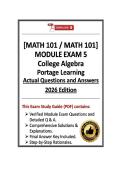
,MATH101/MATH 101 Module Exam 5 | College Algebra
| Portage Learning | Q & A | 2026 Edition (PDF)
1. Which of the following is a polynomial?
A) \( 3x^2 + 2x - 1 \)
B) \( \frac{1}{x} + 2 \)
C) \( \sqrt{x} + 4 \)
D) \( x^{-2} + 3 \)
Correct Answer: \( 3x^2 + 2x - 1 \)
Rationale: A polynomial has non-negative integer exponents on the variable. Option A meets this
criterion. Options B, C, and D contain negative or fractional exponents, which are not allowed in
polynomials.
2. What is the degree of the polynomial \( 4x^3 - 2x^2 + 5x - 1 \)?
A) 1
B) 2
C) 3
D) 4
Correct Answer: 3
Rationale: The degree of a polynomial is the highest exponent of the variable. In \( 4x^3 - 2x^2 + 5x -
1 \), the highest exponent is 3.
3. What is the leading coefficient of the polynomial \( -x^3 + 4x^2 - 2 \)?
A) 1
B) -1
C) 4
,D) -2
Correct Answer: -1
Rationale: The leading coefficient is the coefficient of the term with the highest degree. The term with
the highest degree is \( -x^3 \), so the leading coefficient is -1.
4. Add the polynomials: \( (3x^2 - 2x + 1) + (x^2 + 3x - 5) \).
A) \( 4x^2 + x - 4 \)
B) \( 4x^2 + 5x - 4 \)
C) \( 4x^2 + x + 6 \)
D) \( 4x^2 - x - 4 \)
Correct Answer: \( 4x^2 + x - 4 \)
Rationale: Combine like terms: \( 3x^2 + x^2 = 4x^2 \), \( -2x + 3x = x \), and \( 1 - 5 = -4 \). The result is \(
4x^2 + x - 4 \).
5. Subtract the polynomials: \( (4x^2 + 3x - 2) - (x^2 - 2x + 1) \).
A) \( 3x^2 + 5x - 3 \)
B) \( 3x^2 + x - 3 \)
C) \( 3x^2 + 5x + 1 \)
D) \( 3x^2 + x + 1 \)
Correct Answer: \( 3x^2 + 5x - 3 \)
Rationale: Distribute the negative sign: \( 4x^2 + 3x - 2 - x^2 + 2x - 1 \). Combine like terms: \( 3x^2 + 5x -
3 \).
6. Multiply and simplify: \( (3x + 2)(x - 5) \).
, A) \( 3x^2 - 13x - 10 \)
B) \( 3x^2 - 15x - 10 \)
C) \( 3x^2 - 13x + 10 \)
D) \( 3x^2 + 13x - 10 \)
Correct Answer: \( 3x^2 - 13x - 10 \)
Rationale: Use the FOIL method: \( (3x)(x) + (3x)(-5) + (2)(x) + (2)(-5) = 3x^2 - 15x + 2x - 10 = 3x^2 - 13x -
10 \).
7. Expand and simplify: \( (x - 4)^2 \).
A) \( x^2 - 16 \)
B) \( x^2 - 8x + 16 \)
C) \( x^2 + 8x + 16 \)
D) \( x^2 - 4x + 16 \)
Correct Answer: \( x^2 - 8x + 16 \)
Rationale: \( (x - 4)^2 = (x - 4)(x - 4) = x^2 - 4x - 4x + 16 = x^2 - 8x + 16 \).
8. Divide \( (6x^2 - 13x + 6) \) by \( (2x - 3) \).
A) \( 3x - 2 \)
B) \( 3x + 2 \)
C) \( 2x - 3 \)
D) \( 2x + 3 \)
Correct Answer: \( 3x - 2 \)
| Portage Learning | Q & A | 2026 Edition (PDF)
1. Which of the following is a polynomial?
A) \( 3x^2 + 2x - 1 \)
B) \( \frac{1}{x} + 2 \)
C) \( \sqrt{x} + 4 \)
D) \( x^{-2} + 3 \)
Correct Answer: \( 3x^2 + 2x - 1 \)
Rationale: A polynomial has non-negative integer exponents on the variable. Option A meets this
criterion. Options B, C, and D contain negative or fractional exponents, which are not allowed in
polynomials.
2. What is the degree of the polynomial \( 4x^3 - 2x^2 + 5x - 1 \)?
A) 1
B) 2
C) 3
D) 4
Correct Answer: 3
Rationale: The degree of a polynomial is the highest exponent of the variable. In \( 4x^3 - 2x^2 + 5x -
1 \), the highest exponent is 3.
3. What is the leading coefficient of the polynomial \( -x^3 + 4x^2 - 2 \)?
A) 1
B) -1
C) 4
,D) -2
Correct Answer: -1
Rationale: The leading coefficient is the coefficient of the term with the highest degree. The term with
the highest degree is \( -x^3 \), so the leading coefficient is -1.
4. Add the polynomials: \( (3x^2 - 2x + 1) + (x^2 + 3x - 5) \).
A) \( 4x^2 + x - 4 \)
B) \( 4x^2 + 5x - 4 \)
C) \( 4x^2 + x + 6 \)
D) \( 4x^2 - x - 4 \)
Correct Answer: \( 4x^2 + x - 4 \)
Rationale: Combine like terms: \( 3x^2 + x^2 = 4x^2 \), \( -2x + 3x = x \), and \( 1 - 5 = -4 \). The result is \(
4x^2 + x - 4 \).
5. Subtract the polynomials: \( (4x^2 + 3x - 2) - (x^2 - 2x + 1) \).
A) \( 3x^2 + 5x - 3 \)
B) \( 3x^2 + x - 3 \)
C) \( 3x^2 + 5x + 1 \)
D) \( 3x^2 + x + 1 \)
Correct Answer: \( 3x^2 + 5x - 3 \)
Rationale: Distribute the negative sign: \( 4x^2 + 3x - 2 - x^2 + 2x - 1 \). Combine like terms: \( 3x^2 + 5x -
3 \).
6. Multiply and simplify: \( (3x + 2)(x - 5) \).
, A) \( 3x^2 - 13x - 10 \)
B) \( 3x^2 - 15x - 10 \)
C) \( 3x^2 - 13x + 10 \)
D) \( 3x^2 + 13x - 10 \)
Correct Answer: \( 3x^2 - 13x - 10 \)
Rationale: Use the FOIL method: \( (3x)(x) + (3x)(-5) + (2)(x) + (2)(-5) = 3x^2 - 15x + 2x - 10 = 3x^2 - 13x -
10 \).
7. Expand and simplify: \( (x - 4)^2 \).
A) \( x^2 - 16 \)
B) \( x^2 - 8x + 16 \)
C) \( x^2 + 8x + 16 \)
D) \( x^2 - 4x + 16 \)
Correct Answer: \( x^2 - 8x + 16 \)
Rationale: \( (x - 4)^2 = (x - 4)(x - 4) = x^2 - 4x - 4x + 16 = x^2 - 8x + 16 \).
8. Divide \( (6x^2 - 13x + 6) \) by \( (2x - 3) \).
A) \( 3x - 2 \)
B) \( 3x + 2 \)
C) \( 2x - 3 \)
D) \( 2x + 3 \)
Correct Answer: \( 3x - 2 \)


