

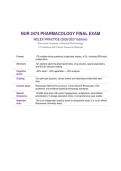
NUR 2474 PHARMACOLOGY FINAL EXAM
NCLEX PRACTICE (2026/2027 Edition)
Rasmussen University • Advanced Pharmacology
175 Questions with Correct Answers & Rationale
Format: 175 multiple-choice questions (single best answer, A–D), including NGN-style
nested items.
Structure: Ten sections spanning pharmacokinetics, drug classes, special populations,
and NCLEX decision-making.
Cognitive ~30% recall • ~50% application • ~20% analysis.
levels:
Grading: One point per question; correct answer and rationale provided after each
item.
Content basis: Rasmussen NUR 2474 curriculum, current NCLEX-RN test plan, FDA
guidelines, and evidence-based pharmacology standards.
Special 10 NGN-style items (HF+renal, hypoglycemia, anaphylaxis, reconciliation,
inclusions: prioritization); 5 dosage-calculation items; 3 comprehensive case studies.
Important This is an independent practice exam for educational study; it is not an official
note: Rasmussen University exam.
, Section 1: Pharmacokinetics, Pharmacodynamics, & Medication Safety (20
questions)
Q1: A drug has a half-life of 12 hours. Approximately how long until it reaches steady state?
A. 2-3 days [CORRECT]
B. 12 hours
C. 24 hours
D. 5 days
Correct Answer: A
Rationale: A is correct: steady state is reached in about 4-5 half-lives; 5 × 12 h = 60 h ≈ 2-3 days. B, C, and D
are incorrect.
Q2: Which of the following best describes bioavailability?
A. The rate of renal excretion
B. The fraction of the administered drug that reaches systemic circulation
unchanged [CORRECT]
C. The degree of protein binding
D. The volume of distribution
Correct Answer: B
Rationale: A is correct: bioavailability is the fraction reaching systemic circulation. B, C, and D describe other
parameters.
Q3: Which CYP450 enzyme metabolizes the largest proportion of drugs and is a common site of
interactions?
A. CYP2D6
B. CYP2C9
C. CYP3A4 [CORRECT]
D. CYP1A2
Correct Answer: C
Rationale: A is correct: CYP3A4 metabolizes about 40-50% of drugs. B, C, and D are important but
metabolize fewer.
Q4: A drug that is an enzyme inducer (e.g., rifampin) would be expected to:
A. Decrease the metabolism of other drugs
B. Have no effect on other drugs
C. Always increase toxicity
D. Increase the metabolism of co-administered drugs, lowering their levels [CORRECT]
Correct Answer: D
Rationale: A is correct: inducers increase metabolism, lowering substrate levels. B, C, and D are incorrect.
Q5: A patient with cirrhosis and reduced hepatic function would most likely require what for
hepatically cleared drugs?
A. A lower dose or longer interval [CORRECT]
B. A higher dose
C. No change
D. A faster rate of infusion
Correct Answer: A
Rationale: A is correct: reduced hepatic metabolism requires dose reduction. B, C, and D are unsafe.
NUR 2474 Pharmacology Final Exam – NCLEX Practice (2026/2027) Page 2
, Q6: A patient with a creatinine clearance (eGFR) of 25 mL/min. Which medication would require
adjustment or avoidance due to renal clearance?
A. A hepatically cleared drug
B. A renally cleared drug such as an aminoglycoside or nitrofurantoin [CORRECT]
C. A drug with no renal elimination
D. Any over-the-counter product
Correct Answer: B
Rationale: A is correct: renally cleared drugs need adjustment/avoidance at low eGFR. B, C, and D are
incorrect.
Q7: The therapeutic index of a drug is the:
A. Number of doses per day
B. Amount of drug absorbed
C. Ratio of the toxic dose to the therapeutic dose [CORRECT]
D. Time to peak effect
Correct Answer: C
Rationale: A is correct: therapeutic index = TD50/LD50 (toxic vs therapeutic). B, C, and D are incorrect.
Q8: Which of the following is a high-alert medication requiring special safeguards?
A. Acetaminophen
B. Oral multivitamin
C. Antacids
D. Heparin [CORRECT]
Correct Answer: D
Rationale: A is correct: anticoagulants like heparin are high-alert medications. B, C, and D are not high-alert.
Q9: Before administering a medication, the nurse must verify which right(s)?
A. Right patient, drug, dose, route, time, and documentation [CORRECT]
B. Only the drug name
C. Only the route
D. Only the time
Correct Answer: A
Rationale: A is correct: the rights include patient, drug, dose, route, time, and documentation. B, C, and D are
incomplete.
Q10: A patient's digoxin level is 3.2 ng/mL (therapeutic 0.5-2). This indicates:
A. A therapeutic level
B. Digoxin toxicity, and the dose should be held [CORRECT]
C. A subtherapeutic level
D. No concern
Correct Answer: B
Rationale: A is correct: a level above therapeutic range indicates toxicity; hold and notify. B, C, and D are
incorrect.
Q11: Which is an appropriate action when a medication error is made?
A. Hide the error
B. Document it as correct
C. Assess the patient, notify the provider, document, and report per policy [CORRECT]
D. Do nothing
Correct Answer: C
Rationale: A is correct: medication errors require assessment, notification, documentation, and reporting. B,
C, and D are improper.
NUR 2474 Pharmacology Final Exam – NCLEX Practice (2026/2027) Page 3
, Q12: A patient is prescribed a drug that is a P-glycoprotein substrate. Which statement is correct?
A. P-gp has no clinical relevance
B. P-gp only affects water
C. P-gp is found only in the liver
D. P-gp inhibitors can raise drug levels, and P-gp inducers can lower them [CORRECT]
Correct Answer: D
Rationale: A is correct: P-gp transport affects drug levels; inhibitors/inducers alter them. B, C, and D are
incorrect.
Q13: Which drug would most likely require a reduced dose in a patient with reduced kidney
function?
A. Gentamicin [CORRECT]
B. Doxycycline
C. Metformin in early mild impairment (still caution)
D. Ceftriaxone
Correct Answer: A
Rationale: A is correct: gentamicin is renally cleared and needs adjustment. B (doxycycline) is hepatically
cleared; C requires caution at low eGFR; D is safer.
Q14: The 'peak' serum level of an IV antibiotic is used to:
A. Ensure the drug is not too high before the next dose
B. Confirm that the drug reached an effective concentration [CORRECT]
C. Measure renal function
D. Test for allergies
Correct Answer: B
Rationale: A is correct: peak levels verify efficacy. B describes trough; C and D are incorrect.
Q15: A patient is taking an MAOI and an SSRI. This combination increases the risk of:
A. Hypertensive crisis only
B. Hypokalemia
C. Serotonin syndrome [CORRECT]
D. No interaction
Correct Answer: C
Rationale: A is correct: MAOI + SSRI risks severe serotonin syndrome. B, C, and D are incorrect.
Q16: A provider orders 2 g of a medication IV. The concentration is 500 mg per 10 mL. How many
mL?
A. 20 mL
B. 10 mL
C. 5 mL
D. 40 mL [CORRECT]
Correct Answer: D
Rationale: A is correct: 2 g = 2000 mg; (2000/500) × 10 = 40 mL. B, C, and D are incorrect.
Q17: A patient is to receive 1000 mL of IV fluid over 8 hours. What is the rate in mL/hour?
A. 125 mL/hour [CORRECT]
B. 100 mL/hour
C. 250 mL/hour
D. 80 mL/hour
Correct Answer: A
Rationale: A is correct: 1000/8 = 125 mL/hour. B, C, and D are incorrect.
NUR 2474 Pharmacology Final Exam – NCLEX Practice (2026/2027) Page 4
NCLEX PRACTICE (2026/2027 Edition)
Rasmussen University • Advanced Pharmacology
175 Questions with Correct Answers & Rationale
Format: 175 multiple-choice questions (single best answer, A–D), including NGN-style
nested items.
Structure: Ten sections spanning pharmacokinetics, drug classes, special populations,
and NCLEX decision-making.
Cognitive ~30% recall • ~50% application • ~20% analysis.
levels:
Grading: One point per question; correct answer and rationale provided after each
item.
Content basis: Rasmussen NUR 2474 curriculum, current NCLEX-RN test plan, FDA
guidelines, and evidence-based pharmacology standards.
Special 10 NGN-style items (HF+renal, hypoglycemia, anaphylaxis, reconciliation,
inclusions: prioritization); 5 dosage-calculation items; 3 comprehensive case studies.
Important This is an independent practice exam for educational study; it is not an official
note: Rasmussen University exam.
, Section 1: Pharmacokinetics, Pharmacodynamics, & Medication Safety (20
questions)
Q1: A drug has a half-life of 12 hours. Approximately how long until it reaches steady state?
A. 2-3 days [CORRECT]
B. 12 hours
C. 24 hours
D. 5 days
Correct Answer: A
Rationale: A is correct: steady state is reached in about 4-5 half-lives; 5 × 12 h = 60 h ≈ 2-3 days. B, C, and D
are incorrect.
Q2: Which of the following best describes bioavailability?
A. The rate of renal excretion
B. The fraction of the administered drug that reaches systemic circulation
unchanged [CORRECT]
C. The degree of protein binding
D. The volume of distribution
Correct Answer: B
Rationale: A is correct: bioavailability is the fraction reaching systemic circulation. B, C, and D describe other
parameters.
Q3: Which CYP450 enzyme metabolizes the largest proportion of drugs and is a common site of
interactions?
A. CYP2D6
B. CYP2C9
C. CYP3A4 [CORRECT]
D. CYP1A2
Correct Answer: C
Rationale: A is correct: CYP3A4 metabolizes about 40-50% of drugs. B, C, and D are important but
metabolize fewer.
Q4: A drug that is an enzyme inducer (e.g., rifampin) would be expected to:
A. Decrease the metabolism of other drugs
B. Have no effect on other drugs
C. Always increase toxicity
D. Increase the metabolism of co-administered drugs, lowering their levels [CORRECT]
Correct Answer: D
Rationale: A is correct: inducers increase metabolism, lowering substrate levels. B, C, and D are incorrect.
Q5: A patient with cirrhosis and reduced hepatic function would most likely require what for
hepatically cleared drugs?
A. A lower dose or longer interval [CORRECT]
B. A higher dose
C. No change
D. A faster rate of infusion
Correct Answer: A
Rationale: A is correct: reduced hepatic metabolism requires dose reduction. B, C, and D are unsafe.
NUR 2474 Pharmacology Final Exam – NCLEX Practice (2026/2027) Page 2
, Q6: A patient with a creatinine clearance (eGFR) of 25 mL/min. Which medication would require
adjustment or avoidance due to renal clearance?
A. A hepatically cleared drug
B. A renally cleared drug such as an aminoglycoside or nitrofurantoin [CORRECT]
C. A drug with no renal elimination
D. Any over-the-counter product
Correct Answer: B
Rationale: A is correct: renally cleared drugs need adjustment/avoidance at low eGFR. B, C, and D are
incorrect.
Q7: The therapeutic index of a drug is the:
A. Number of doses per day
B. Amount of drug absorbed
C. Ratio of the toxic dose to the therapeutic dose [CORRECT]
D. Time to peak effect
Correct Answer: C
Rationale: A is correct: therapeutic index = TD50/LD50 (toxic vs therapeutic). B, C, and D are incorrect.
Q8: Which of the following is a high-alert medication requiring special safeguards?
A. Acetaminophen
B. Oral multivitamin
C. Antacids
D. Heparin [CORRECT]
Correct Answer: D
Rationale: A is correct: anticoagulants like heparin are high-alert medications. B, C, and D are not high-alert.
Q9: Before administering a medication, the nurse must verify which right(s)?
A. Right patient, drug, dose, route, time, and documentation [CORRECT]
B. Only the drug name
C. Only the route
D. Only the time
Correct Answer: A
Rationale: A is correct: the rights include patient, drug, dose, route, time, and documentation. B, C, and D are
incomplete.
Q10: A patient's digoxin level is 3.2 ng/mL (therapeutic 0.5-2). This indicates:
A. A therapeutic level
B. Digoxin toxicity, and the dose should be held [CORRECT]
C. A subtherapeutic level
D. No concern
Correct Answer: B
Rationale: A is correct: a level above therapeutic range indicates toxicity; hold and notify. B, C, and D are
incorrect.
Q11: Which is an appropriate action when a medication error is made?
A. Hide the error
B. Document it as correct
C. Assess the patient, notify the provider, document, and report per policy [CORRECT]
D. Do nothing
Correct Answer: C
Rationale: A is correct: medication errors require assessment, notification, documentation, and reporting. B,
C, and D are improper.
NUR 2474 Pharmacology Final Exam – NCLEX Practice (2026/2027) Page 3
, Q12: A patient is prescribed a drug that is a P-glycoprotein substrate. Which statement is correct?
A. P-gp has no clinical relevance
B. P-gp only affects water
C. P-gp is found only in the liver
D. P-gp inhibitors can raise drug levels, and P-gp inducers can lower them [CORRECT]
Correct Answer: D
Rationale: A is correct: P-gp transport affects drug levels; inhibitors/inducers alter them. B, C, and D are
incorrect.
Q13: Which drug would most likely require a reduced dose in a patient with reduced kidney
function?
A. Gentamicin [CORRECT]
B. Doxycycline
C. Metformin in early mild impairment (still caution)
D. Ceftriaxone
Correct Answer: A
Rationale: A is correct: gentamicin is renally cleared and needs adjustment. B (doxycycline) is hepatically
cleared; C requires caution at low eGFR; D is safer.
Q14: The 'peak' serum level of an IV antibiotic is used to:
A. Ensure the drug is not too high before the next dose
B. Confirm that the drug reached an effective concentration [CORRECT]
C. Measure renal function
D. Test for allergies
Correct Answer: B
Rationale: A is correct: peak levels verify efficacy. B describes trough; C and D are incorrect.
Q15: A patient is taking an MAOI and an SSRI. This combination increases the risk of:
A. Hypertensive crisis only
B. Hypokalemia
C. Serotonin syndrome [CORRECT]
D. No interaction
Correct Answer: C
Rationale: A is correct: MAOI + SSRI risks severe serotonin syndrome. B, C, and D are incorrect.
Q16: A provider orders 2 g of a medication IV. The concentration is 500 mg per 10 mL. How many
mL?
A. 20 mL
B. 10 mL
C. 5 mL
D. 40 mL [CORRECT]
Correct Answer: D
Rationale: A is correct: 2 g = 2000 mg; (2000/500) × 10 = 40 mL. B, C, and D are incorrect.
Q17: A patient is to receive 1000 mL of IV fluid over 8 hours. What is the rate in mL/hour?
A. 125 mL/hour [CORRECT]
B. 100 mL/hour
C. 250 mL/hour
D. 80 mL/hour
Correct Answer: A
Rationale: A is correct: 1000/8 = 125 mL/hour. B, C, and D are incorrect.
NUR 2474 Pharmacology Final Exam – NCLEX Practice (2026/2027) Page 4


