

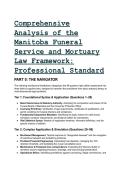
Comprehensive
Analysis of the
Manitoba Funeral
Service and Mortuary
Law Framework:
Professional Standard
PART 0: THE NAVIGATOR
The following architectural breakdown categorizes the 88-question high-caliber assessment into
three distinct cognitive tiers, designed to transition the practitioner from basic statutory literacy to
multi-dimensional legal synthesis.
Tier 1: Foundational Syntax & Application (Questions 1–28)
● Board Governance & Statutory Authority: Analyzing the composition and powers of the
Funeral Board of Manitoba and the Consumer Protection Office.
● Licensing Primitives: Verification of age requirements, certificates of qualification, and
permit conditions for funeral directors and embalmers.
● Fundamental Disposition Mandates: Identifying the basic metrics for earth burial,
cremation container requirements, and distance buffers for crematories.
● Vital Statistics Syntax: Mastery of registration timelines, informant definitions, and the
specific metrics of stillbirth.
Tier 2: Complex Application & Simulation (Questions 29–58)
● Bio-Hazard Management: Tactical response to "designated diseases" and the navigation
of restrictive transport and embalming protocols.
● Pre-Need Financial Engineering: Calculating trust deposits, managing the 12%
retention threshold, and facilitating the 3-year cancellation pivot.
● Maintenance & Perpetual Care Jurisprudence: Evaluating the fiduciary duties of
cemetery owners regarding enclosure, drainage, and trust principal preservation.
● Operational Ethics: Identifying prohibitions against canvassing, illegal commissions, and
, the "Honesty in Offering" standard of the 2026 Code of Ethics.
Tier 3: Grandmaster Synthesis (Questions 59–88)
● Inter-Statutory Conflict Resolution: Solving dilemmas where the Fatality Inquiries Act
overlaps with the Public Health Act or The Anatomy Act.
● Fiduciary Failure Recovery: Managing trust accounts during licensee insolvency or
administrative license suspension by the Consumer Protection Office.
● Adjudicative Logic: Determining the legal hierarchy of decision-makers (Executors vs.
Public Trustee vs. Preferred Claimants) in high-stakes scenarios.
● Grandmaster Compliance: Synthesizing the 2026/2027 best practices into complex,
paragraph-long case studies involving unclaimed remains, scientific donation, and
cross-border repatriation.
PART I: THE PRIMER
The Hook
Mastering the Manitoba mortuary legal framework is the singular barrier between a standard
practitioner and an elite guardian of public trust. This 88-question gauntlet transforms abstract
statutes into surgical analytical tools, ensuring that "Universal Mastery" is not merely a title, but
a high-performance operational reality.
The "Critical Axioms" Cheat Sheet
Axiom Name Statutory Reference Core Data Point / Rule
The 12% Retention Cap Prearranged Funeral Services Licensees may retain exactly
Act 12% of the contract principal
only if explicitly stipulated; this
is the maximum allowed for
administration.
The 3-Foot Earth Cover Dead Bodies Regulation Burials must provide 0.91
meters (3 feet) of earth from the
top of the remains to the
surrounding ground level.
The 5-Day Vital Stats Rule Vital Statistics Act Deaths must be registered
within 5 business days of
receiving particulars; delay
triggers regulatory scrutiny.
The 48-Hour Search Window The Anatomy Act Remains are not "unclaimed"
until a 48-hour diligent search
for "preferred claimants" is
completed and documented.
The Post-Op Inquiry Trigger Fatality Inquiries Act Any death within 10 days of a
surgical or invasive procedure
must be reported to the Medical
Examiner.
,PART II: THE ELITE TEST BANK
Tier 1: Foundational Syntax & Application (Questions 1–28)
Q1: Under the 2026 consolidated version of The Funeral Directors and Embalmers Act, what is
the precise composition of the Funeral Board of Manitoba regarding professional
representation? A) Four licensed funeral directors and two public representatives. B) One
departmental chair and five persons, of whom exactly two are licensed funeral directors. C)
Three licensed funeral directors and three licensed embalmers. D) Six persons, all of whom
must be licensed funeral directors to ensure industry expertise.
● The Answer: B (One departmental chair and five persons, of whom exactly two are
licensed funeral directors.)
● Distractor Analysis:
● A is incorrect: This composition would allow industry captured-regulation; the Act limits
professional representation to ensure the public interest remains the primary focus.
● C is incorrect: Embalmer representation is not explicitly mandated as a 50/50 split; the Act
focuses on the broader designation of "licensed funeral directors" for its two professional
seats.
● D is incorrect: This is a common novice misconception that regulatory boards are
peer-only groups. The Lieutenant Governor in Council appoints laypeople to balance the
board.
The Mentor's Analysis: The board is designed as a hybrid oversight body, blending specific
industry expertise with neutral departmental governance. This structure prevents monopolistic
control while providing the technical knowledge required for adjudication.
Professional/Academic Intuition: Always remember the "Rule of Two"—no more than two
directors may sit on the six-person board.
Q2: A funeral home in Winnipeg is hiring a new intern. According to the statutory requirements
for licensure, what is the "Hard Deck" age of majority required to be issued a Funeral Director’s
license? A) 16 years of age with a high school diploma. B) 18 years of age. C) 19 years of age.
D) 21 years of age.
● The Answer: B (18 years of age.)
● Distractor Analysis:
● A is incorrect: While employment may begin earlier, professional licensure is tied to the
legal age of majority for contract liability.
● C is incorrect: This reflects the age of majority in some other provinces (e.g., BC/NB), but
Manitoba aligns with the 18-year standard.
● D is incorrect: This is an outdated legacy standard from the early 20th century that is no
longer reflective of current Manitoba law.
The Mentor's Analysis: The 18-year requirement ensures that the licensee is legally capable of
entering into binding fiduciary contracts under The Prearranged Funeral Services Act.
Professional/Academic Intuition: Completion of an "approved school" curriculum does not
waive the chronological age floor.
Q3: Under The Cemeteries Act, a crematory operator is planning a new facility. What is the
MANDATORY buffer distance between the crematory and a dwelling house, absent written
consent? A) 100 yards. B) 200 yards. C) 500 yards. D) 1,000 yards.
● The Answer: B (200 yards.)
● Distractor Analysis:
, ● A is incorrect: 100 yards is an insufficient buffer under Section 19(2) of The Cemeteries
Act.
● C is incorrect: 500 yards may be a zoning preference in certain municipalities, but the
provincial statutory minimum is specifically 200 yards.
● D is incorrect: This distance is excessive and not supported by the current legislative text.
The Mentor's Analysis: The 200-yard rule serves as a "nuisance mitigation" boundary. It is a
psychological and environmental safeguard for residential zones. Professional/Academic
Intuition: Consent from an "occupier" is as critical as consent from the "owner"; both
must be in writing to override this distance.
Q4: A "stillbirth" requires a specific registration process in Manitoba. According to The Vital
Statistics Act, which set of metrics triggers this mandatory legal registration? A) Expulsion after
12 weeks of pregnancy or a weight of 250 grams. B) Expulsion after 20 weeks of pregnancy or
a weight of 500 grams. C) Expulsion after 24 weeks of pregnancy or a weight of 1,000 grams.
D) Any product of conception that shows movement of voluntary muscle.
● The Answer: B (Expulsion after 20 weeks of pregnancy or a weight of 500 grams.)
● Distractor Analysis:
● A is incorrect: Metrics below this threshold are typically treated as miscarriages and do
not require formal Vital Statistics registration.
● C is incorrect: These metrics are too high; the law captures "stillbirths" earlier to ensure
comprehensive demographic data.
● D is incorrect: Movement of voluntary muscle would define the event as a "live birth,"
requiring a birth certificate and a subsequent death certificate if the infant later expires.
The Mentor's Analysis: The 20-week/500-gram rule is the "Legal Threshold of Personhood" for
registration purposes. It dictates whether a funeral director must issue a Burial Permit or if the
remains can be handled via clinical disposal. Professional/Academic Intuition: This is a binary
rule; if either metric is met, the registration is compulsory.
Q5: When a funeral director receives payment for a prearranged funeral plan, what is the
maximum "administration fee" they are permitted to retain under The Prearranged Funeral
Services Act? A) 5% of the total contract. B) 10% of the total contract. 3) 12% of the money paid
under the plan. D) 15% of the money paid under the plan.
● The Answer: C (12% of the money paid under the plan.)
● Distractor Analysis:
● A is incorrect: This is a low-end estimate used by some non-profit societies but is not the
statutory limit.
● B is incorrect: While a common round number, the Act explicitly allows for a higher 12%
ceiling.
● D is incorrect: 15% exceeds the statutory cap and would constitute a regulatory violation if
retained.
The Mentor's Analysis: The 12% retention is a "cost-recovery mechanism" for the funeral home.
It compensates the business for the significant administrative and inflationary risks associated
with long-term trust management. Professional/Academic Intuition: This 12% can only be
retained if the contract explicitly permits it; silence defaults to 0% retention.
Q6: According to the Dead Bodies Regulation, which specific action is strictly FORBIDDEN for a
body known to be infected with a "designated disease" (e.g., Anthrax or viral hemorrhagic
fever)? A) Direct cremation. B) Immediate burial within 48 hours. C) Embalming. D) Hermetic
sealing in a metal coffin.
● The Answer: C (Embalming.)
● Distractor Analysis:
Analysis of the
Manitoba Funeral
Service and Mortuary
Law Framework:
Professional Standard
PART 0: THE NAVIGATOR
The following architectural breakdown categorizes the 88-question high-caliber assessment into
three distinct cognitive tiers, designed to transition the practitioner from basic statutory literacy to
multi-dimensional legal synthesis.
Tier 1: Foundational Syntax & Application (Questions 1–28)
● Board Governance & Statutory Authority: Analyzing the composition and powers of the
Funeral Board of Manitoba and the Consumer Protection Office.
● Licensing Primitives: Verification of age requirements, certificates of qualification, and
permit conditions for funeral directors and embalmers.
● Fundamental Disposition Mandates: Identifying the basic metrics for earth burial,
cremation container requirements, and distance buffers for crematories.
● Vital Statistics Syntax: Mastery of registration timelines, informant definitions, and the
specific metrics of stillbirth.
Tier 2: Complex Application & Simulation (Questions 29–58)
● Bio-Hazard Management: Tactical response to "designated diseases" and the navigation
of restrictive transport and embalming protocols.
● Pre-Need Financial Engineering: Calculating trust deposits, managing the 12%
retention threshold, and facilitating the 3-year cancellation pivot.
● Maintenance & Perpetual Care Jurisprudence: Evaluating the fiduciary duties of
cemetery owners regarding enclosure, drainage, and trust principal preservation.
● Operational Ethics: Identifying prohibitions against canvassing, illegal commissions, and
, the "Honesty in Offering" standard of the 2026 Code of Ethics.
Tier 3: Grandmaster Synthesis (Questions 59–88)
● Inter-Statutory Conflict Resolution: Solving dilemmas where the Fatality Inquiries Act
overlaps with the Public Health Act or The Anatomy Act.
● Fiduciary Failure Recovery: Managing trust accounts during licensee insolvency or
administrative license suspension by the Consumer Protection Office.
● Adjudicative Logic: Determining the legal hierarchy of decision-makers (Executors vs.
Public Trustee vs. Preferred Claimants) in high-stakes scenarios.
● Grandmaster Compliance: Synthesizing the 2026/2027 best practices into complex,
paragraph-long case studies involving unclaimed remains, scientific donation, and
cross-border repatriation.
PART I: THE PRIMER
The Hook
Mastering the Manitoba mortuary legal framework is the singular barrier between a standard
practitioner and an elite guardian of public trust. This 88-question gauntlet transforms abstract
statutes into surgical analytical tools, ensuring that "Universal Mastery" is not merely a title, but
a high-performance operational reality.
The "Critical Axioms" Cheat Sheet
Axiom Name Statutory Reference Core Data Point / Rule
The 12% Retention Cap Prearranged Funeral Services Licensees may retain exactly
Act 12% of the contract principal
only if explicitly stipulated; this
is the maximum allowed for
administration.
The 3-Foot Earth Cover Dead Bodies Regulation Burials must provide 0.91
meters (3 feet) of earth from the
top of the remains to the
surrounding ground level.
The 5-Day Vital Stats Rule Vital Statistics Act Deaths must be registered
within 5 business days of
receiving particulars; delay
triggers regulatory scrutiny.
The 48-Hour Search Window The Anatomy Act Remains are not "unclaimed"
until a 48-hour diligent search
for "preferred claimants" is
completed and documented.
The Post-Op Inquiry Trigger Fatality Inquiries Act Any death within 10 days of a
surgical or invasive procedure
must be reported to the Medical
Examiner.
,PART II: THE ELITE TEST BANK
Tier 1: Foundational Syntax & Application (Questions 1–28)
Q1: Under the 2026 consolidated version of The Funeral Directors and Embalmers Act, what is
the precise composition of the Funeral Board of Manitoba regarding professional
representation? A) Four licensed funeral directors and two public representatives. B) One
departmental chair and five persons, of whom exactly two are licensed funeral directors. C)
Three licensed funeral directors and three licensed embalmers. D) Six persons, all of whom
must be licensed funeral directors to ensure industry expertise.
● The Answer: B (One departmental chair and five persons, of whom exactly two are
licensed funeral directors.)
● Distractor Analysis:
● A is incorrect: This composition would allow industry captured-regulation; the Act limits
professional representation to ensure the public interest remains the primary focus.
● C is incorrect: Embalmer representation is not explicitly mandated as a 50/50 split; the Act
focuses on the broader designation of "licensed funeral directors" for its two professional
seats.
● D is incorrect: This is a common novice misconception that regulatory boards are
peer-only groups. The Lieutenant Governor in Council appoints laypeople to balance the
board.
The Mentor's Analysis: The board is designed as a hybrid oversight body, blending specific
industry expertise with neutral departmental governance. This structure prevents monopolistic
control while providing the technical knowledge required for adjudication.
Professional/Academic Intuition: Always remember the "Rule of Two"—no more than two
directors may sit on the six-person board.
Q2: A funeral home in Winnipeg is hiring a new intern. According to the statutory requirements
for licensure, what is the "Hard Deck" age of majority required to be issued a Funeral Director’s
license? A) 16 years of age with a high school diploma. B) 18 years of age. C) 19 years of age.
D) 21 years of age.
● The Answer: B (18 years of age.)
● Distractor Analysis:
● A is incorrect: While employment may begin earlier, professional licensure is tied to the
legal age of majority for contract liability.
● C is incorrect: This reflects the age of majority in some other provinces (e.g., BC/NB), but
Manitoba aligns with the 18-year standard.
● D is incorrect: This is an outdated legacy standard from the early 20th century that is no
longer reflective of current Manitoba law.
The Mentor's Analysis: The 18-year requirement ensures that the licensee is legally capable of
entering into binding fiduciary contracts under The Prearranged Funeral Services Act.
Professional/Academic Intuition: Completion of an "approved school" curriculum does not
waive the chronological age floor.
Q3: Under The Cemeteries Act, a crematory operator is planning a new facility. What is the
MANDATORY buffer distance between the crematory and a dwelling house, absent written
consent? A) 100 yards. B) 200 yards. C) 500 yards. D) 1,000 yards.
● The Answer: B (200 yards.)
● Distractor Analysis:
, ● A is incorrect: 100 yards is an insufficient buffer under Section 19(2) of The Cemeteries
Act.
● C is incorrect: 500 yards may be a zoning preference in certain municipalities, but the
provincial statutory minimum is specifically 200 yards.
● D is incorrect: This distance is excessive and not supported by the current legislative text.
The Mentor's Analysis: The 200-yard rule serves as a "nuisance mitigation" boundary. It is a
psychological and environmental safeguard for residential zones. Professional/Academic
Intuition: Consent from an "occupier" is as critical as consent from the "owner"; both
must be in writing to override this distance.
Q4: A "stillbirth" requires a specific registration process in Manitoba. According to The Vital
Statistics Act, which set of metrics triggers this mandatory legal registration? A) Expulsion after
12 weeks of pregnancy or a weight of 250 grams. B) Expulsion after 20 weeks of pregnancy or
a weight of 500 grams. C) Expulsion after 24 weeks of pregnancy or a weight of 1,000 grams.
D) Any product of conception that shows movement of voluntary muscle.
● The Answer: B (Expulsion after 20 weeks of pregnancy or a weight of 500 grams.)
● Distractor Analysis:
● A is incorrect: Metrics below this threshold are typically treated as miscarriages and do
not require formal Vital Statistics registration.
● C is incorrect: These metrics are too high; the law captures "stillbirths" earlier to ensure
comprehensive demographic data.
● D is incorrect: Movement of voluntary muscle would define the event as a "live birth,"
requiring a birth certificate and a subsequent death certificate if the infant later expires.
The Mentor's Analysis: The 20-week/500-gram rule is the "Legal Threshold of Personhood" for
registration purposes. It dictates whether a funeral director must issue a Burial Permit or if the
remains can be handled via clinical disposal. Professional/Academic Intuition: This is a binary
rule; if either metric is met, the registration is compulsory.
Q5: When a funeral director receives payment for a prearranged funeral plan, what is the
maximum "administration fee" they are permitted to retain under The Prearranged Funeral
Services Act? A) 5% of the total contract. B) 10% of the total contract. 3) 12% of the money paid
under the plan. D) 15% of the money paid under the plan.
● The Answer: C (12% of the money paid under the plan.)
● Distractor Analysis:
● A is incorrect: This is a low-end estimate used by some non-profit societies but is not the
statutory limit.
● B is incorrect: While a common round number, the Act explicitly allows for a higher 12%
ceiling.
● D is incorrect: 15% exceeds the statutory cap and would constitute a regulatory violation if
retained.
The Mentor's Analysis: The 12% retention is a "cost-recovery mechanism" for the funeral home.
It compensates the business for the significant administrative and inflationary risks associated
with long-term trust management. Professional/Academic Intuition: This 12% can only be
retained if the contract explicitly permits it; silence defaults to 0% retention.
Q6: According to the Dead Bodies Regulation, which specific action is strictly FORBIDDEN for a
body known to be infected with a "designated disease" (e.g., Anthrax or viral hemorrhagic
fever)? A) Direct cremation. B) Immediate burial within 48 hours. C) Embalming. D) Hermetic
sealing in a metal coffin.
● The Answer: C (Embalming.)
● Distractor Analysis:


