

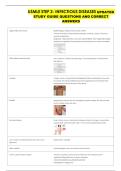
USMLE STEP 2- INFECTIOUS DISEASES UPDATED
STUDY GUIDE QUESTIONS AND CORRECT
ANSWERS
Legionnaire pneumonia Epidemiology: hospital, travel (cruise, hotel)
Clinical: Fever>38..8, Gastrointestinal (diarrhea vomiting, cramps), Pulmonary
symptoms delayed
Diagnostic: Hyponatremia, X ray show Lobar infiltrate, Urine Legionella antigen
Treatment: respiratory fluoroquinolones (levofloxacin) or newer macrolide
Otitis externa (swimmer ear) pain, erythema , edema and discharge. Commonpathogen is Pseudomonas
aeruginosa
measles cough, coryza, conjunctivitis and koplik spots (blue-white lesions on buccal
mucossa). The classic reddish-brown rash apppears 3-5 on the face and
spreads downward to the rest of the body
Rubella spreads from head to toe but not darken as does measles. The fever is lower
and no Koplic spots are seen
Kawasaki diease fever>=5 days mucous membrane changes, extremity changes, nonexudative
conjunctivitis, cervical lymph node >=1.5 cm and a polymorphous rash
Live vaccines contraindicated if CD4+ cell count < MMR, zoster, varicella
200/mm3
Optic cellulitis Opthalmoplegia, pain with extraocular movement
Chronic granulomatous diease -recurrent cutaneous and pulmonary infections with catalase-positve
organisms (Staphalococcus aureus, Serratia)
-Abnormal oxidative (e.g dihydrorhodamine
testing)burst is diagnostic
, Acute rheumatic fever untreated group A strptococcal pharyngitis can be complicated by acute
rheumatic fever. This condition should be suspected in a child with sore throat,
fever, pericarditis, erythema marginatum, arthritis, chorea and subcutaneous
nodules.
babesiosis
pts receiving solid organ transplatations at risk for -pneumocystic pneumonia (respiratory failture, cough, dyspnea)
opportunistic infections, most due to____ and ____ -cytomeglovirus presemt with
pneumonitis, hepatitis, gastroenteritits.
pulmonary symptoms (dyspnea on exertion, dry cough), gastrointestinal
symptoms (abdominal pain, diarrhea, hematochezi), pancytopenia, mild
hepatitis and interstitial infiltrates on X ray
clostridium difficile colitis clinical presentations -watery diarrhea
fulminant colitis/toxic megacolon
drug for cat bits -amoxicilin with clavulanate
Hemochromatosis -considered in pts who have elevated liver enzymes, diabetes mellitus and skin
hyperpigmentation.
-can progress to cirrhosis and is associated with a significantly increased risk
for hepatocellular carcinoma
most common organisms for osteomyelitis Pts with plantar
puncture wounds through footwear are at risk for Pseudomonas aeruginosa
osteomylitis
drug for engerobium vermicularis (pinworm), perianal Albendazole or pyrantel pamoate for pts & all household contacts
pruritus at night
drug for Non-bullous impetigo (painful pustules and Topical mupiurocin
honey crusted lesions)
STUDY GUIDE QUESTIONS AND CORRECT
ANSWERS
Legionnaire pneumonia Epidemiology: hospital, travel (cruise, hotel)
Clinical: Fever>38..8, Gastrointestinal (diarrhea vomiting, cramps), Pulmonary
symptoms delayed
Diagnostic: Hyponatremia, X ray show Lobar infiltrate, Urine Legionella antigen
Treatment: respiratory fluoroquinolones (levofloxacin) or newer macrolide
Otitis externa (swimmer ear) pain, erythema , edema and discharge. Commonpathogen is Pseudomonas
aeruginosa
measles cough, coryza, conjunctivitis and koplik spots (blue-white lesions on buccal
mucossa). The classic reddish-brown rash apppears 3-5 on the face and
spreads downward to the rest of the body
Rubella spreads from head to toe but not darken as does measles. The fever is lower
and no Koplic spots are seen
Kawasaki diease fever>=5 days mucous membrane changes, extremity changes, nonexudative
conjunctivitis, cervical lymph node >=1.5 cm and a polymorphous rash
Live vaccines contraindicated if CD4+ cell count < MMR, zoster, varicella
200/mm3
Optic cellulitis Opthalmoplegia, pain with extraocular movement
Chronic granulomatous diease -recurrent cutaneous and pulmonary infections with catalase-positve
organisms (Staphalococcus aureus, Serratia)
-Abnormal oxidative (e.g dihydrorhodamine
testing)burst is diagnostic
, Acute rheumatic fever untreated group A strptococcal pharyngitis can be complicated by acute
rheumatic fever. This condition should be suspected in a child with sore throat,
fever, pericarditis, erythema marginatum, arthritis, chorea and subcutaneous
nodules.
babesiosis
pts receiving solid organ transplatations at risk for -pneumocystic pneumonia (respiratory failture, cough, dyspnea)
opportunistic infections, most due to____ and ____ -cytomeglovirus presemt with
pneumonitis, hepatitis, gastroenteritits.
pulmonary symptoms (dyspnea on exertion, dry cough), gastrointestinal
symptoms (abdominal pain, diarrhea, hematochezi), pancytopenia, mild
hepatitis and interstitial infiltrates on X ray
clostridium difficile colitis clinical presentations -watery diarrhea
fulminant colitis/toxic megacolon
drug for cat bits -amoxicilin with clavulanate
Hemochromatosis -considered in pts who have elevated liver enzymes, diabetes mellitus and skin
hyperpigmentation.
-can progress to cirrhosis and is associated with a significantly increased risk
for hepatocellular carcinoma
most common organisms for osteomyelitis Pts with plantar
puncture wounds through footwear are at risk for Pseudomonas aeruginosa
osteomylitis
drug for engerobium vermicularis (pinworm), perianal Albendazole or pyrantel pamoate for pts & all household contacts
pruritus at night
drug for Non-bullous impetigo (painful pustules and Topical mupiurocin
honey crusted lesions)


