

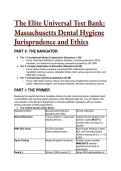
The Elite Universal Test Bank:
Massachusetts Dental Hygiene
Jurisprudence and Ethics
PART 0: THE NAVIGATOR
● Tier 1: Foundational Syntax & Application (Questions 1–28)
○ Focus: Hard-deck definitions, statutory timelines, continuing education (CEU)
mandates, and baseline record-keeping parameters dictated by 234 CMR.
● Tier 2: Complex Application & Simulation (Questions 29–58)
○ Focus: Multi-variable scenarios including PHDH collaborative agreements,
mandated reporting nuances, delegable duties under various supervision tiers, and
2026 N2O protocols.
● Tier 3: Grandmaster Synthesis (Questions 59–88)
○ Focus: High-stakes clinical, ethical, and legal cross-jurisdictional synthesis involving
audits, malpractice triggers, anti-kickback statutes, and Board disciplinary actions.
PART I: THE PRIMER
Mastering this specific test bank translates directly into elite clinical autonomy, bulletproof audit
invulnerability, and supreme patient advocacy under Massachusetts law. You will replace rote
memorization of the Board of Registration in Dentistry (BORID) regulations with an intuitive,
tactical command of state jurisprudence.
● The Critical Axioms Cheat Sheet:
Regulatory Metric Massachusetts Statutory Clinical Implication
Standard (234 CMR)
Record Retention 7 years (Adults) / 3 years past Original records belong to the
majority (Minors) practice; copies MUST be
provided within 30 days of a
request.
RDH CEU Cycle 20 CEUs biennially Must include Infection Control,
(Odd-numbered years) BLS, and Domestic/Sexual
Violence training (M.G.L. c. 112
§ 264).
Spore Testing Weekly biological monitoring Positive results mandate
IMMEDIATE sterilizer
quarantine and recall of
instruments.
Permit L 35-hour CODA course (12 Allows RDH administration of
,Regulatory Metric Massachusetts Statutory Clinical Implication
Standard (234 CMR)
clinical hours) local anesthesia strictly under
Direct Supervision.
PHDH Mandate 4,500 clinical hours + Written Enables autonomous public
Collaborative Agreement health practice; requires
monthly REDCap reporting by
the 10th.
PART II: THE ELITE TEST BANK
Tier 1: Foundational Syntax & Application
Q1: A registered dental hygienist (RDH) in Massachusetts is preparing for license renewal.
According to 234 CMR 4.14, by which deadline MUST the RDH successfully complete the
renewal process? A) March 31st of even-numbered years B) October 31st of odd-numbered
years C) March 31st of odd-numbered years D) December 31st annually
● The Answer: C (March 31st of odd-numbered years)
● Distractor Analysis:
○ A is incorrect: This is the statutory renewal deadline for licensed dentists.
○ B is incorrect: This is the statutory renewal deadline for dental assistants.
○ D is incorrect: Licenses in Massachusetts are renewed biennially, not annually.
The Mentor's Analysis: Statutory deadlines are rigid. An expired license defaults a clinician to
unauthorized practice immediately. Professional/Academic Intuition: Odd years for hygienists;
even years for dentists.
Q2: During a biennial renewal cycle, an RDH is auditing their Continuing Education Units
(CEUs). According to 234 CMR 8.00, what is the MINIMUM number of CEUs required, and what
specific training is mandated by M.G.L. c. 112, § 264? A) 40 CEUs; including opioid
management B) 20 CEUs; including domestic and sexual violence training C) 15 CEUs;
including OSHA bloodborne pathogens D) 20 CEUs; including a 12-hour local anesthesia
refresher
● The Answer: B (20 CEUs; including domestic and sexual violence training)
● Distractor Analysis:
○ A is incorrect: Dentists require 40 CEUs and opioid training.
○ C is incorrect: The total required is 20 CEUs.
○ D is incorrect: Local anesthesia certification requires ongoing BLS, not a recurring
12-hour CEU refresher.
The Mentor's Analysis: CEU audits are the most common source of non-clinical board discipline.
Massachusetts uniquely mandates domestic violence training. Professional/Academic Intuition:
Twenty units seal the cycle; specialized mandates ensure public safety.
Q3: A dental practice is establishing a biological monitoring protocol for its autoclaves.
According to CDC guidelines adopted by 234 CMR, how frequently MUST spore testing be
performed and logged? A) Daily B) Weekly C) Bi-weekly D) Monthly
● The Answer: B (Weekly)
● Distractor Analysis:
○ A is incorrect: Daily testing exceeds the minimum regulatory standard.
○ C is incorrect: Bi-weekly fails the strict Massachusetts infection control standard.
○ D is incorrect: Monthly testing is a legacy standard resulting in immediate Board
, citation.
The Mentor's Analysis: Infection control violations trigger immediate Board scrutiny. Spore
testing is the ultimate biological proof of sterilization. Professional/Academic Intuition: Weekly
spore testing is the non-negotiable heartbeat of infection control.
Q4: A 14-year-old patient receives a prophylaxis. According to 234 CMR 5.13, how long MUST
the practice retain this patient's original dental record? A) Seven years from the date of the last
treatment B) Seven years from the date of the last treatment, or three years past the age of
majority, whichever is later C) Ten years from the date of the last treatment D) Indefinitely
● The Answer: B (Seven years from the date of the last treatment, or three years past the
age of majority, whichever is later)
● Distractor Analysis:
○ A is incorrect: This is the standard for adult patients.
○ C is incorrect: Ten years applies to specific federal mandates, not standard MA law.
○ D is incorrect: Indefinite retention is a logistical impossibility.
The Mentor's Analysis: Pediatric records carry a delayed statute of limitations for malpractice.
The retention period extends until the patient has legal standing. Professional/Academic
Intuition: Retain pediatric records until the patient is legally an adult, plus three years.
Q5: A patient formally requests a copy of their dental records. Under 234 CMR 5.13, what is the
MAXIMUM allowable timeframe to provide these records? A) 10 calendar days B) 15 calendar
days C) 30 calendar days D) 60 calendar days
● The Answer: C (30 calendar days)
● Distractor Analysis:
○ A is incorrect: Ten days applies to Nevada or federal urgent requests.
○ B is incorrect: Proposed HIPAA updates suggest 15 days, but MA regulations
currently permit up to 30 days.
○ D is incorrect: Sixty days exposes the practice to Board complaints.
The Mentor's Analysis: Record withholding is a primary catalyst for patient-initiated complaints.
Provision must be prompt. Professional/Academic Intuition: Thirty days is the absolute ceiling
for record duplication.
Q6: An RDH seeks to obtain Permit L for local anesthesia administration. What prerequisite
FIRST satisfies 234 CMR 6.16? A) 20 hours of didactic training B) A 35-hour CODA-accredited
course, including a minimum of 12 clinical hours C) 1,000 hours of general clinical experience
D) A collaborative agreement with an oral surgeon
● The Answer: B (A 35-hour CODA-accredited course, including a minimum of 12 clinical
hours)
● Distractor Analysis:
○ A is incorrect: 20 hours falls short of the statutory 35-hour requirement.
○ C is incorrect: General clinical hours are not a prerequisite for Permit L.
○ D is incorrect: Direct supervision by any licensed dentist is required, not just a
surgeon.
The Mentor's Analysis: Permit L is a strict expansion of the legal scope, demanding rigorous
foundational education. Professional/Academic Intuition: Permit L requires 35 hours total,
anchored by 12 live clinical hours.
Q7: According to 234 CMR 2.03, which type of supervision requires a licensed dentist to
authorize the procedure and remain in the dental facility, but does NOT require the dentist to
evaluate the treatment before patient dismissal? A) General Supervision B) Direct Supervision
C) Immediate Supervision D) Personal Supervision
● The Answer: B (Direct Supervision)
Massachusetts Dental Hygiene
Jurisprudence and Ethics
PART 0: THE NAVIGATOR
● Tier 1: Foundational Syntax & Application (Questions 1–28)
○ Focus: Hard-deck definitions, statutory timelines, continuing education (CEU)
mandates, and baseline record-keeping parameters dictated by 234 CMR.
● Tier 2: Complex Application & Simulation (Questions 29–58)
○ Focus: Multi-variable scenarios including PHDH collaborative agreements,
mandated reporting nuances, delegable duties under various supervision tiers, and
2026 N2O protocols.
● Tier 3: Grandmaster Synthesis (Questions 59–88)
○ Focus: High-stakes clinical, ethical, and legal cross-jurisdictional synthesis involving
audits, malpractice triggers, anti-kickback statutes, and Board disciplinary actions.
PART I: THE PRIMER
Mastering this specific test bank translates directly into elite clinical autonomy, bulletproof audit
invulnerability, and supreme patient advocacy under Massachusetts law. You will replace rote
memorization of the Board of Registration in Dentistry (BORID) regulations with an intuitive,
tactical command of state jurisprudence.
● The Critical Axioms Cheat Sheet:
Regulatory Metric Massachusetts Statutory Clinical Implication
Standard (234 CMR)
Record Retention 7 years (Adults) / 3 years past Original records belong to the
majority (Minors) practice; copies MUST be
provided within 30 days of a
request.
RDH CEU Cycle 20 CEUs biennially Must include Infection Control,
(Odd-numbered years) BLS, and Domestic/Sexual
Violence training (M.G.L. c. 112
§ 264).
Spore Testing Weekly biological monitoring Positive results mandate
IMMEDIATE sterilizer
quarantine and recall of
instruments.
Permit L 35-hour CODA course (12 Allows RDH administration of
,Regulatory Metric Massachusetts Statutory Clinical Implication
Standard (234 CMR)
clinical hours) local anesthesia strictly under
Direct Supervision.
PHDH Mandate 4,500 clinical hours + Written Enables autonomous public
Collaborative Agreement health practice; requires
monthly REDCap reporting by
the 10th.
PART II: THE ELITE TEST BANK
Tier 1: Foundational Syntax & Application
Q1: A registered dental hygienist (RDH) in Massachusetts is preparing for license renewal.
According to 234 CMR 4.14, by which deadline MUST the RDH successfully complete the
renewal process? A) March 31st of even-numbered years B) October 31st of odd-numbered
years C) March 31st of odd-numbered years D) December 31st annually
● The Answer: C (March 31st of odd-numbered years)
● Distractor Analysis:
○ A is incorrect: This is the statutory renewal deadline for licensed dentists.
○ B is incorrect: This is the statutory renewal deadline for dental assistants.
○ D is incorrect: Licenses in Massachusetts are renewed biennially, not annually.
The Mentor's Analysis: Statutory deadlines are rigid. An expired license defaults a clinician to
unauthorized practice immediately. Professional/Academic Intuition: Odd years for hygienists;
even years for dentists.
Q2: During a biennial renewal cycle, an RDH is auditing their Continuing Education Units
(CEUs). According to 234 CMR 8.00, what is the MINIMUM number of CEUs required, and what
specific training is mandated by M.G.L. c. 112, § 264? A) 40 CEUs; including opioid
management B) 20 CEUs; including domestic and sexual violence training C) 15 CEUs;
including OSHA bloodborne pathogens D) 20 CEUs; including a 12-hour local anesthesia
refresher
● The Answer: B (20 CEUs; including domestic and sexual violence training)
● Distractor Analysis:
○ A is incorrect: Dentists require 40 CEUs and opioid training.
○ C is incorrect: The total required is 20 CEUs.
○ D is incorrect: Local anesthesia certification requires ongoing BLS, not a recurring
12-hour CEU refresher.
The Mentor's Analysis: CEU audits are the most common source of non-clinical board discipline.
Massachusetts uniquely mandates domestic violence training. Professional/Academic Intuition:
Twenty units seal the cycle; specialized mandates ensure public safety.
Q3: A dental practice is establishing a biological monitoring protocol for its autoclaves.
According to CDC guidelines adopted by 234 CMR, how frequently MUST spore testing be
performed and logged? A) Daily B) Weekly C) Bi-weekly D) Monthly
● The Answer: B (Weekly)
● Distractor Analysis:
○ A is incorrect: Daily testing exceeds the minimum regulatory standard.
○ C is incorrect: Bi-weekly fails the strict Massachusetts infection control standard.
○ D is incorrect: Monthly testing is a legacy standard resulting in immediate Board
, citation.
The Mentor's Analysis: Infection control violations trigger immediate Board scrutiny. Spore
testing is the ultimate biological proof of sterilization. Professional/Academic Intuition: Weekly
spore testing is the non-negotiable heartbeat of infection control.
Q4: A 14-year-old patient receives a prophylaxis. According to 234 CMR 5.13, how long MUST
the practice retain this patient's original dental record? A) Seven years from the date of the last
treatment B) Seven years from the date of the last treatment, or three years past the age of
majority, whichever is later C) Ten years from the date of the last treatment D) Indefinitely
● The Answer: B (Seven years from the date of the last treatment, or three years past the
age of majority, whichever is later)
● Distractor Analysis:
○ A is incorrect: This is the standard for adult patients.
○ C is incorrect: Ten years applies to specific federal mandates, not standard MA law.
○ D is incorrect: Indefinite retention is a logistical impossibility.
The Mentor's Analysis: Pediatric records carry a delayed statute of limitations for malpractice.
The retention period extends until the patient has legal standing. Professional/Academic
Intuition: Retain pediatric records until the patient is legally an adult, plus three years.
Q5: A patient formally requests a copy of their dental records. Under 234 CMR 5.13, what is the
MAXIMUM allowable timeframe to provide these records? A) 10 calendar days B) 15 calendar
days C) 30 calendar days D) 60 calendar days
● The Answer: C (30 calendar days)
● Distractor Analysis:
○ A is incorrect: Ten days applies to Nevada or federal urgent requests.
○ B is incorrect: Proposed HIPAA updates suggest 15 days, but MA regulations
currently permit up to 30 days.
○ D is incorrect: Sixty days exposes the practice to Board complaints.
The Mentor's Analysis: Record withholding is a primary catalyst for patient-initiated complaints.
Provision must be prompt. Professional/Academic Intuition: Thirty days is the absolute ceiling
for record duplication.
Q6: An RDH seeks to obtain Permit L for local anesthesia administration. What prerequisite
FIRST satisfies 234 CMR 6.16? A) 20 hours of didactic training B) A 35-hour CODA-accredited
course, including a minimum of 12 clinical hours C) 1,000 hours of general clinical experience
D) A collaborative agreement with an oral surgeon
● The Answer: B (A 35-hour CODA-accredited course, including a minimum of 12 clinical
hours)
● Distractor Analysis:
○ A is incorrect: 20 hours falls short of the statutory 35-hour requirement.
○ C is incorrect: General clinical hours are not a prerequisite for Permit L.
○ D is incorrect: Direct supervision by any licensed dentist is required, not just a
surgeon.
The Mentor's Analysis: Permit L is a strict expansion of the legal scope, demanding rigorous
foundational education. Professional/Academic Intuition: Permit L requires 35 hours total,
anchored by 12 live clinical hours.
Q7: According to 234 CMR 2.03, which type of supervision requires a licensed dentist to
authorize the procedure and remain in the dental facility, but does NOT require the dentist to
evaluate the treatment before patient dismissal? A) General Supervision B) Direct Supervision
C) Immediate Supervision D) Personal Supervision
● The Answer: B (Direct Supervision)


