

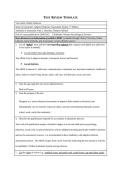
TEST REVIEW TEMPLATE
Your name: Deshia Waterson
Name of instrument: Adaptive Behavior Assessment System, 3rd Edition
Author(s) of instrument: Patti L. Harrison; Thomas Oakland
Date of current publication: 2000-2015 Publisher: Western Psychological Services
Base all answers on information provided in MMY (available through Liberty University Online
Library), course textbook, and, if necessary, recent scholarly sources.
1. List all “global” areas and their corresponding subtests that comprise each global area (add more
or less space as needed):
A. List all Global Areas (aka Domains, Clusters):
The ABAS-3 has 3 adaptive domains: Conceptual, Social, and Practical
B. List all Subtests:
The ABAS-3 assesses 11 skill areas: communication, community use, functional academics, health and
safety, home or school living, leisure, motor, self-care, self-direction, social, and work.
2. State the age range this test can be administered to:
Birth to 89 years.
3. State the purpose of the test:
Designed as a 'norm-referenced assessment of adaptive skills needed to effectively and
independently care for oneself, respond to others, and meet environmental demands at home,
school, work, and in the community.'
4. Describe the qualifications required for an examiner to administer this test:
Tests with a B qualification require a bachelor's degree in a relevant field such as psychology,
education, social work, or special education, with no additional training specifically needed to purchase
and use the assessment; however, it is recommended to have familiarity with adaptive behavior
assessment practices. The ABAS-3 paper form can be scored by hand using the test manual or with the
test publisher’s Online Evaluation System scoring software.
5. List the types of scores (e.g., standard scores, percentile rank, scaled scores, age equivalent, grade
, equivalent, etc.) this test uses to report results. Your answer should follow the examples stated
here. Do not list anything else.
Scoring includes summing the item ratings within adaptive skill areas and converting the totals to
scaled scores (M = 10, SD = 3). Area scores combine to form an overall General Adaptive Composite
(GAC) and three domain scores
6. List the instrument’s technical data (including actual numbers) regarding validity, reliability, and
standardization / normative process.
Validity:
Convergent validity:
Scores on the ABAS-3 correlate well with other established measures of adaptive behavior, like the
Vineland Adaptive Behavior Scales, indicating that it is measuring similar constructs.
Criterion-related validity:
Studies have shown that ABAS-3 scores can distinguish between individuals with different levels
of adaptive functioning, including those with intellectual disabilities, autism, and ADHD,
demonstrating its ability to differentiate clinical populations.
Reliability:
High internal consistency:
The GAC and adaptive domains show very high internal consistency with reliability coefficients
often close to 0.99.
Moderate test-retest reliability:
While not as high as internal consistency, test-retest reliability is still considered good, with
coefficients typically in the 0.70s to 0.80s.
Standardization/Normative Process:
The ABAS-3 measures adaptive behavior across three primary domains: Conceptual
(communication, functional academics, self-direction), Social (social skills, leisure), and Practical
(self-care, home/school living, community use, health and safety, work). The ABAS-3 can be
Your name: Deshia Waterson
Name of instrument: Adaptive Behavior Assessment System, 3rd Edition
Author(s) of instrument: Patti L. Harrison; Thomas Oakland
Date of current publication: 2000-2015 Publisher: Western Psychological Services
Base all answers on information provided in MMY (available through Liberty University Online
Library), course textbook, and, if necessary, recent scholarly sources.
1. List all “global” areas and their corresponding subtests that comprise each global area (add more
or less space as needed):
A. List all Global Areas (aka Domains, Clusters):
The ABAS-3 has 3 adaptive domains: Conceptual, Social, and Practical
B. List all Subtests:
The ABAS-3 assesses 11 skill areas: communication, community use, functional academics, health and
safety, home or school living, leisure, motor, self-care, self-direction, social, and work.
2. State the age range this test can be administered to:
Birth to 89 years.
3. State the purpose of the test:
Designed as a 'norm-referenced assessment of adaptive skills needed to effectively and
independently care for oneself, respond to others, and meet environmental demands at home,
school, work, and in the community.'
4. Describe the qualifications required for an examiner to administer this test:
Tests with a B qualification require a bachelor's degree in a relevant field such as psychology,
education, social work, or special education, with no additional training specifically needed to purchase
and use the assessment; however, it is recommended to have familiarity with adaptive behavior
assessment practices. The ABAS-3 paper form can be scored by hand using the test manual or with the
test publisher’s Online Evaluation System scoring software.
5. List the types of scores (e.g., standard scores, percentile rank, scaled scores, age equivalent, grade
, equivalent, etc.) this test uses to report results. Your answer should follow the examples stated
here. Do not list anything else.
Scoring includes summing the item ratings within adaptive skill areas and converting the totals to
scaled scores (M = 10, SD = 3). Area scores combine to form an overall General Adaptive Composite
(GAC) and three domain scores
6. List the instrument’s technical data (including actual numbers) regarding validity, reliability, and
standardization / normative process.
Validity:
Convergent validity:
Scores on the ABAS-3 correlate well with other established measures of adaptive behavior, like the
Vineland Adaptive Behavior Scales, indicating that it is measuring similar constructs.
Criterion-related validity:
Studies have shown that ABAS-3 scores can distinguish between individuals with different levels
of adaptive functioning, including those with intellectual disabilities, autism, and ADHD,
demonstrating its ability to differentiate clinical populations.
Reliability:
High internal consistency:
The GAC and adaptive domains show very high internal consistency with reliability coefficients
often close to 0.99.
Moderate test-retest reliability:
While not as high as internal consistency, test-retest reliability is still considered good, with
coefficients typically in the 0.70s to 0.80s.
Standardization/Normative Process:
The ABAS-3 measures adaptive behavior across three primary domains: Conceptual
(communication, functional academics, self-direction), Social (social skills, leisure), and Practical
(self-care, home/school living, community use, health and safety, work). The ABAS-3 can be


