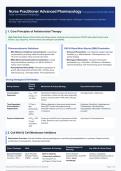
Nurse Practitioner Advanced Pharmacology Comprehensive Examination Study
Guide: Anti-Infective Therapeutics
Focused Blueprint: Drug Classes • Mechanisms of Action (MOA) • Prototype Agents • Indications • Contraindications • Black Box
Warnings • High-Yield Clinical Pearls
1. Core Principles of Antimicrobial Therapy
High-Yield Exam Focus: Antimicrobial prescribing requires matching pharmacodynamics (PK/PD) with patient factors (renal
function, age, pregnancy, immune status) and pathogen susceptibility.
Pharmacodynamic Definitions CNS & Blood-Brain Barrier (BBB) Penetration
MIC (Minimum Inhibitory Concentration): Lowest drug Enhanced Penetration: Low molecular weight, high lipid
concentration preventing visible microbial growth after solubility (e.g., Metronidazole, Chloramphenicol), low
18–24 hrs incubation. Most common lab metric. protein binding.
MBC (Minimum Bactericidal Concentration): Lowest Meningeal Inflammation: Increases local barrier
drug concentration resulting in a ≥ 99.9% decline in permeability (e.g., Penicillins, Ceftriaxone, Cefotaxime
colony count overnight. achieve therapeutic CSF levels during active meningitis).
Postantibiotic Effect (PAE): Persistent suppression of
growth after drug levels fall below MIC. Enables once-
daily dosing (e.g., Aminoglycosides, Fluoroquinolones).
Dosing Strategies & Kill Kinetics
Primary
Killing Kinetics Metric & Mechanism & Dosing Strategy Key Antimicrobial Classes
Target
Concentration- Cmax / MIC Rate/extent of killing increases with peak serum Aminoglycosides, Daptomycin
Dependent (Target: 8– concentration. Dosed via high-dose single daily
10x MIC) bolus to maximize peak & PAE while reducing
toxicity.
Time-Dependent % Time > Efficacy depends on time serum levels remain β-lactams (Penicillins, Cephalosporins,
(Concentration- MIC above MIC. Dosed via frequent dosing, Carbapenems, Monobactams),
Independent) (PCN ≥50%, extended infusions (3–4 hrs), or continuous 24- Glycopeptides, Macrolides, Clindamycin,
Cephs hr infusions. Linezolid
≥60%)
Exposure-Dependent AUC24 / MIC Driven by overall 24-hour drug exposure relative Vancomycin, Fluoroquinolones
(Target: to MIC. Balances total concentration and time
AUC/MIC ≥ exposure.
400)
2. Cell Wall & Cell Membrane Inhibitors
Mechanism Overview: Cell wall inhibitors disrupt peptidoglycan cross-linking (transpeptidation) or synthesis. Require actively
proliferating microorganisms. Generally bactericidal.
Contraindications &
Class / Prototype MOA Indications & Coverage Key ADEs & Clinical Pearls
Warnings
Natural Penicillins Binds Penicillin- DOC for Syphilis Severe β-lactam Urticaria, anaphylaxis.
Penicillin G (IV/IM) Binding Proteins (Treponema pallidum), hypersensitivity. SJS/TEN Neurotoxicity/seizures at high IV
Penicillin V (PO) (PBPs) → inhibits Gas Gangrene (C. history: never doses (GABA inhibition).
perfringens), Strep throat. rechallenge.
Advanced Pharmacology NP Board Review | Anti-Infectives Page 1 of 9
, Contraindications &
Class / Prototype MOA Indications & Coverage Key ADEs & Clinical Pearls
Warnings
transpeptidation → Gram(+) cocci, oral Procaine & Benzathine are IM
wall lysis. anaerobes. depot forms only.
Aminopenicillins Same as PCN; Ampicillin (+ Gentamicin) Inactivated by β- Amoxicillin is acid-stable & well-
Amoxicillin (PO) enters Gram(-) is DOC for Listeria lactamases unless absorbed. Diarrhea,
Ampicillin (IV/PO) outer membrane monocytogenes and combined with inhibitors maculopapular rash (especially
via porin channels. Enterococcus. URIs, otitis (Clavulanate, Sulbactam). in EBV/Mononucleosis).
media, endocarditis
prophylaxis.
Antistaphylococcal Penicillinase- DOC for MSSA infections Methicillin withdrawn in US Eliminated via liver/biliary
PCNs resistant due to (bacteremia, endocarditis, due to acute interstitial system → NO renal dose
Nafcillin (IV) bulky side chains skin/soft tissue). Zero nephritis. adjustment in CKD. Phlebitis,
Oxacillin (IV) blocking β- activity vs Gram(-) or neutropenia, elevated LFTs.
Dicloxacillin (PO) lactamase MRSA. Dicloxacillin: take on empty
cleavage. stomach.
Antipseudomonal Extended Gram(-) Nosocomial pneumonia, Severe β-lactam allergy Impaired platelet aggregation/
PCNs outer membrane intra-abdominal infections, history. coagulation at high doses.
Piperacillin (+ penetration + β- Pseudomonas Weekly CBC required for
Tazobactam = lactamase aeruginosa, ESBL/ prolonged therapy (>2 wks) due
Zosyn) inhibition. Bacteroides (with to cytopenias.
Tazobactam).
1st Gen Binds PBPs → Cefazolin is DOC for Ineffective vs LAME: 5–10% cross-reactivity with
Cephalosporins inhibits surgical prophylaxis. Skin Listeria, Atypical, MRSA, PCN allergy (highest among
Cefazolin (IV) peptidoglycan infections, pharyngitis. Enterococci. cephalosporins). Cefazolin
Cephalexin (PO) cross-linking. MSSA, E. coli, K. penetrates bone well.
pneumoniae, P. mirabilis.
2nd Gen Binds PBPs. Respiratory infections (CAP, LAME organisms. Cefotetan contains MTT side
Cephalosporins Enhanced Gram(-) bronchitis). Cefoxitin & Hypersensitivity. chain → disulfiram-like reaction
Cefuroxime (IV/PO) & anaerobic Cefotetan cover with alcohol & bleeding risk
Cefoxitin (IV) activity. anaerobes (B. fragilis) & (hypoprothrombinemia).
Cefotetan (IV) surgical prophylaxis.
3rd Gen Broad Gram(-), DOC for Meningitis Ceftriaxone Ceftriaxone excreted via bile/
Cephalosporins enhanced stability (Ceftriaxone, Cefotaxime), contraindicated with IV feces → NO renal dose
Ceftriaxone (IV) against β- Gonorrhea, Lyme disease. Calcium in neonates adjustment needed. High risk
Cefotaxime (IV) lactamases, high Ceftazidime covers P. (fatal precipitation in lungs/ of C. difficile superinfection.
Ceftazidime (IV) CSF level. aeruginosa. kidneys). LAME
organisms.
4th Gen Zwitterion Empiric neutropenic fever, LAME organisms. Severe Neurotoxicity &
Cephalosporins structure; severe nosocomial β-lactam allergy. encephalopathy (myoclonus,
Cefepime (IV) penetrates infections, P. aeruginosa, seizures) if dose not adjusted
Gram(-) porins Enterobacteriaceae, MSSA. for renal impairment.
rapidly; resists β-
lactamases.
Advanced Binds modified Only β-lactam in US Does NOT cover P. Twice-daily dosing. Diarrhea,
Cephalosporins PBP2a present in covering MRSA. Acute aeruginosa, ESBL, or positive Coombs test, rash.
Ceftaroline (IV) MRSA and PBP2x bacterial skin/structure Acinetobacter.
in PRSP. infections (ABSSSI) & CAP.
Carbapenems Ultra-broad β- Mixed aerobic/anaerobic, Ertapenem DOES NOT Imipenem lowers seizure
Imipenem/Cilastatin lactam; penetrates ESBL producers, severe cover Pseudomonas, threshold (highest risk in renal
Meropenem porins; highly polymicrobial sepsis. Acinetobacter, or failure). Cilastatin inhibits renal
Ertapenem resistant to β- Meropenem reaches CSF Enterococcus. dehydropeptidase-1. Cross-
lactamases. even without inflammation. reactivity with PCN <1%.
Monobactams Binds PBP3 of Gram(-) infections including NO activity against Safe in PCN-allergic patients
Aztreonam (IV/IM) aerobic Gram(-) P. aeruginosa in PCN- Gram(+) or anaerobes. (no cross-reactivity, except
bacilli exclusively. allergic patients. potential with Ceftazidime due
Advanced Pharmacology NP Board Review | Anti-Infectives Page 2 of 9
Guide: Anti-Infective Therapeutics
Focused Blueprint: Drug Classes • Mechanisms of Action (MOA) • Prototype Agents • Indications • Contraindications • Black Box
Warnings • High-Yield Clinical Pearls
1. Core Principles of Antimicrobial Therapy
High-Yield Exam Focus: Antimicrobial prescribing requires matching pharmacodynamics (PK/PD) with patient factors (renal
function, age, pregnancy, immune status) and pathogen susceptibility.
Pharmacodynamic Definitions CNS & Blood-Brain Barrier (BBB) Penetration
MIC (Minimum Inhibitory Concentration): Lowest drug Enhanced Penetration: Low molecular weight, high lipid
concentration preventing visible microbial growth after solubility (e.g., Metronidazole, Chloramphenicol), low
18–24 hrs incubation. Most common lab metric. protein binding.
MBC (Minimum Bactericidal Concentration): Lowest Meningeal Inflammation: Increases local barrier
drug concentration resulting in a ≥ 99.9% decline in permeability (e.g., Penicillins, Ceftriaxone, Cefotaxime
colony count overnight. achieve therapeutic CSF levels during active meningitis).
Postantibiotic Effect (PAE): Persistent suppression of
growth after drug levels fall below MIC. Enables once-
daily dosing (e.g., Aminoglycosides, Fluoroquinolones).
Dosing Strategies & Kill Kinetics
Primary
Killing Kinetics Metric & Mechanism & Dosing Strategy Key Antimicrobial Classes
Target
Concentration- Cmax / MIC Rate/extent of killing increases with peak serum Aminoglycosides, Daptomycin
Dependent (Target: 8– concentration. Dosed via high-dose single daily
10x MIC) bolus to maximize peak & PAE while reducing
toxicity.
Time-Dependent % Time > Efficacy depends on time serum levels remain β-lactams (Penicillins, Cephalosporins,
(Concentration- MIC above MIC. Dosed via frequent dosing, Carbapenems, Monobactams),
Independent) (PCN ≥50%, extended infusions (3–4 hrs), or continuous 24- Glycopeptides, Macrolides, Clindamycin,
Cephs hr infusions. Linezolid
≥60%)
Exposure-Dependent AUC24 / MIC Driven by overall 24-hour drug exposure relative Vancomycin, Fluoroquinolones
(Target: to MIC. Balances total concentration and time
AUC/MIC ≥ exposure.
400)
2. Cell Wall & Cell Membrane Inhibitors
Mechanism Overview: Cell wall inhibitors disrupt peptidoglycan cross-linking (transpeptidation) or synthesis. Require actively
proliferating microorganisms. Generally bactericidal.
Contraindications &
Class / Prototype MOA Indications & Coverage Key ADEs & Clinical Pearls
Warnings
Natural Penicillins Binds Penicillin- DOC for Syphilis Severe β-lactam Urticaria, anaphylaxis.
Penicillin G (IV/IM) Binding Proteins (Treponema pallidum), hypersensitivity. SJS/TEN Neurotoxicity/seizures at high IV
Penicillin V (PO) (PBPs) → inhibits Gas Gangrene (C. history: never doses (GABA inhibition).
perfringens), Strep throat. rechallenge.
Advanced Pharmacology NP Board Review | Anti-Infectives Page 1 of 9
, Contraindications &
Class / Prototype MOA Indications & Coverage Key ADEs & Clinical Pearls
Warnings
transpeptidation → Gram(+) cocci, oral Procaine & Benzathine are IM
wall lysis. anaerobes. depot forms only.
Aminopenicillins Same as PCN; Ampicillin (+ Gentamicin) Inactivated by β- Amoxicillin is acid-stable & well-
Amoxicillin (PO) enters Gram(-) is DOC for Listeria lactamases unless absorbed. Diarrhea,
Ampicillin (IV/PO) outer membrane monocytogenes and combined with inhibitors maculopapular rash (especially
via porin channels. Enterococcus. URIs, otitis (Clavulanate, Sulbactam). in EBV/Mononucleosis).
media, endocarditis
prophylaxis.
Antistaphylococcal Penicillinase- DOC for MSSA infections Methicillin withdrawn in US Eliminated via liver/biliary
PCNs resistant due to (bacteremia, endocarditis, due to acute interstitial system → NO renal dose
Nafcillin (IV) bulky side chains skin/soft tissue). Zero nephritis. adjustment in CKD. Phlebitis,
Oxacillin (IV) blocking β- activity vs Gram(-) or neutropenia, elevated LFTs.
Dicloxacillin (PO) lactamase MRSA. Dicloxacillin: take on empty
cleavage. stomach.
Antipseudomonal Extended Gram(-) Nosocomial pneumonia, Severe β-lactam allergy Impaired platelet aggregation/
PCNs outer membrane intra-abdominal infections, history. coagulation at high doses.
Piperacillin (+ penetration + β- Pseudomonas Weekly CBC required for
Tazobactam = lactamase aeruginosa, ESBL/ prolonged therapy (>2 wks) due
Zosyn) inhibition. Bacteroides (with to cytopenias.
Tazobactam).
1st Gen Binds PBPs → Cefazolin is DOC for Ineffective vs LAME: 5–10% cross-reactivity with
Cephalosporins inhibits surgical prophylaxis. Skin Listeria, Atypical, MRSA, PCN allergy (highest among
Cefazolin (IV) peptidoglycan infections, pharyngitis. Enterococci. cephalosporins). Cefazolin
Cephalexin (PO) cross-linking. MSSA, E. coli, K. penetrates bone well.
pneumoniae, P. mirabilis.
2nd Gen Binds PBPs. Respiratory infections (CAP, LAME organisms. Cefotetan contains MTT side
Cephalosporins Enhanced Gram(-) bronchitis). Cefoxitin & Hypersensitivity. chain → disulfiram-like reaction
Cefuroxime (IV/PO) & anaerobic Cefotetan cover with alcohol & bleeding risk
Cefoxitin (IV) activity. anaerobes (B. fragilis) & (hypoprothrombinemia).
Cefotetan (IV) surgical prophylaxis.
3rd Gen Broad Gram(-), DOC for Meningitis Ceftriaxone Ceftriaxone excreted via bile/
Cephalosporins enhanced stability (Ceftriaxone, Cefotaxime), contraindicated with IV feces → NO renal dose
Ceftriaxone (IV) against β- Gonorrhea, Lyme disease. Calcium in neonates adjustment needed. High risk
Cefotaxime (IV) lactamases, high Ceftazidime covers P. (fatal precipitation in lungs/ of C. difficile superinfection.
Ceftazidime (IV) CSF level. aeruginosa. kidneys). LAME
organisms.
4th Gen Zwitterion Empiric neutropenic fever, LAME organisms. Severe Neurotoxicity &
Cephalosporins structure; severe nosocomial β-lactam allergy. encephalopathy (myoclonus,
Cefepime (IV) penetrates infections, P. aeruginosa, seizures) if dose not adjusted
Gram(-) porins Enterobacteriaceae, MSSA. for renal impairment.
rapidly; resists β-
lactamases.
Advanced Binds modified Only β-lactam in US Does NOT cover P. Twice-daily dosing. Diarrhea,
Cephalosporins PBP2a present in covering MRSA. Acute aeruginosa, ESBL, or positive Coombs test, rash.
Ceftaroline (IV) MRSA and PBP2x bacterial skin/structure Acinetobacter.
in PRSP. infections (ABSSSI) & CAP.
Carbapenems Ultra-broad β- Mixed aerobic/anaerobic, Ertapenem DOES NOT Imipenem lowers seizure
Imipenem/Cilastatin lactam; penetrates ESBL producers, severe cover Pseudomonas, threshold (highest risk in renal
Meropenem porins; highly polymicrobial sepsis. Acinetobacter, or failure). Cilastatin inhibits renal
Ertapenem resistant to β- Meropenem reaches CSF Enterococcus. dehydropeptidase-1. Cross-
lactamases. even without inflammation. reactivity with PCN <1%.
Monobactams Binds PBP3 of Gram(-) infections including NO activity against Safe in PCN-allergic patients
Aztreonam (IV/IM) aerobic Gram(-) P. aeruginosa in PCN- Gram(+) or anaerobes. (no cross-reactivity, except
bacilli exclusively. allergic patients. potential with Ceftazidime due
Advanced Pharmacology NP Board Review | Anti-Infectives Page 2 of 9