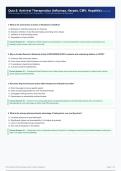
Quiz 8: Antiviral Therapeutics (Influenza, Herpes, CMV, Hepatitis) Advanced
Pharmacology NP Board Exam Preparation • 10 Practice Questions & Rationales
1. What is the mechanism of action of Oseltamivir (Tamiflu)?
A. Blockade of viral M2 membrane ion channels
B. Selective inhibition of viral Neuraminidase preventing virion release
C. Inhibition of viral thymidine kinase
D. Degradation of host cell RNA
Correct Answer: B — Oseltamivir inhibits influenza neuraminidase, an enzyme essential for cleaving sialic acid residues and
releasing newly formed virions from host cells.
2. Why is inhaled Zanamivir (Relenza) strictly CONTRAINDICATED in patients with underlying Asthma or COPD?
A. It induces fatal pulmonary edema
B. It can cause severe bronchospasm and acute decline in lung function
C. It neutralizes inhaled bronchodilators
D. It causes systemic hypertension
Correct Answer: B — Powdered inhaled Zanamivir can irritate airways and cause severe bronchospasm in patients with reactive
airway disease (Asthma/COPD).
3. How does Acyclovir become active within herpesvirus-infected host cells?
A. Direct cleavage by human gastric pepsin
B. Initial monophosphorylation by viral Thymidine Kinase
C. Conjugation with glucuronic acid in the liver
D. Deamination by extracellular cellular kinases
Correct Answer: B — Acyclovir is a prodrug selectively monophosphorylated by viral Thymidine Kinase, then converted to
triphosphate by host cell kinases to inhibit viral DNA polymerase.
4. What is the primary pharmacokinetic advantage of Valacyclovir over oral Acyclovir?
A. Complete absence of renal elimination
B. Significantly higher oral bioavailability (3–5x higher drug levels)
C. Lack of viral thymidine kinase requirement
D. Zero risk of headache or GI distress
Correct Answer: B — Valacyclovir is the L-valyl ester prodrug of Acyclovir; it undergoes rapid first-pass intestinal/hepatic hydrolysis to
yield 3–5x higher oral bioavailability.
NP Advanced Pharmacology Exam Practice Questions Page 1 of 3
Pharmacology NP Board Exam Preparation • 10 Practice Questions & Rationales
1. What is the mechanism of action of Oseltamivir (Tamiflu)?
A. Blockade of viral M2 membrane ion channels
B. Selective inhibition of viral Neuraminidase preventing virion release
C. Inhibition of viral thymidine kinase
D. Degradation of host cell RNA
Correct Answer: B — Oseltamivir inhibits influenza neuraminidase, an enzyme essential for cleaving sialic acid residues and
releasing newly formed virions from host cells.
2. Why is inhaled Zanamivir (Relenza) strictly CONTRAINDICATED in patients with underlying Asthma or COPD?
A. It induces fatal pulmonary edema
B. It can cause severe bronchospasm and acute decline in lung function
C. It neutralizes inhaled bronchodilators
D. It causes systemic hypertension
Correct Answer: B — Powdered inhaled Zanamivir can irritate airways and cause severe bronchospasm in patients with reactive
airway disease (Asthma/COPD).
3. How does Acyclovir become active within herpesvirus-infected host cells?
A. Direct cleavage by human gastric pepsin
B. Initial monophosphorylation by viral Thymidine Kinase
C. Conjugation with glucuronic acid in the liver
D. Deamination by extracellular cellular kinases
Correct Answer: B — Acyclovir is a prodrug selectively monophosphorylated by viral Thymidine Kinase, then converted to
triphosphate by host cell kinases to inhibit viral DNA polymerase.
4. What is the primary pharmacokinetic advantage of Valacyclovir over oral Acyclovir?
A. Complete absence of renal elimination
B. Significantly higher oral bioavailability (3–5x higher drug levels)
C. Lack of viral thymidine kinase requirement
D. Zero risk of headache or GI distress
Correct Answer: B — Valacyclovir is the L-valyl ester prodrug of Acyclovir; it undergoes rapid first-pass intestinal/hepatic hydrolysis to
yield 3–5x higher oral bioavailability.
NP Advanced Pharmacology Exam Practice Questions Page 1 of 3