

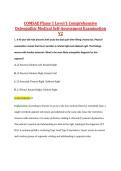
COMSAE Phase 1 Level 1 Comprehensive
Osteopathic Medical Self-Assessment Examination
V2
1. A 45-year-old male presents with acute low back pain after lifting a heavy box. Physical
examination reveals that the L3 vertebra is rotated right and sidebent right. The findings
worsen with lumbar extension. What is the most likely osteopathic diagnosis for this
segment?
A. L3 Neutral, Sidebent Left, Rotated Right
B. L3 Neutral, Sidebent Right, Rotated Left
C. L3 Extended, Rotated Right, Sidebent Right
D. L3 Flexed, Rotated Right, Sidebent Right
Correct Answer: D
Explanation: According to Fryette’s Law II, in the non-neutral (flexed or extended) state, a
single vertebral segment will rotate and sidebend to the same side. Since the restriction
worsens with extension, it is easier in flexion, making it a Flexed (F) somatic dysfunction.
The patient’s rotation and sidebending are both to the right, leading to the diagnosis L3 F
RrSr. A common pitfall is confusing Type I and Type II mechanics; Type I occurs in neutral
and involves groups of segments rotating and sidebending to opposite sides.
,2. A 62-year-old male with a history of chronic heart failure presents for a follow-up. He is
currently taking lisinopril, carvedilol, and furosemide. He complains of a persistent, non-
productive cough. Which of the following substances is most likely accumulating in this
patient to cause his symptoms?
A. Angiotensin II
B. Renin
C. Bradykinin
D. Aldosterone
Correct Answer: C
Explanation: ACE inhibitors, such as lisinopril, inhibit the angiotensin-converting enzyme,
which is also responsible for the degradation of bradykinin. The accumulation of
bradykinin leads to increased prostaglandin production and irritation of the lungs,
resulting in a dry cough. Clinical management often involves switching the patient to an
Angiotensin II Receptor Blocker (ARB) which does not affect bradykinin levels.
Practitioners must recognize this side effect to prevent unnecessary workups for
pulmonary disease.
3. A 4-year-old boy is brought to the clinic with honey-colored crusting lesions around his
mouth and nose. A culture of the lesion shows Gram-positive cocci in clusters that are
catalase-positive and coagulase-positive. What is the most likely causative organism?
A. Streptococcus pyogenes
,B. Staphylococcus aureus
C. Staphylococcus epidermidis
D. Streptococcus agalactiae
Correct Answer: B
Explanation: The clinical description of honey-colored crusts is pathognomonic for
impetigo, which can be caused by either Staphylococcus aureus or Streptococcus pyogenes.
The laboratory findings of Gram-positive cocci in clusters, catalase-positive, and coagulase-
positive specifically identify Staphylococcus aureus. Streptococcus pyogenes would be
catalase-negative and arranged in chains. Early diagnosis and topical treatment with
mupirocin are standard for localized impetigo to prevent the spread of the infection.
4. A 22-year-old female presents with malaise and abdominal pain. On physical exam, she has
tenderness at the right 5th intercostal space at the mid-clavicular line. This palpatory finding
is most likely a Chapman reflex point for which of the following organs?
A. Liver
B. Gallbladder
C. Stomach (acidity)
D. Appendix
Correct Answer: A
, Explanation: The anterior Chapman reflex point for the liver is located in the right 5th
intercostal space. The Chapman point for the gallbladder is located in the right 6th
intercostal space, while the stomach (acidity) is on the left 5th intercostal space. These
points represent viscerosomatic reflexes where internal organ dysfunction manifests as
localized myofascial congestion. Recognizing these points helps in differential diagnosis
during an osteopathic structural exam.
5. A 55-year-old female smoker presents with a 2-week history of worsening shortness of
breath. A chest X-ray shows a large right-sided pleural effusion. Thoracentesis is performed,
and the fluid analysis shows a protein ratio (pleural/serum) of 0.7 and a lactate
dehydrogenase (LDH) ratio (pleural/serum) of 0.8. What is the most likely underlying cause?
A. Congestive heart failure
B. Cirrhosis
C. Nephrotic syndrome
D. Malignancy
Correct Answer: D
Explanation: Light’s criteria are used to distinguish between transudative and exudative
pleural effusions. An exudate meets at least one of the following: pleural/serum protein >
0.5, pleural/serum LDH > 0.6, or pleural LDH > 2/3 the upper limit of normal serum LDH.
This patient’s ratios (0.7 and 0.8) indicate an exudative effusion, which is commonly caused
by malignancy, infection, or pulmonary embolism. Transudates, caused by heart failure or
cirrhosis, would have lower ratios.
Osteopathic Medical Self-Assessment Examination
V2
1. A 45-year-old male presents with acute low back pain after lifting a heavy box. Physical
examination reveals that the L3 vertebra is rotated right and sidebent right. The findings
worsen with lumbar extension. What is the most likely osteopathic diagnosis for this
segment?
A. L3 Neutral, Sidebent Left, Rotated Right
B. L3 Neutral, Sidebent Right, Rotated Left
C. L3 Extended, Rotated Right, Sidebent Right
D. L3 Flexed, Rotated Right, Sidebent Right
Correct Answer: D
Explanation: According to Fryette’s Law II, in the non-neutral (flexed or extended) state, a
single vertebral segment will rotate and sidebend to the same side. Since the restriction
worsens with extension, it is easier in flexion, making it a Flexed (F) somatic dysfunction.
The patient’s rotation and sidebending are both to the right, leading to the diagnosis L3 F
RrSr. A common pitfall is confusing Type I and Type II mechanics; Type I occurs in neutral
and involves groups of segments rotating and sidebending to opposite sides.
,2. A 62-year-old male with a history of chronic heart failure presents for a follow-up. He is
currently taking lisinopril, carvedilol, and furosemide. He complains of a persistent, non-
productive cough. Which of the following substances is most likely accumulating in this
patient to cause his symptoms?
A. Angiotensin II
B. Renin
C. Bradykinin
D. Aldosterone
Correct Answer: C
Explanation: ACE inhibitors, such as lisinopril, inhibit the angiotensin-converting enzyme,
which is also responsible for the degradation of bradykinin. The accumulation of
bradykinin leads to increased prostaglandin production and irritation of the lungs,
resulting in a dry cough. Clinical management often involves switching the patient to an
Angiotensin II Receptor Blocker (ARB) which does not affect bradykinin levels.
Practitioners must recognize this side effect to prevent unnecessary workups for
pulmonary disease.
3. A 4-year-old boy is brought to the clinic with honey-colored crusting lesions around his
mouth and nose. A culture of the lesion shows Gram-positive cocci in clusters that are
catalase-positive and coagulase-positive. What is the most likely causative organism?
A. Streptococcus pyogenes
,B. Staphylococcus aureus
C. Staphylococcus epidermidis
D. Streptococcus agalactiae
Correct Answer: B
Explanation: The clinical description of honey-colored crusts is pathognomonic for
impetigo, which can be caused by either Staphylococcus aureus or Streptococcus pyogenes.
The laboratory findings of Gram-positive cocci in clusters, catalase-positive, and coagulase-
positive specifically identify Staphylococcus aureus. Streptococcus pyogenes would be
catalase-negative and arranged in chains. Early diagnosis and topical treatment with
mupirocin are standard for localized impetigo to prevent the spread of the infection.
4. A 22-year-old female presents with malaise and abdominal pain. On physical exam, she has
tenderness at the right 5th intercostal space at the mid-clavicular line. This palpatory finding
is most likely a Chapman reflex point for which of the following organs?
A. Liver
B. Gallbladder
C. Stomach (acidity)
D. Appendix
Correct Answer: A
, Explanation: The anterior Chapman reflex point for the liver is located in the right 5th
intercostal space. The Chapman point for the gallbladder is located in the right 6th
intercostal space, while the stomach (acidity) is on the left 5th intercostal space. These
points represent viscerosomatic reflexes where internal organ dysfunction manifests as
localized myofascial congestion. Recognizing these points helps in differential diagnosis
during an osteopathic structural exam.
5. A 55-year-old female smoker presents with a 2-week history of worsening shortness of
breath. A chest X-ray shows a large right-sided pleural effusion. Thoracentesis is performed,
and the fluid analysis shows a protein ratio (pleural/serum) of 0.7 and a lactate
dehydrogenase (LDH) ratio (pleural/serum) of 0.8. What is the most likely underlying cause?
A. Congestive heart failure
B. Cirrhosis
C. Nephrotic syndrome
D. Malignancy
Correct Answer: D
Explanation: Light’s criteria are used to distinguish between transudative and exudative
pleural effusions. An exudate meets at least one of the following: pleural/serum protein >
0.5, pleural/serum LDH > 0.6, or pleural LDH > 2/3 the upper limit of normal serum LDH.
This patient’s ratios (0.7 and 0.8) indicate an exudative effusion, which is commonly caused
by malignancy, infection, or pulmonary embolism. Transudates, caused by heart failure or
cirrhosis, would have lower ratios.


