

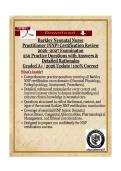
, Barkley Neonatal Nurse Practitioner (NNP)
Certification Review 2026–2027
250 Practice Questions with Answers & Detailed Rationales
Graded A+ | 2026 Update | 100% Correct
Content Areas Covered:
• Neonatal Assessment & Physical Examination
• Respiratory Disorders & Mechanical Ventilation
• Cardiovascular Disorders & Congenital Heart Disease
• Neurological Disorders
• Infectious Diseases & Sepsis
• Gastrointestinal & Nutritional Disorders
• Renal & Metabolic Disorders
• Hematology
• Pharmacology
• High-Risk Delivery & Resuscitation
• Professional Practice & Ethics
SECTION 1: NEONATAL ASSESSMENT & PHYSICAL
EXAMINATION (Questions 1–30)
Question 1
A 38-week gestation infant is born via vaginal delivery to a mother with gestational
diabetes. The infant is large for gestational age (LGA) and vigorous at birth. Upon
examination, the nurse practitioner notes asymmetrical movement of the upper
extremities with the right arm flaccid compared to the left. What is the most likely
diagnosis?
,A. Erb's palsy (brachial plexus injury)
B. Fractured clavicle
C. Developmental dysplasia of the hip
D. Congenital torticollis
Answer: A. Erb's palsy (brachial plexus injury)
Rationale: Erb's palsy (brachial plexus injury) occurs when the upper brachial plexus
(C5-C6) is stretched during a difficult delivery, especially in LGA infants with shoulder
dystocia. The affected arm presents with a characteristic "waiter's tip" posture with
adduction and internal rotation.
Question 2
A term infant is being evaluated at 2 weeks of age. The infant has not regained birth
weight, appears listless, has a drawn face, and poor skin turgor. What is the most likely
diagnosis?
A. Normal newborn transition
B. Failure to thrive with dehydration
C. Sepsis
D. Congenital hypothyroidism
Answer: B. Failure to thrive with dehydration
Rationale: A term infant who has not regained birth weight by 2 weeks of age with
signs of poor feeding, listlessness, and poor skin turgor is concerning for failure to thrive
and dehydration.
Question 3
Which maternal condition is most strongly associated with neonatal hypoglycemia in the
first 24 hours of life?
A. Preeclampsia
B. Uncontrolled type 1 diabetes
, C. Chorioamnionitis
D. Thyroid disease
Answer: B. Uncontrolled type 1 diabetes
Rationale: Maternal diabetes (especially poorly controlled) leads to fetal
hyperinsulinemia, which causes neonatal hypoglycemia after birth when the maternal
glucose supply is abruptly removed.
Question 4
A newborn is noted to have bilaterally symmetric, non-blanching, violaceous skin lesions
on the trunk and extremities. The lesions are firm and slightly raised. What is the most
likely diagnosis?
A. Erythema toxicum
B. Neonatal herpes simplex
C. Congenital syphilis
D. Extramedullary hematopoiesis ("blueberry muffin" lesions)
Answer: D. Extramedullary hematopoiesis ("blueberry muffin" lesions)
Rationale: "Blueberry muffin" lesions are violaceous, non-blanching papules that
indicate extramedullary hematopoiesis and are associated with congenital infections
(TORCH) or hematologic disorders.
Question 5
A newborn is being assessed for a possible congenital heart defect. Which finding is
most concerning for a ductal-dependent lesion?
A. Mild cyanosis that resolves with oxygen
B. A systolic murmur that is audible at 24 hours of life
C. A sudden drop in SpO₂ and acidosis as the ductus arteriosus begins to close
D. Tachypnea with a respiratory rate of 60 breaths/min
Certification Review 2026–2027
250 Practice Questions with Answers & Detailed Rationales
Graded A+ | 2026 Update | 100% Correct
Content Areas Covered:
• Neonatal Assessment & Physical Examination
• Respiratory Disorders & Mechanical Ventilation
• Cardiovascular Disorders & Congenital Heart Disease
• Neurological Disorders
• Infectious Diseases & Sepsis
• Gastrointestinal & Nutritional Disorders
• Renal & Metabolic Disorders
• Hematology
• Pharmacology
• High-Risk Delivery & Resuscitation
• Professional Practice & Ethics
SECTION 1: NEONATAL ASSESSMENT & PHYSICAL
EXAMINATION (Questions 1–30)
Question 1
A 38-week gestation infant is born via vaginal delivery to a mother with gestational
diabetes. The infant is large for gestational age (LGA) and vigorous at birth. Upon
examination, the nurse practitioner notes asymmetrical movement of the upper
extremities with the right arm flaccid compared to the left. What is the most likely
diagnosis?
,A. Erb's palsy (brachial plexus injury)
B. Fractured clavicle
C. Developmental dysplasia of the hip
D. Congenital torticollis
Answer: A. Erb's palsy (brachial plexus injury)
Rationale: Erb's palsy (brachial plexus injury) occurs when the upper brachial plexus
(C5-C6) is stretched during a difficult delivery, especially in LGA infants with shoulder
dystocia. The affected arm presents with a characteristic "waiter's tip" posture with
adduction and internal rotation.
Question 2
A term infant is being evaluated at 2 weeks of age. The infant has not regained birth
weight, appears listless, has a drawn face, and poor skin turgor. What is the most likely
diagnosis?
A. Normal newborn transition
B. Failure to thrive with dehydration
C. Sepsis
D. Congenital hypothyroidism
Answer: B. Failure to thrive with dehydration
Rationale: A term infant who has not regained birth weight by 2 weeks of age with
signs of poor feeding, listlessness, and poor skin turgor is concerning for failure to thrive
and dehydration.
Question 3
Which maternal condition is most strongly associated with neonatal hypoglycemia in the
first 24 hours of life?
A. Preeclampsia
B. Uncontrolled type 1 diabetes
, C. Chorioamnionitis
D. Thyroid disease
Answer: B. Uncontrolled type 1 diabetes
Rationale: Maternal diabetes (especially poorly controlled) leads to fetal
hyperinsulinemia, which causes neonatal hypoglycemia after birth when the maternal
glucose supply is abruptly removed.
Question 4
A newborn is noted to have bilaterally symmetric, non-blanching, violaceous skin lesions
on the trunk and extremities. The lesions are firm and slightly raised. What is the most
likely diagnosis?
A. Erythema toxicum
B. Neonatal herpes simplex
C. Congenital syphilis
D. Extramedullary hematopoiesis ("blueberry muffin" lesions)
Answer: D. Extramedullary hematopoiesis ("blueberry muffin" lesions)
Rationale: "Blueberry muffin" lesions are violaceous, non-blanching papules that
indicate extramedullary hematopoiesis and are associated with congenital infections
(TORCH) or hematologic disorders.
Question 5
A newborn is being assessed for a possible congenital heart defect. Which finding is
most concerning for a ductal-dependent lesion?
A. Mild cyanosis that resolves with oxygen
B. A systolic murmur that is audible at 24 hours of life
C. A sudden drop in SpO₂ and acidosis as the ductus arteriosus begins to close
D. Tachypnea with a respiratory rate of 60 breaths/min


