

Northwest Territories Bar
Jurisprudence and Ethics
Exam: The Elite Universal Test
Bank
PART 0: THE NAVIGATOR
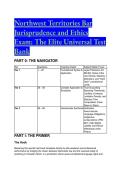
Tier Questions Cognitive Depth Subject Matter Focus
Tier 1 1 – 28 Foundational Syntax & Legal Profession Act
Application (Bill 82), Rules of the
Law Society, Statutory
Definitions, and "Hard
Deck" Jurisdictional
Limits.
Tier 2 29 – 58 Complex Application & Trust Accounting
Simulation Reporting Thresholds,
Conflicts of Interest,
Limitation Periods, and
Statutory Time
Computation (Clear
Days vs. Days).
Tier 3 59 – 88 Grandmaster Synthesis Fédération
franco-ténoise
Language Obligations,
Indigenous
Jurisprudence (TRC
#27), High-Stakes
Liability, and Ethical
Withdrawal under
Perjury.
PART I: THE PRIMER
The Hook
Mastering this specific test bank translates directly to elite academic and professional
performance by bridging the chasm between black-letter law and the nuanced reality of
practicing in Canada’s North. In a jurisdiction where quasi-constitutional language rights and
,Indigenous legal traditions intersect with modernized regulatory frameworks, only those who
synthesize these competing variables with surgical precision will achieve the status of an
Industry Titan.
The Critical Axioms Cheat Sheet
● Public Interest Paramountcy: The Law Society of the Northwest Territories (LSNT)
exists to govern the profession in the public interest; regulatory identity is now defined by
the transition from "Member" to "Registrant" under the modernized Bill 82.
● The Obligation of Result: Language rights in the NWT (under the Official Languages
Act) are not satisfied by "best efforts" but by an "obligation of result"—the achievement of
substantive equality of status and use for official languages.
● Trust Ledger Rigor: Shortages exceeding \$50 (unattributed) or specific client file
thresholds require immediate LSNT notification via a Trust Account Shortages Form to
maintain the integrity of the Special Fund.
● Discovery vs. Ultimate Limitation: NWT maintains a 2-year discovery-based basic
limitation period but provides a 30-year ultimate limitation "tail," the longest in the
Canadian common law jurisdictions.
● Cultural Safety as Competence: Indigenous intercultural competency is a
non-negotiable component of professional competence, mirroring Truth and
Reconciliation Commission (TRC) Call to Action #27.
PART II: THE ELITE TEST BANK
Tier 1: Foundational Syntax & Application (Questions 1–28)
Q1: Under the modernized Legal Profession Act (Bill 82), the Law Society of the Northwest
Territories has transitioned its terminology from "member" to "registrant." Based on the
regulatory intent of this shift, which of the following is the MOST ACCURATE justification for this
change? A) To align with federal linguistic requirements under the Official Languages Act. B) To
reflect the Law Society’s role as a regulator in the public interest rather than a private club for
lawyers. C) To facilitate the automatic admission of lawyers from the Yukon and Nunavut without
local exams. D) To reduce the administrative burden of tracking lawyers who are not in active
practice.
● The Answer: B (To reflect the Law Society’s role as a regulator in the public interest
rather than a private club for lawyers.)
● Distractor Analysis:
○ A is incorrect: Terminology shifts in Bill 82 are driven by regulatory modernization,
not primarily by the Official Languages Act.
○ C is incorrect: Mobility is governed by the Territorial Mobility Agreement, not by the
specific term used to describe practitioners.
○ D is incorrect: If anything, the term "registrant" broadens the scope of oversight to
ensure all classes of practitioners are captured.
The Mentor's Analysis: The nomenclature of "Registrant" signals a fundamental shift in the
social contract between the profession and the public. When the Law Society views you as a
registrant, they emphasize their duty to oversee you, rather than your right to belong.
Professional/Academic Intuition: The transition from "Member" to "Registrant" is the
,hallmark of modern, public-centric professional regulation..
Q2: A practitioner in Yellowknife is opening a new sole proprietorship and wishes to name the
firm "Northwest Territories Premier Litigation Group." Based on the Code of Professional
Conduct and LSNT Rules regarding firm names, why might the Law Society object to this title?
A) Because sole practitioners are strictly required to use their own surname in the firm name. B)
Because the term "Premier" implies a scale, capacity, or government endorsement that is false
and misleading. C) Because the name is not translated into all eleven official languages of the
territory. D) Because the name lacks the mandatory inclusion of the lawyer's bar admission
date.
● The Answer: B (Because the term "Premier" implies a scale, capacity, or government
endorsement that is false and misleading.)
● Distractor Analysis:
○ A is incorrect: Trade names are permitted, but they must not be misleading.
○ C is incorrect: While the government must be bilingual, private firms are not
mandated to translate firm names into eleven languages.
○ D is incorrect: There is no statutory requirement to include admission dates in a firm
title.
The Mentor's Analysis: Marketing is the public face of professional integrity. Titles that imply
superiority (e.g., "Premier") or a level of partnership that does not exist (e.g., "Group" for a sole
practitioner) erode public trust. Professional/Academic Intuition: Firm names must be mirrors
of professional reality, never marketing mirages..
Q3: A civil claim with a total value of \$32,500 is initiated in the Northwest Territories. Which
court is the normal court of first appearance for a claim of this magnitude? A) Justice of the
Peace Court. B) Territorial Court of the Northwest Territories. C) Supreme Court of the
Northwest Territories. D) Court of Appeal for the Northwest Territories.
● The Answer: B (Territorial Court of the Northwest Territories.)
● Distractor Analysis:
○ A is incorrect: JP Courts handle small criminal matters and municipal bylaws, not
mid-level civil claims.
○ C is incorrect: While the Supreme Court has general jurisdiction, the Territorial
Court is specifically empowered for claims up to \$35,000.
○ D is incorrect: The Court of Appeal is an appellate body, not a court of first instance.
The Mentor's Analysis: Jurisdiction is defined by the value of the claim and the nature of the
dispute. In the NWT, the Territorial Court serves as the primary circuit-riding body for civil claims
below the \$35,000 threshold. Professional/Academic Intuition: \$35,000 is the jurisdictional
ceiling for the Territorial Court's civil reach..
---
Q4: Under the Legal Profession Act and LSNT Rules, which entity provides the mandatory
professional liability insurance group policy for all active resident members? A) The Alberta
Lawyers Indemnity Association (ALIA). B) The Canadian Bar Association (CBA). C) The
Canadian Lawyers Insurance Association (CLIA). D) The Government of the Northwest
Territories Risk Management Division.
● The Answer: C (The Canadian Lawyers Insurance Association (CLIA).)
● Distractor Analysis:
○ A is incorrect: ALIA handles Alberta practitioners, although NWT lawyers may
encounter them during the PREP process.
○ B is incorrect: The CBA is a voluntary association, not an insurance provider for the
mandatory indemnity program.
, ○ D is incorrect: The GNWT does not insure private practitioners; coverage is
managed by the Law Society through the CLIA reciprocal exchange.
The Mentor's Analysis: Professional liability coverage is a non-negotiable condition of practice.
The LSNT uses the CLIA reciprocal model to ensure a consistent, territory-wide baseline of
public protection. Professional/Academic Intuition: Mandatory insurance is the financial
backbone of public accountability in the legal profession..
Q5: A lawyer discovers an "unattributed" shortage in the firm’s trust account totaling \$75.00 that
cannot be linked to any specific client ledger. According to LSNT reporting rules, what action is
REQUIRED? A) No action is required if the lawyer replaces the funds within 60 days. B) The
lawyer must report the shortage via a Trust Account Shortages Form if it is greater than \$50.00
and not corrected within 30 days. C) The lawyer must immediately notify the RCMP and the
Public Trustee. D) The lawyer must wait until the annual September 1 report to disclose the
discrepancy.
● The Answer: B (The lawyer must report the shortage via a Trust Account Shortages
Form if it is greater than \$50.00 and not corrected within 30 days.)
● Distractor Analysis:
○ A is incorrect: The 30-day window and \$50 threshold are strict requirements for
unattributed shortages.
○ C is incorrect: The LSNT is the primary regulator; criminal or other agencies are
only involved if misappropriation is suspected.
○ D is incorrect: Shortages require specific interim reporting separate from the annual
self-report.
The Mentor's Analysis: Unattributed shortages suggest a failure in the firm's accounting systems
rather than a specific transactional error. The \$50 threshold is a low-bar "tripwire" designed to
identify systemic ledger instability early. Professional/Academic Intuition: Unattributed trust
discrepancies are "check engine" lights for firm compliance..
Q6: In the Northwest Territories, the age of majority is established by statute at nineteen years.
If a child is injured due to the negligence of a third party, how does this affect the
commencement of the two-year limitation period? A) The clock begins running immediately on
the date of the accident. B) The clock is suspended and only begins running when the child
turns nineteen. C) The clock is shortened to one year to ensure the child’s memory remains
fresh. D) The clock only runs if a litigation guardian is appointed before the child turns eighteen.
● The Answer: B (The clock is suspended and only begins running when the child turns
nineteen.)
● Distractor Analysis:
○ A is incorrect: Common law and statutory principles across Canada generally
suspend limitations for minors.
○ C is incorrect: There is no statutory basis for shortening the period for minors.
○ D is incorrect: While a guardian can start a claim earlier, the limitation clock itself is
suspended for the minor until majority.
The Mentor's Analysis: The suspension of limitations for minors is an essential safeguard of
justice. In the NWT, the age of 19 (rather than 18) is a critical distinction that ( جنوبیSouthern)
practitioners often overlook. Professional/Academic Intuition: Limitations for NWT minors are
frozen until the nineteenth birthday..
Q7: Under the NWT Interpretation Act, when a period of time is expressed as "clear days" or "at
least" a certain number of days, how must the days be calculated for the purpose of a legal
deadline? A) Include both the first day (the day of the event) and the last day (the day of the
deadline). B) Exclude the first day but include the last day. C) Exclude both the first day and the
Jurisprudence and Ethics
Exam: The Elite Universal Test
Bank
PART 0: THE NAVIGATOR
Tier Questions Cognitive Depth Subject Matter Focus
Tier 1 1 – 28 Foundational Syntax & Legal Profession Act
Application (Bill 82), Rules of the
Law Society, Statutory
Definitions, and "Hard
Deck" Jurisdictional
Limits.
Tier 2 29 – 58 Complex Application & Trust Accounting
Simulation Reporting Thresholds,
Conflicts of Interest,
Limitation Periods, and
Statutory Time
Computation (Clear
Days vs. Days).
Tier 3 59 – 88 Grandmaster Synthesis Fédération
franco-ténoise
Language Obligations,
Indigenous
Jurisprudence (TRC
#27), High-Stakes
Liability, and Ethical
Withdrawal under
Perjury.
PART I: THE PRIMER
The Hook
Mastering this specific test bank translates directly to elite academic and professional
performance by bridging the chasm between black-letter law and the nuanced reality of
practicing in Canada’s North. In a jurisdiction where quasi-constitutional language rights and
,Indigenous legal traditions intersect with modernized regulatory frameworks, only those who
synthesize these competing variables with surgical precision will achieve the status of an
Industry Titan.
The Critical Axioms Cheat Sheet
● Public Interest Paramountcy: The Law Society of the Northwest Territories (LSNT)
exists to govern the profession in the public interest; regulatory identity is now defined by
the transition from "Member" to "Registrant" under the modernized Bill 82.
● The Obligation of Result: Language rights in the NWT (under the Official Languages
Act) are not satisfied by "best efforts" but by an "obligation of result"—the achievement of
substantive equality of status and use for official languages.
● Trust Ledger Rigor: Shortages exceeding \$50 (unattributed) or specific client file
thresholds require immediate LSNT notification via a Trust Account Shortages Form to
maintain the integrity of the Special Fund.
● Discovery vs. Ultimate Limitation: NWT maintains a 2-year discovery-based basic
limitation period but provides a 30-year ultimate limitation "tail," the longest in the
Canadian common law jurisdictions.
● Cultural Safety as Competence: Indigenous intercultural competency is a
non-negotiable component of professional competence, mirroring Truth and
Reconciliation Commission (TRC) Call to Action #27.
PART II: THE ELITE TEST BANK
Tier 1: Foundational Syntax & Application (Questions 1–28)
Q1: Under the modernized Legal Profession Act (Bill 82), the Law Society of the Northwest
Territories has transitioned its terminology from "member" to "registrant." Based on the
regulatory intent of this shift, which of the following is the MOST ACCURATE justification for this
change? A) To align with federal linguistic requirements under the Official Languages Act. B) To
reflect the Law Society’s role as a regulator in the public interest rather than a private club for
lawyers. C) To facilitate the automatic admission of lawyers from the Yukon and Nunavut without
local exams. D) To reduce the administrative burden of tracking lawyers who are not in active
practice.
● The Answer: B (To reflect the Law Society’s role as a regulator in the public interest
rather than a private club for lawyers.)
● Distractor Analysis:
○ A is incorrect: Terminology shifts in Bill 82 are driven by regulatory modernization,
not primarily by the Official Languages Act.
○ C is incorrect: Mobility is governed by the Territorial Mobility Agreement, not by the
specific term used to describe practitioners.
○ D is incorrect: If anything, the term "registrant" broadens the scope of oversight to
ensure all classes of practitioners are captured.
The Mentor's Analysis: The nomenclature of "Registrant" signals a fundamental shift in the
social contract between the profession and the public. When the Law Society views you as a
registrant, they emphasize their duty to oversee you, rather than your right to belong.
Professional/Academic Intuition: The transition from "Member" to "Registrant" is the
,hallmark of modern, public-centric professional regulation..
Q2: A practitioner in Yellowknife is opening a new sole proprietorship and wishes to name the
firm "Northwest Territories Premier Litigation Group." Based on the Code of Professional
Conduct and LSNT Rules regarding firm names, why might the Law Society object to this title?
A) Because sole practitioners are strictly required to use their own surname in the firm name. B)
Because the term "Premier" implies a scale, capacity, or government endorsement that is false
and misleading. C) Because the name is not translated into all eleven official languages of the
territory. D) Because the name lacks the mandatory inclusion of the lawyer's bar admission
date.
● The Answer: B (Because the term "Premier" implies a scale, capacity, or government
endorsement that is false and misleading.)
● Distractor Analysis:
○ A is incorrect: Trade names are permitted, but they must not be misleading.
○ C is incorrect: While the government must be bilingual, private firms are not
mandated to translate firm names into eleven languages.
○ D is incorrect: There is no statutory requirement to include admission dates in a firm
title.
The Mentor's Analysis: Marketing is the public face of professional integrity. Titles that imply
superiority (e.g., "Premier") or a level of partnership that does not exist (e.g., "Group" for a sole
practitioner) erode public trust. Professional/Academic Intuition: Firm names must be mirrors
of professional reality, never marketing mirages..
Q3: A civil claim with a total value of \$32,500 is initiated in the Northwest Territories. Which
court is the normal court of first appearance for a claim of this magnitude? A) Justice of the
Peace Court. B) Territorial Court of the Northwest Territories. C) Supreme Court of the
Northwest Territories. D) Court of Appeal for the Northwest Territories.
● The Answer: B (Territorial Court of the Northwest Territories.)
● Distractor Analysis:
○ A is incorrect: JP Courts handle small criminal matters and municipal bylaws, not
mid-level civil claims.
○ C is incorrect: While the Supreme Court has general jurisdiction, the Territorial
Court is specifically empowered for claims up to \$35,000.
○ D is incorrect: The Court of Appeal is an appellate body, not a court of first instance.
The Mentor's Analysis: Jurisdiction is defined by the value of the claim and the nature of the
dispute. In the NWT, the Territorial Court serves as the primary circuit-riding body for civil claims
below the \$35,000 threshold. Professional/Academic Intuition: \$35,000 is the jurisdictional
ceiling for the Territorial Court's civil reach..
---
Q4: Under the Legal Profession Act and LSNT Rules, which entity provides the mandatory
professional liability insurance group policy for all active resident members? A) The Alberta
Lawyers Indemnity Association (ALIA). B) The Canadian Bar Association (CBA). C) The
Canadian Lawyers Insurance Association (CLIA). D) The Government of the Northwest
Territories Risk Management Division.
● The Answer: C (The Canadian Lawyers Insurance Association (CLIA).)
● Distractor Analysis:
○ A is incorrect: ALIA handles Alberta practitioners, although NWT lawyers may
encounter them during the PREP process.
○ B is incorrect: The CBA is a voluntary association, not an insurance provider for the
mandatory indemnity program.
, ○ D is incorrect: The GNWT does not insure private practitioners; coverage is
managed by the Law Society through the CLIA reciprocal exchange.
The Mentor's Analysis: Professional liability coverage is a non-negotiable condition of practice.
The LSNT uses the CLIA reciprocal model to ensure a consistent, territory-wide baseline of
public protection. Professional/Academic Intuition: Mandatory insurance is the financial
backbone of public accountability in the legal profession..
Q5: A lawyer discovers an "unattributed" shortage in the firm’s trust account totaling \$75.00 that
cannot be linked to any specific client ledger. According to LSNT reporting rules, what action is
REQUIRED? A) No action is required if the lawyer replaces the funds within 60 days. B) The
lawyer must report the shortage via a Trust Account Shortages Form if it is greater than \$50.00
and not corrected within 30 days. C) The lawyer must immediately notify the RCMP and the
Public Trustee. D) The lawyer must wait until the annual September 1 report to disclose the
discrepancy.
● The Answer: B (The lawyer must report the shortage via a Trust Account Shortages
Form if it is greater than \$50.00 and not corrected within 30 days.)
● Distractor Analysis:
○ A is incorrect: The 30-day window and \$50 threshold are strict requirements for
unattributed shortages.
○ C is incorrect: The LSNT is the primary regulator; criminal or other agencies are
only involved if misappropriation is suspected.
○ D is incorrect: Shortages require specific interim reporting separate from the annual
self-report.
The Mentor's Analysis: Unattributed shortages suggest a failure in the firm's accounting systems
rather than a specific transactional error. The \$50 threshold is a low-bar "tripwire" designed to
identify systemic ledger instability early. Professional/Academic Intuition: Unattributed trust
discrepancies are "check engine" lights for firm compliance..
Q6: In the Northwest Territories, the age of majority is established by statute at nineteen years.
If a child is injured due to the negligence of a third party, how does this affect the
commencement of the two-year limitation period? A) The clock begins running immediately on
the date of the accident. B) The clock is suspended and only begins running when the child
turns nineteen. C) The clock is shortened to one year to ensure the child’s memory remains
fresh. D) The clock only runs if a litigation guardian is appointed before the child turns eighteen.
● The Answer: B (The clock is suspended and only begins running when the child turns
nineteen.)
● Distractor Analysis:
○ A is incorrect: Common law and statutory principles across Canada generally
suspend limitations for minors.
○ C is incorrect: There is no statutory basis for shortening the period for minors.
○ D is incorrect: While a guardian can start a claim earlier, the limitation clock itself is
suspended for the minor until majority.
The Mentor's Analysis: The suspension of limitations for minors is an essential safeguard of
justice. In the NWT, the age of 19 (rather than 18) is a critical distinction that ( جنوبیSouthern)
practitioners often overlook. Professional/Academic Intuition: Limitations for NWT minors are
frozen until the nineteenth birthday..
Q7: Under the NWT Interpretation Act, when a period of time is expressed as "clear days" or "at
least" a certain number of days, how must the days be calculated for the purpose of a legal
deadline? A) Include both the first day (the day of the event) and the last day (the day of the
deadline). B) Exclude the first day but include the last day. C) Exclude both the first day and the


