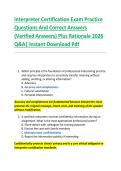
Interpreter Certification Exam Practice
Questions And Correct Answers
(Verified Answers) Plus Rationale 2026
Q&A| Instant Download Pdf
1. Which principle is the foundation of professional interpreting practice
and requires interpreters to accurately transfer meaning without
adding, omitting, or altering information?
A. Advocacy
B. Accuracy and completeness
C. Cultural substitution
D. Personal interpretation
Accuracy and completeness are fundamental because interpreters must
preserve the original message, intent, tone, and meaning of the speaker
without modification.
2. A certified interpreter receives confidential information during an
assignment. What is the most appropriate professional action?
A. Share details with colleagues for training purposes
B. Discuss the case with family members
C. Maintain strict confidentiality
D. Report the information publicly if interesting
Confidentiality protects clients’ privacy and is a core ethical obligation in
interpreter certification standards.
, 3. When interpreting between two languages, the interpreter’s primary
responsibility is to:
A. Improve the speaker’s grammar
B. Explain personal opinions
C. Render the message faithfully in the target language
D. Replace unfamiliar cultural references automatically
A professional interpreter transfers meaning accurately rather than
correcting, advising, or changing the speaker’s message.
4. What does the term “role boundaries” refer to in interpreting?
A. The interpreter’s preferred working hours
B. Limits that define appropriate interpreter responsibilities
C. The interpreter’s personal beliefs
D. Rules about language learning
Role boundaries prevent interpreters from becoming participants, advisors,
or decision-makers during assignments.
5. During a medical interpreting session, a patient asks the interpreter,
“What should I do?” The interpreter should:
A. Provide medical advice
B. Recommend a treatment
C. Refer the question back to the healthcare provider
D. Answer based on personal knowledge
Interpreters facilitate communication but do not provide professional
advice outside their interpreting role.
6. What skill allows an interpreter to understand the intended meaning
beyond individual words?
A. Memorization only
B. Contextual comprehension
C. Literal word replacement
D. Vocabulary listing
, Effective interpreting requires understanding context, culture, intent, and
meaning rather than translating words mechanically.
7. Which mode of interpreting involves rendering a message after the
speaker pauses?
A. Simultaneous interpreting
B. Sight translation
C. Consecutive interpreting
D. Written translation
Consecutive interpreting requires the interpreter to listen, retain
information, and interpret during natural pauses.
8. Simultaneous interpreting requires the interpreter to:
A. Wait until the speaker finishes completely
B. Translate written documents only
C. Interpret while listening to the ongoing speech
D. Ask the speaker to repeat every sentence
Simultaneous interpreting involves listening and producing the
interpretation almost at the same time.
9. What is the purpose of interpreter certification examinations?
A. To test personal opinions
B. To assess professional knowledge, skills, and ethical competence
C. To replace language education
D. To determine personality traits only
Certification examinations evaluate whether interpreters meet established
professional standards.
10. An interpreter encounters an unfamiliar technical term during
an assignment. The best response is to:
A. Guess the meaning
B. Ignore the term
C. Use appropriate clarification strategies
D. Substitute a similar word
Questions And Correct Answers
(Verified Answers) Plus Rationale 2026
Q&A| Instant Download Pdf
1. Which principle is the foundation of professional interpreting practice
and requires interpreters to accurately transfer meaning without
adding, omitting, or altering information?
A. Advocacy
B. Accuracy and completeness
C. Cultural substitution
D. Personal interpretation
Accuracy and completeness are fundamental because interpreters must
preserve the original message, intent, tone, and meaning of the speaker
without modification.
2. A certified interpreter receives confidential information during an
assignment. What is the most appropriate professional action?
A. Share details with colleagues for training purposes
B. Discuss the case with family members
C. Maintain strict confidentiality
D. Report the information publicly if interesting
Confidentiality protects clients’ privacy and is a core ethical obligation in
interpreter certification standards.
, 3. When interpreting between two languages, the interpreter’s primary
responsibility is to:
A. Improve the speaker’s grammar
B. Explain personal opinions
C. Render the message faithfully in the target language
D. Replace unfamiliar cultural references automatically
A professional interpreter transfers meaning accurately rather than
correcting, advising, or changing the speaker’s message.
4. What does the term “role boundaries” refer to in interpreting?
A. The interpreter’s preferred working hours
B. Limits that define appropriate interpreter responsibilities
C. The interpreter’s personal beliefs
D. Rules about language learning
Role boundaries prevent interpreters from becoming participants, advisors,
or decision-makers during assignments.
5. During a medical interpreting session, a patient asks the interpreter,
“What should I do?” The interpreter should:
A. Provide medical advice
B. Recommend a treatment
C. Refer the question back to the healthcare provider
D. Answer based on personal knowledge
Interpreters facilitate communication but do not provide professional
advice outside their interpreting role.
6. What skill allows an interpreter to understand the intended meaning
beyond individual words?
A. Memorization only
B. Contextual comprehension
C. Literal word replacement
D. Vocabulary listing
, Effective interpreting requires understanding context, culture, intent, and
meaning rather than translating words mechanically.
7. Which mode of interpreting involves rendering a message after the
speaker pauses?
A. Simultaneous interpreting
B. Sight translation
C. Consecutive interpreting
D. Written translation
Consecutive interpreting requires the interpreter to listen, retain
information, and interpret during natural pauses.
8. Simultaneous interpreting requires the interpreter to:
A. Wait until the speaker finishes completely
B. Translate written documents only
C. Interpret while listening to the ongoing speech
D. Ask the speaker to repeat every sentence
Simultaneous interpreting involves listening and producing the
interpretation almost at the same time.
9. What is the purpose of interpreter certification examinations?
A. To test personal opinions
B. To assess professional knowledge, skills, and ethical competence
C. To replace language education
D. To determine personality traits only
Certification examinations evaluate whether interpreters meet established
professional standards.
10. An interpreter encounters an unfamiliar technical term during
an assignment. The best response is to:
A. Guess the meaning
B. Ignore the term
C. Use appropriate clarification strategies
D. Substitute a similar word